Showing posts with label periodic table. Show all posts

May 30 - Krypton Discovered

  Posted on May 30, 2022     


This is an update of my post published on May 30, 2011:
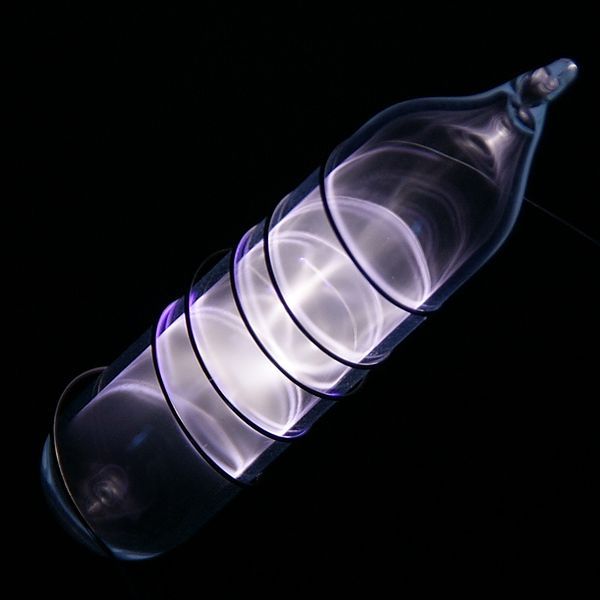


On this date in 1898, krypton was discovered.

And by krypton, I don't mean Superman's planet!

I am of course referring to the chemical element krypton, atomic number 36. One of the “inert” or noble gases, krypton doesn't react with other elements (and only rarely can scientists force it to make compounds). Can you name the other noble gases?

Scottish researcher William Ramsey had already - several years earlier, with Lord Rayleigh - discovered the noble gases helium and argon. Ramsey worked with his English student Morris Travers to search for more gases in the helium family. On this day in 1898, they boiled liquefied air until they got rid of the water, oxygen, nitrogen, helium, and argon. The residue produced a unique spectrum with bright yellow and green lines. Ramsey and Travers named this element krypton because it had been hidden—like the other noble gases, colorless, odorless, and tasteless—and kryptos is Greek for hidden.

In the next few weeks Ramsey and Travers discovered two more noble gases, neon and xenon. That means that Ramsey was responsible for discovering almost the entire column of noble gases (lacking only radon)!


So...what about Krypton the planet?

In the DC Comics universe, Krypton is a planet, the birthplace of Superman, that was tragically destroyed by a nuclear chain reaction in its core. The explosion created kryptonite, a material that is the one weakness of the otherwise invulnerable Superman.

Kryptonite is sometimes used as a metaphor for one's great weakness, just like Achilles' heel. For example, a dieter could (exaggeratedly) say, “Chocolate chip cookies are my kryptonite.”


For more on krypton and other noble gases, check out Chem 4 Kids.


(Last Monday in May)


Memorial Day in the U.S.A.
(last Monday in May) 


Plan ahead:


Check out my Pinterest boards for:
And here are my Pinterest boards for:


August 27 - Discovery of Gallium!!

Posted on August 27, 2021


This is an update of my post published on August 27, 2010:


Gallium doesn't exist by itself in nature, so it took some doing to find it!

Dmitri Mendeleev predicted its existence, using the periodic table of elements: There was zinc (Zn) with atomic number 30, and arsenic (As) with atomic number 33... So, Mendeleev asked, where were the elements with the atomic numbers 31 and 32?

The beauty of Mendeleev's periodic table is that elements share properties with the elements positioned above them on the table. So Mendeleev was able to guess some of the properties of the elements before they had even been discovered.

After 15 years of work, on this date in 1875, Paul Emile Lecoq de Boisaudran discovered the predicted element with atomic number 31. He named the new element gallium in honor of his country, France (Gallia).


Gallium is right under aluminum on the periodic table, and like aluminum it is a soft, silvery metal.


Lecoq made his discovery with a spectroscope, which uses a prism to separate the various colors of light from a light source. When chemists use spectroscopes, they either burn a bit of material and analyze the light emitted from the burning material, or they create a gas form of the material and shine white light through the gas and see which light is absorbed.

In this case, Lecoq was analyzing zinc blende, and he found two violet lines that were not accounted for by other elements in the ore. Later the same year, Lecoq was able to isolate gallium using a process called electrolysis.


Gallium has a very low melting point.
Like, if you try to hold it in your hand, it melts!


Create a spectrum.

In other words, make a rainbow! 

Use a glass prism to separate white light into a rainbow. Yep, a rainbow is a spectrum! Remember, each raindrop acts as a prism separating the light.


If you don't have a prism, check out this YouTube video of a prism creating a rainbow.

Or make a rainbow in some other way - there are lots!


To make a rainbow with a hose, make sure the sun isn't overhead
and stand so that the sun is at your back. Then shoot the hose
toward your shadow - making sure that your thumb or a nozzle
makes the stream of water into a spray of many drops of water.


A glass of water can make a rainbow!


CDs can make rainbows!


Here is a video about a man called the Rainbow Maker.


January 11 - Anniversary of the Discovery of Francium

 Posted on January 11, 2021

This post is an update of my January 11, 2010, post:

The element francium was discovered by French chemist Marguerite Catherine Perey on this date in 1939. She had been analyzing another element, actinium, which experiences radioactive decay. In other words, without any outside force, actinium suddenly releases radiation or a particle—and becomes another element! Perey's sample of actinium became astatine, bismuth, and then francium.


Francium, 
too, is radioactive and experiences this kind of spontaneous decay, becoming astatine, radium, or radon. Radioactive elements are dangerous because of the radiation and high-energy particles they release.
 

Each radioactive element has its own half-life, which is a measure of how soon it decays into another element. (Half-life means, as you might guess, that half of a given sample has decayed in the time period.) Some radioactive elements have long half-lives. Uranium 234, for example, has a half-life of 240,000 years. But Francium is very unstable, with a half-life of only 22 minutes.

As a matter of fact, francium is the most unstable of all the elements that occurs in nature. Scientists estimate that there is no more than one ounce of francium in all of the earth's crust at one time. That makes it the second rarest naturally-occurring element!


Since Perey discovered the element, she got to name it. Francium was her second sugg
estion and honors France as the place of discovery.
(Her first suggestion was catium, because Perey believed this new discovery would be the most electrically positive ion - or cation - of all the elements. Her supervisor didn't like the name suggestion and pointed out that people would think of cat rather than cation.)

Last to be discovered...now on to creating new elements!


Perey's discovery of francium was the last discovery of a naturally-occuring element. But scientists have created (or synthesized) other elements in nuclear reactors and particle colliders. (A few of these elements have actually been discovered in tiny amounts, in nature, after first being synthesized.)

Some of these elements have been named after the place in which they
 were created, following Perey's example of naming her discovery after her country. So many of the elements were first created in America, scientists started to run out of place names. Look at this list:
Americium – created in 1944, at the University of Chicago, U.S. of America 
Berkelium – created in 1949, at the University of California, Berkeley, USA
Californium – created in 1950, at the University of California, Berkeley, USA
Lawrencium – created in 1961, at the University of California, Berkeley, USA, in the Lawrence Radiation Lab

Other elements were named after famous scientists (although not the scientists who created them!).
 Who is each of these elements named for?
1. Curium
2. Einsteinium

3. Fermium

4. Mendelevium

5. Nobelium


ANSWERS: 
1. Marie and Pierre Curie 
2. Albert Einstein 
3. Enrico Fermi 
4. Dimitri Mendeleev
5. Alfred Nobel


You can explore the periodic table of elements here.

Here is a game that can help you learn the Atomic Symbols of each element.

This visual periodic table is beautiful, with pictures and videos and lots of info (click around, of course!).


Now, for some common stuff...


Francium is a heavy, unstable, extremely rare element. But all around us are lighter, stable, common elements. Can you match the element name with the description?


1. Carbon

2. Oxygen
3. Helium

4. Nitrogen

5. Gold

6. Hydrogen

7. Chlorine

8. Aluminum


A. Atomic number 1 – the simplest, lightest, most common element in the universe

B. Atomic number 2 – used inside lighter-than-air toys, it's safe because it doesn't react to other elements

C. Atomic number 6 – the building block of life because it forms chains and rings easily

D. Atomic number 7 – most of the air we breathe is made of this

E. Atomic number 8 – something plants get rid of, but that animals (and also fires!) need

F. Atomic number 13 – a lightweight, silvery metal

G. Atomic number 17 – a poisonous gas that, when mixed with a particular poisonous metal, makes yummy salt!

H. Atomic number 79 – a heavy yellow metal


ANSWERS: 
1.C 
2.E 
3.B 
4.D 
5.H 
6.A 
7.G 
8.F