
Posted on April 8, 2022
This is an update of my post published on April 8, 2011:

On this day in 1820, a peasant named Yorgos Kentrotas discovered the statue of a woman or goddess inside a buried niche in the ancient city ruins of Milos, a Greek island.

 |
Above, the place where the statue was discovered. Below, the island of Milos today. |
A French officer was exploring the island and helped Yorgos excavate the statue, and soon another French officer made arrangements for a purchase by the French ambassador to Turkey.
There are several inconsistent accounts of this discovery and the subsequent sale—it seems clear that representatives of Turkey tried to purchase the ancient statue, and there are accounts of the French seizing the statue just as it was being loaded onto a ship bound for Constantinople—but, at any rate, the statue has been on display in the Louvre, in Paris, France, since 1821.
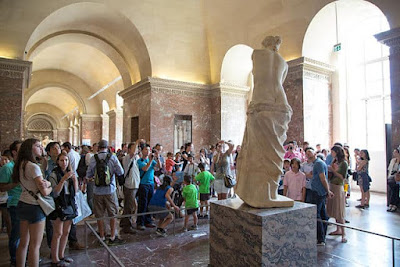
Most people think the statue portrays Aphrodite, the ancient Greek goddess of love and beauty. The Roman name for Aphrodite, of course, was Venus, and since the statue was discovered on Milos, the name Venus de Milo is most commonly applied to the statue. However, it is not certain that the statue does in fact represent Aphrodite or Venus. Several competing theories include the idea that it portrays the sea goddess Amphitrite, who was very important to the people of Milos.
The Venus de Milo is famously missing her arms. Actually, she is made of two blocks of marble, and various parts were carved separately and then fixed with vertical pegs. This technique was common around 100 BC, when the statue was carved. The arms were never found, although a few fragments of the upper left arm and a left hand holding an apple were found.

The goddess originally wore metal jewelry—bracelet, headband, earrings—as we can see from the remaining fixation holes. She was probably painted in multiple strong, bright colors. For centuries people thought that Greek temples and statuary, made of unpainted white marble, was the essence of Classical beauty, but traces of paint and scientific tests show us that the buildings and statues were once painted.

Some people are horrified to learn that the Ancient Greeks used bright colors on their statues and insist that they look much better white. Do you agree or disagree?
Does it matter what looks better—or is it important to know what is true?
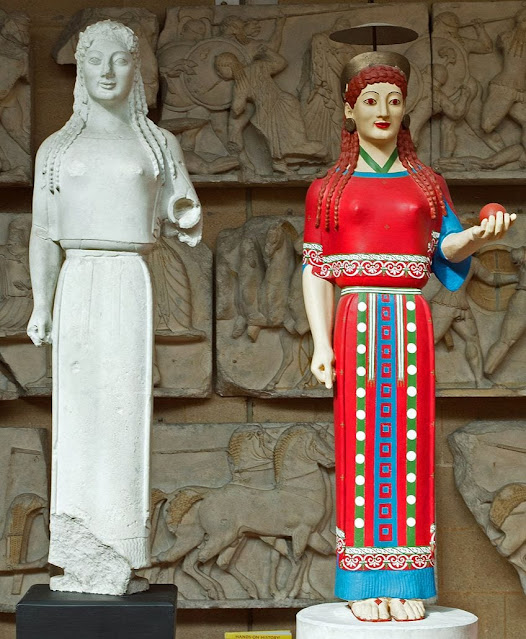 |
| I couldn't find a colored replica of Venus de Milo, but check out this other famous Greek statue: it's a comparison of now-paint-free marble with what science and other evidence indicate was more like the original, colorful version of the statue. |


Plan ahead:
Check out my Pinterest boards for:
And here are my Pinterest boards for:


