Showing posts with label elements. Show all posts

May 30 - Krypton Discovered

  Posted on May 30, 2022     


This is an update of my post published on May 30, 2011:
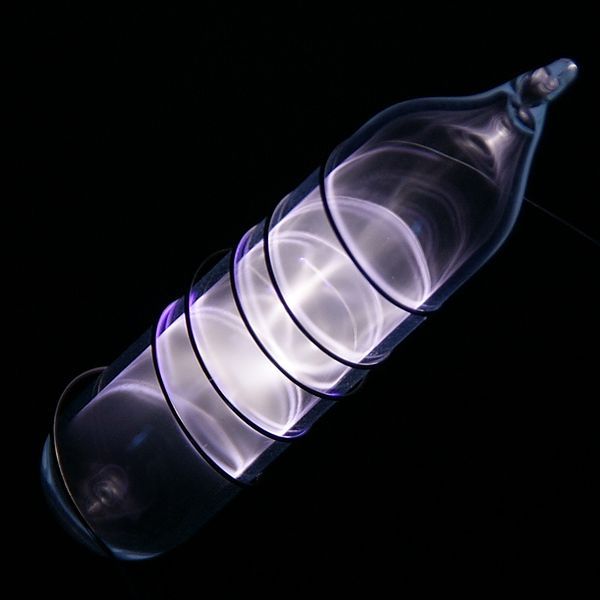


On this date in 1898, krypton was discovered.

And by krypton, I don't mean Superman's planet!

I am of course referring to the chemical element krypton, atomic number 36. One of the “inert” or noble gases, krypton doesn't react with other elements (and only rarely can scientists force it to make compounds). Can you name the other noble gases?

Scottish researcher William Ramsey had already - several years earlier, with Lord Rayleigh - discovered the noble gases helium and argon. Ramsey worked with his English student Morris Travers to search for more gases in the helium family. On this day in 1898, they boiled liquefied air until they got rid of the water, oxygen, nitrogen, helium, and argon. The residue produced a unique spectrum with bright yellow and green lines. Ramsey and Travers named this element krypton because it had been hidden—like the other noble gases, colorless, odorless, and tasteless—and kryptos is Greek for hidden.

In the next few weeks Ramsey and Travers discovered two more noble gases, neon and xenon. That means that Ramsey was responsible for discovering almost the entire column of noble gases (lacking only radon)!


So...what about Krypton the planet?

In the DC Comics universe, Krypton is a planet, the birthplace of Superman, that was tragically destroyed by a nuclear chain reaction in its core. The explosion created kryptonite, a material that is the one weakness of the otherwise invulnerable Superman.

Kryptonite is sometimes used as a metaphor for one's great weakness, just like Achilles' heel. For example, a dieter could (exaggeratedly) say, “Chocolate chip cookies are my kryptonite.”


For more on krypton and other noble gases, check out Chem 4 Kids.


(Last Monday in May)


Memorial Day in the U.S.A.
(last Monday in May) 


Plan ahead:


Check out my Pinterest boards for:
And here are my Pinterest boards for:


April 29 - Happy Birthday, Harold Urey

    Posted on April 29, 2022

This is an update of my post published on April 29, 2011:


Harold Urey, born on this date in 1893, discovered  “heavy hydrogen” and “heavy water”!

Imagine a glass of water saying, “Does this hydrogen make me look heavy?”


Of course, the answer is that certain hydrogen atoms and kinds of water don't look heavy, but they are in fact heavier than “normal.” In other words, they weigh more.

If you want to know why, you need to learn a bit about isotopes.

Each kind of element—like carbon or gold or iron or oxygen—has recognizable characteristics. It's the kind of element that easily combines with other elements—or it isn't very reactive. It's a metal, or it isn't. It's radioactive, or not; brittle, or not. At room temperature, a particular element may be a solid, liquid, or gas. It has a certain color.

The thing that makes an element that element—in other words, what makes gold gold and oxygen oxygen—is the number of protons it has.

Gold always has 79 protons and generally has 79 electrons. Oxygen just has 8 protons (and, generally, 8 electrons). It's really hard to change the number of protons an atom has—that's what happens in the center of the sun and in nuclear reactors—but, if you do change the number of protons, you change the element. For example, take away one of gold's protons, you get platinum. Add a proton, you get mercury.


The Periodic Table of the Elements is
organized in part by atomic number, which
is the number of protons each element has.

There aren't just protons and electrons in an atom; there are also neutrons. These particles are about a large as a proton but have no charge. Neutrons are necessary to help protons hang together despite their like charges.

The thing is, since neutrons have no charge, you can add them to an atom and not change the element. Most gold atoms have 117 or 118 neutrons—but if you add a few more or take a few away, you still have gold. You just have a different isotope of gold. It has the same characteristics (solid, metal, yellow colored), but it is heavier.


Forget about gold...I thought we were talking about hydrogen!

Hydrogen, which is the most common element, by far, in the universe, has a super simple structure: just one proton and one electron.

But some hydrogen atoms have one neutron as well. These hydrogen atoms act just like other hydrogen atoms (super light, super reactive, gaseous), but they are almost twice as heavy as normal hydrogen atoms.
Different "flavors" of hydrogen.
The one labeled "protium" is by
far the most common!

These heavier-than-normal atoms are called deuterium, or heavy hydrogen. About one out of every 6,400 hydrogen atoms in Earth's oceans is deuterium.

Discovery!

Back in the day, scientists didn't know why certain samples of materials were heavier than others, they didn't know the reason for the difference in weight; some theorized that it was caused by different numbers of “nuclear electrons.” (Remember, the difference is actually caused by more neutrons.) Scientists believed that hydrogen couldn't have isotopes. But an American chemist named Harold Urey was able to repeatedly distill liquid hydrogen and then—in 1931—to detect “heavy hydrogen” with a spectroscope.

And so it was that Urey and his coworkers were able to discover deuterium a year before scientists discovered neutrons—the correct explanation for deuterium!—and for his work, Urey won a Nobel Prize.


By the way, people are still making discoveries about heavy water. Like, ice cubes made from heavy water sink rather than float!


And heavy water tastes sweet! WARNING: Heavy water can be toxic. Only taste a tiny bit - and only with adult approval and supervision.


December 3 - Neon Glow!

  Posted on December 3, 2021


This is an update of my post published on December 3, 2010:


The orange-red glowing light now used for neon signs was first demonstrated at the Paris Motor Show (an automobile show) on this date in 1910.

Neon lighting was developed by the French physicist Georges Claude. He passed an electric current through a glass tube filled with neon gas. He also had to invent a way to purify the neon gas and a way to minimize the sputtering of the electrodes that go between the power supply and the gas.

(By the way, Claude made many other scientific advances and inventions as well. Some people call him the Thomas Edison of France. He collaborated with the Nazis when they took over France during World War II, however, and ruined his reputation with many people.)

Neon gas is inert. That means it doesn't react with other elements. 

(Hydrogen and oxygen are examples of gases that definitely DO react with other elements—and burn!)


Neither hydrogen nor oxygen are inert.
They easily and readily combine with other
elements - and they burn!

Helium is also inert, which is why it is safe to use inside children's balloons. It glows pink when electricity passes through it. The other inert gases that are used for lighting include xenon, which produces a soft lavender light, and argon (enhanced with mercury), which produces a brilliant blue light. Other colors are achieved by combining different gases, including the other inert gas, krypton, which glows yellow-green.

To learn more about inert gases, check out Chem 4 Kids


A fellow named Earle C. Anthony, brought neon lighting to America in 1923 when he bought two signs in Paris and installed them in his Los Angeles car dealership. For decades Times Square in New York City and Las Vegas in Nevada have been famous for their elaborate use of neon lighting (including signage using other inert gases) and, of course, other sorts of lighting as well!


Neon Colors

Sometimes you see felt pens or paints, clothing or shoes advertised as being “bright neon colors.” That means colors that seem to glow—even though of course they have nothing to do, really, with the element neon.


Neon green seems to me to be an oxymoron - because
neon's red-orange glow is the polar opposite of green!


Glow sticks and glow jewelry are often marketed as “neon sticks” or described as being “neon colors.” Again, these light sticks and colors have nothing to do with the element neon or any other inert gas, and they don't use electricity. Instead, they use chemicals that react together to excite atoms, which release light.


Here is an article about how glow sticks work. 


Ghana National Farmers' Day

(First Friday in December)


(First Friday of December)