Showing posts with label Macedonia. Show all posts

August 2 - Ilinden AND Day of the Republic in North Macedonia

    Posted on August 2, 2022     


This is an update of my post published on August 2, 2011:


On this day in 1903, Macedonians rose up in the Ilinden Uprising
against the harsh rule of the Ottoman Empire. For a while, they were successful, but soon the Ottoman forces crushed the rebellion and took revenge by killing people and destroying thousands of homes.

Ilinden Memorial


And on this day in 1944, the Republic of Macedonia was established. It was part of the communist nation of Yugoslavia.

It wasn't until 1991 that Macedonia was able to establish true independence, as Soviet-backed Yugoslavia broke apart. Independence day on September 8 celebrates this 1991 beginning of the modern Republic of Macedonia; still, August 2 is also celebrated as a patriotic public holiday.

In 2019, a dispute with Greece over the name Macedonia was settled, and the Republic of Macedonia became the Republic of North Macedonia.


Don't you love the flag of North Macedonia?


Do you know where North Macedonia is?


North Macedonia is a small landlocked nation on the Balkan peninsula in eastern Europe. Its neighbors include Kosovo, Serbia, Bulgaria, Greece, and Albania.

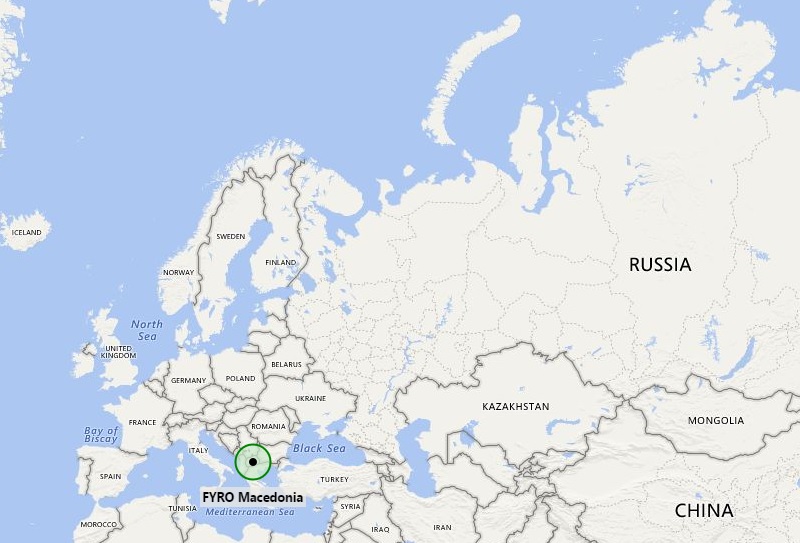


When was Macedonia powerful?


In ancient times, in the 300s B.C.E., Philip II of Macedon conquered nearby lands and made them a part of his kingdom. His son, Alexander the Great, conquered even more lands and built up the kingdom even larger—as a matter of fact, Macedonia was one of the largest empires of ancient history. Alexander the Great was undefeated in battle and is considered one of the most successful military commanders of ALL time!


Alexander the Great, King of Macedonia
(facial reconstruction)


October 11 – Anti-fascist Uprising Day in Macedonia

Posted October 11, 2017


On this date in 1941, Macedonians began an uprising against - well, as you can see in the holiday's name - against fascists.

The Axis powers that occupied the region - Macedonia at that time was a part of Yugoslavia - were Italian and German troops - basically World War II Nazis. 


The National Liberation War that finally drove out the Nazis in 1944 resulted in the Socialist Republic of Macedonia, which was a part of the the People's Federal Republic of Yugoslavia. When Yugoslavia broke up in 1991, the Republic of Macedonia became fully independent.

Fascism is a horrible thing.

It's radical - which means extreme.

It's authoritarian - which means that a "strong" ruler acts as a dictator, ruling every aspect of peoples' lives instead of allowing for personal freedom.

It's nationalistic - which means that the country is glorified and considered better than - and more important than - other countries...and also more important than individuals or "the world."

It suppresses opposition - which means that it stops people from expressing their opinions, if they disagree with the government, it doesn't allow fair voting, and it silences debate by arresting or even killing those who disagree.

It's generally bigoted - a fascist government often tries to silence or even eliminate anyone who is different - anyone who looks different, who speaks another language, who has another religion, etc.

Nowadays, forces of fascism are rising up in many countries again, even though almost every nation in the world was involved in a horrific, bloody battle to defeat fascism in the mid-1900s. (Why-oh-why can't we learn from history?)

Actually, we can and do learn from history, and many people are fighting back against modern fascism. Join the battle!

To encourage us as we fight for the good, here are some lovely photos of Macedonia:


Also on this date:


(Wednesday of the second full week of October)


(Second Wednesday in October)


aka Unity Day
(Second Wednesday in October)


Plan ahead:


Check out my Pinterest boards for:
And here are my Pinterest boards for:


May 6 – Đurđevdan

Posted May 6, 2015

Đurđevdan translates to "George's Day"—as in St. George.

As in the guy on a horse killing a dragon!

St. George is considered the patron saint of England, and that is why his feast day is still celebrated there every April 23. That is the traditionally accepted anniversary of his death in 303 C.E. (or A.D.).


However, St. George's feast day was April 23 on the Julian calendar. That translates to May 6 on the Gregorian calendar (which is the one we use nowadays).

Even though the people of Southern Slavic nations use the Gregorian calendar for most purposes, Eastern Orthodox Christianity generally still uses the Julian calendar for feast days and other religious holidays. So nations like Serbia, Bulgaria, Croatia, Macedonia, Bosnia and Herzegovina, and Kosovo celebrate the feast day today. (I think. Honestly, I found all of this stuff about April 23 and May 6 quite confusing!)

A Southern Slavic version
of St. George killing a dragon.

Đurđevdan marks the beginning of spring, and some of the spring celebrations enjoyed in other nations on other days take place today in Southern Slavic nations. That includes having bonfires and decorating the home with flowers and blooming twigs, taking baths with flowers and washing with water from holy wells. Another slavic tradition is choosing girls to dress in leaves and play the part of Dodola goddesses by singing all through the village.

Even though this holiday has its basis in Christian traditions, with a Catholic saint and feast day, the connection with springtime celebrations, particularly the Dodola goddesses, comes from pagan traditions. In some areas, such as Bosnia and Kosovo, many Muslim people also celebrated Đurđevdan, at least in the past.

More about South Slavs...

In the past, just as in the present, people moved about trying to find resources and land; as they spread out and moved away from former neighbors, their languages and customs began to diverge as they evolved.

There are many nations that are settled by mostly “Slavic peoples,” largely defined by their Slavic languages. The South Slavs include the majority of people in Bosnia and Herzegovina, Bulgaria, Croatia, Macedonia, Montenegro, Serbia, Slovenia, and a sizable minority in the Republic of Kosovo (a disputed nation).


Notice that the Southern Slavic nations, shown above in green, are cut off from the other Slavic nations by non-Slavic countries like Austria, Hungary, Romania, and Moldova.

Check out these flags and photos for each of the Southern Slavic nation:

Bosnia and Herzegovina:


Bulgaria:


Croatia:


Kosovo:


Macedonia:


Montenegro:


Serbia:


Slovenia:


Also on this date:


Teacher Appreciation Week (May 4 - 8)


Plan ahead:

Check out my Pinterest boards for:
And here are my Pinterest boards for: