Showing posts with label clock. Show all posts

April 13 – Happy Birthday to the Henry Ford of Clocks!

Posted on April 13, 2018

Do you know what "interchangeable parts" means?

It means that many different products can use the same gear, or plug, or whatever-it-is. That means it's easier to build things, easier to replace broken things, easier to replace lost parts, easier to use different products together...

Just EASIER!

Consider this example:

Back in the bad old days, every cell phone had a different, but similar looking, phone charger.  

Plugging a phone into a car recharger required a different cord attached to something that connected with a car's cigarette lighter. 

And plugging the phones into computers or anything else required entirely different cords and cables and connectors and...

Well, nowadays, almost all cell phone chargers and plugs and connectors work with standardized USB technology. My iPhone cord may not be the same as your Android cord, but either one can connect with an electrical plug, and both can connect with a USB outlet on a computer, TV, car, electrical strip, or other device. Because of this, things have become easier.

That "interchangeable parts" thing is what Henry Ford did for automobiles. And before that, it is what today's famous birthday, Eli Terry, did for clocks.

Born in Connecticut 1772, Terry began to make clocks when he was just twenty years old. He had learned the craft from two master clockmakers, but he also innovated:

He had apprentices make rough-cut wheels that he and other skilled clockmakers could shape into precise clockworks.

Then he created water-powered machines to make those rough-cut wheels. Still, a master clockmaker had to make the gears with precision so that they would fit together.

Then he invented jigs and fixtures so that the gears themselves were manufactured - always the same, always fitting together perfectly, and therefore interchangeable with one another!

Before all of Terry's inventiveness, a skilled clockmaker could make six clocks in a year. But, with Terry's inventions, Terry could make three THOUSAND clocks in a year!

Naturally, this meant that clocks could be sold way more cheaply, to average folks. They weren't just for the rich, anymore!

Terry's inexpensive household clocks didn't sell right away. Many people were not used to the idea that they could have timepieces in their homes - they relied on hearing the time from the community or church bells that chimed out the hour, half hour, and quarter hour.

So Terry came up with another innovation - this time in marketing and sales: 

Get your free trial!
Own your own clock! 
No money down! 

Eventually, Terry sold enough clocks that he had accumulated a comfortable bank balance - one might even say a fortune. He then worked to help his three sons who went into the clockmaking business to establish themselves, and he also went back into the making of fine hand-made clockworks for high-end special-order clocks!


January 10 – Happy Birthday, Abraham-Louis Breguet

Posted on January 10, 2015

I read that our birthday boy, Abraham-Louis Breguet, was one of the greatest horologists of all times.

Swell...but what the heck is an horologist?

It's someone who studies the measurement of time – someone who creates devices that measure time.

In other words, a watchmaker or clockmaker!

Born in Switzerland on this date in 1747, Breguet became famous for his watchmaking skills and knowledge. He and his friend John Arnold were both considered THE leading watchmakers of their day and are still considered some of the best of all time. They created watches and clocks for famous people, noblemen, and even kings and at least one queen of France.

His company, the Breguet company, is now the luxury watch division of the Swiss Swatch group.

Get this: even though his company produced around 17,000 timepieces during Breguet's life, no two pieces are exactly alike! How is that possible? It turns out that Breguet was constantly experimenting and improving his timepieces, and he paid attention to every tiny detail, and these tiny adjustments and details helped set each individual watch or clock apart, as well.

Here are some of Breguet's achievements:
  • the “Marie Antoinette,” now widely held as one of the most important and valuable timepieces ever made.
  • self-winding (automatic winding) mechanisms.
  • the tourbillon, which counters the effects of gravity on clockworks.

  • scientific clocks, one of which was used for almost a century, it was so accurate.
  • the gong for repeater watches.
  • anti-shock devices.
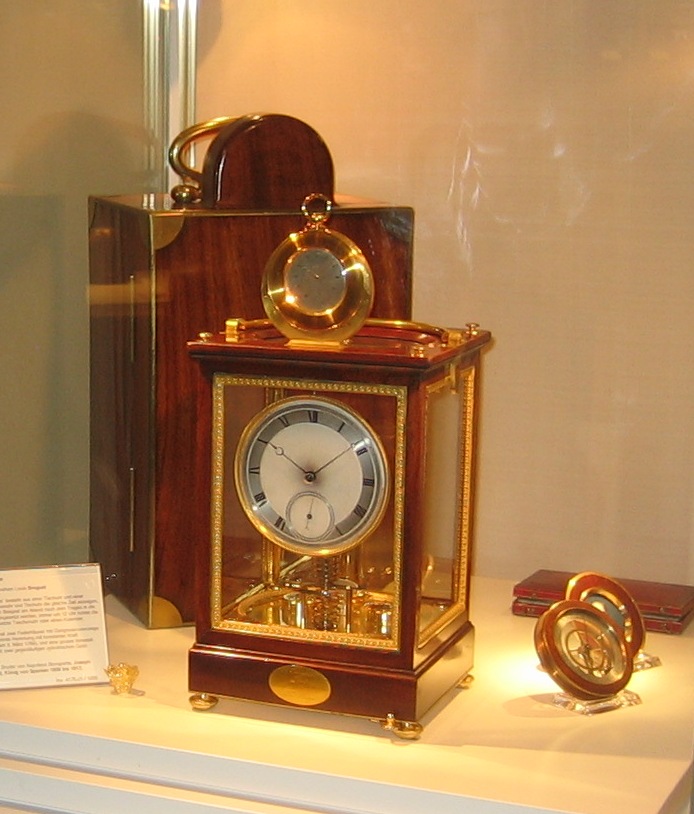
  • a “sympathetic” carriage clock that rewinds and sets time to a detachable pocket watch.


Also on this date:


League of Nations Day


National Vodoun Day in Benin 


Astronomer Robert Woodrow Wilson's birthday


Plan ahead:

Check out my Pinterest pages on:
And here are my Pinterest boards for:

August 19 – Happy Birthday, Seth Thomas

Posted on August 19, 2014

Tick, tock, a wooden block.
Tick, tock, make a clock!


Today's birthday was an American carpenter who built houses and barns...but then a fellow named Eli Terry convinced him to get into the clock-making business.

Born on this date in 1785, in Connecticut, Seth Thomas worked with Terry on tall clocks with wooden movements – which means that the gears inside the clock – the things that moved together in such a way that they could keep the hands of the clock moving to mark the seconds, minutes, and hours – were made out of wood!

I have always thought of gears being made of metal!

In 1812 Thomas left Terry and started a clock-making business on his own. His factory was one of the first to mass-produce clocks – and he made them with brass movements (gears). His shelf and mantel clocks were particularly popular with people.


One reason Thomas was able to sell so many clocks was that they were affordable. He streamlined the manufacturing process with automated methods and an assembly line, and he passed the savings on to his customers.


Also on this date:


National Aviation Day


Plan ahead:

Check out my Pinterest boards for:

And here are my Pinterest boards for:

April 28 – Biological Clock Day

Posted on April 28, 2014

A time to sleep, a time to awake,
A time to work, a time to relax,
A time to eat, a time to refrain from eating...

Your body knows when it is time to do things like go to sleep, wake up, and eat, because it has a biological clock! Other animals, too, have biological clocks – as do plants, fungi and even cyanobacteria!

The biological clock we associate with daily routines such as sleeping and eating is called “circadian rhythm.” There are other “biological clocks” associated with seasonal or yearly rhythms. We even refer to a biological clock “ticking” when we talk about adults' ability and desire to have children.

I couldn't find out why today, of all days, is Biological Clock Day, but I do think it's a great excuse to learn more about this intriguing topic!


The biological clock has three parts.

The first part is the ability to sense changes in light and temperature; these cues are used to set the biological clock. As you can guess, our eyes and nerve endings are used to sense light and temperature. But it's interesting to note that blind animals that live in dark cave environments with steady temperatures still have circadian rhythms. Also, if you deprive people and other animals of light, you can disrupt their circadian rhythms to some extent, but they will develop new rhythms in absence of the usual cues.

The second part of the biological clock is what we can call “clock genes.” Scientists are trying to understand exactly how they work. New discoveries in this area will help us to treat sleep disorders such as narcolepsy, and they may also help us fight cancer, because clock genes are used in cell production and cell suicide – and uncontrolled cell production and failure of cells to commit suicide are basically what defines cancer.

The third part of the biological clock is the genes that help the biological clock control the activity of other genes. Brain wave activity, hormone production, cell regeneration, and many other biological processes are all coordinated by the biological clock with the coordinating power of these genes.

Staying up all night, flying into another time zone, and using special “sun” lamps are all ways of messing with your biological clock. Jet lag and seasonal affective disorder (SAD, a problem many people have during sunless winters) are both examples of problems people experience with their circadian rhythms. Hopefully we will someday know enough about clock genes and the genes that help them control our bodily functions to develop better medicines and treatments of these and other problems.


Also on this date:


Anniversary of Maryland's statehood 


Plan ahead:

Check out my Pinterest boards for:
And here are my Pinterest boards for: