Showing posts with label Georgia. Show all posts

April 9 - Independence Day in Georgia

   Posted on April 9, 2022

This is an update of my post published on April 9, 2011:
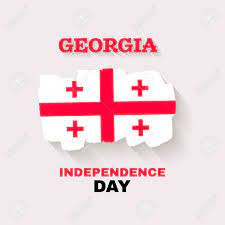

Which political body, do you think, declared independence on this day in 1991—Georgia, the country, or Georgia, the U.S. state?

If you guessed the country, you are right. The nation of Georgia traces its history all the way back to ancient kingdoms called Colchis and Iberia, but it probably got its current name from Saint George, whose red-on-white cross appears five times on the Georgian flag.


Georgia was taken over by the Russian Empire in the 19th Century and, after just a few years of independence when that empire was overthrown by the Russian Revolution, Georgia was again taken over by the Soviet Union in the 20th Century. Georgians took advantage of the breakup of the Soviet Union to pull away from Russia in 1991.


Because of this back-and-forth history, Georgia has two independence days: May 26 is the “Day of First Republic” (1918), and April 9 is “Independence Restoration Day” (1991). The May date seems to be more widely and vigorously celebrated—but I always think two holidays are even nicer than one!

Did you know that Europe started in Georgia?
Well, that's its tourism claim. Check it out.


If your tastes are more extreme, you could watch Georgians ice climbing


May 12 - St. Andrea's Day in Georgia

 Posted on May 12, 2021


This is an update of my post published on May 12, 2010:


St. Andrea's Day is a holiday in the Georgian Orthodox Church. 

I hope everyone reading this realizes that I mean Georgia-the-country, not Georgia-the-state-of-the-U.S.! Georgia is a country that is situated where Western Asia meets Eastern Europe, next to the Black Sea.


Abkhazia (the paler area within the red boundary line of
Georgia, above) is recognized by most nations as being
a part of Georgia, but some consider it an autonomous republic.

Below, Georgia is colored orange.


This is the Black Sea, 
looking very non-black.
(Remember, unlike most of the continents, it's not so easy to figure out where the separation between Europe and Asia is. The land mass is more properly called Eurasia, because (at least for the last 350 million years or so) the only division between Europe and Asia has been cultural and arbitrary.)

Georgia was part of several ancient kingdoms and had a “heydey” of sorts during the 11th and 12th Centuries. In the 19th Century, it was taken over by the Russian Empire; it briefly became independent when the Russian czar was ov
erthrown, in 1917, but then it was taken over again, this time by the communist Soviet Union. It finally became independent in 1991 when the U.S.S.R. broke up.

Sing a song, sing along...


Georgian vocal music includes “polyphonic music,” which is two or more songs sung at the same time, with beautiful, harmonious results. This kind of singing is different from a “round,” in which the same song is sung by two or more voices, each voice starting at a different time. In polyphonic music, each song is different in melody and words.


Does it seem like that would sound awful? Check out Simon and Garfunkel's version of “Parsley, Sage, Rosemary and Thyme (Scarborough Fair/The Canticle).”


Another world for polyphonic music is “counterpoint.”

This type of music was popular during the Renaissance (15th Century) and Baroque period (17th - 18th Century); Bach used a lot of counterpoint in his music. Georgian polyphonic music came earlier than that – about 1,000 years before!


Mountains, mountains, everywhere

The Caucasus Mountains divide Georgia into different regions. Some areas are covered with many valleys and go
rges separated by mountains. The Voronya Cave is the deepest cave system known in the world—but some of the nearby mountains reach 17,000 feet!

Because Georgia is “carved up” by mountains, the folk music, languages, and traditions of various tow
ns can be quite different, there is a huge variety of climates and plant life, and the landscapes are often spectacular! Take a look:


Learn why mountains are important 
at The Mountain Institute's website.  

This super-short animation and this longer video explains how mountains are formed.

Did you know...?

The word Caucasian (often used as a synonym for white, as in race) comes from the name Caucasus Mountains. This video goes into an amazing description of the many languages of this mountain area.


The Soviet Union's infamous dictator Josef Stalin came from Georgia. The word infamous means famous for evil deeds and “accomplishments” rather than good ones. 


An athlete named Nodar Kumaritashvili tragically died at the 2010 Olympic Games during a training run on the luge, just before the games officially opened. He was from Georgia.


Also on this date:


August 28 - Mariamoba in the Nation of Georgia

Posted on August 28, 2020

I am not sure how the nation of Georgia is faring with the COVID-19 pandemic - hopefully better than my nation is! - so this may be an off year as far as celebrations go...

But normally (and maybe this year, as well) you can see many (maybe thousands) of people climbing hills to their local church to light candles for Mariamoba.
 
Many churches in Georgia are built on the tops of hills.


Mariamoba is the celebration of what is called "The Asssumption" for many English-speaking Christians. Some Christian churches teach that Mary, mother of Jesus, did not physically die and was not buried; instead, they maintain that she was physically taken up to heaven at the end of her life.

Some Georgians go farther than just lighting candles to celebrate Mariamoba; they sacrifice a lamb or sheep in the churchyard. Of course then the meat is boiled and eaten, shared all around.