Showing posts with label Evo Morales. Show all posts

January 22 – Anniversary of Evo-Victory!

Posted on January 22, 2018

When I write about Bolivia (like here and here), I often mention the man who is considered the most famous Bolivian:

Evo Morales.

Why is this guy so famous?

Morales is Bolivia's first indigenous (indio / Indian / aboriginal or native) president. Actually, he is the first indigenous president in the entire continent of South America!

He's been president of Bolivia since this date in 2006 - having won three different elections, that makes it 12 years and counting. Morales is so popular, his first name has been used to coin words: his left-leaning economic ideas are called Evonomics, and his political ideas are called Evoism. 

Let's get down to some specifics:

This is Wiphala,
the Aymara flag.
Morales is from the Aymara indigenous group. These people have lived in the Andes Mountains and on the high planes of what is now Bolivia, Peru, and Chile - even before the Spaniards colonized the area, and even before the Inca conquered the region!

Before becoming Bolivia's president, Morales was a farmer and then an activist for workers' rights, labor unions, and land reform.

Morales became the world's oldest active professional football player (soccer player, people in the U.S. would say) in 2014. (But presumedly he is too busy to be doing a LOT of playing with Sport Boys Warnes.)

There have been complaints about Morales from wealthy Bolivians as well as from poorer Bolivians, from people with European ancestry and from those with indio ancestry - which proves that you definitely cannot please everybody, all the time! Still, many people have praised Morales for his efforts to fight against illiteracy, poverty, racism, and sexism. Many indios consider him a hero, and some people say that he is a champion for the environment.

One thing I like about Morales is that he was able to increase awareness of - appreciation for - and pride in indigenous cultures by his use of traditional clothing ("Fashion of the Populist") and indio symbols in the halls of power.


Notice the presence of Wiphala as well as
the Bolivian flag (the red-yellow-green flag).


Also on this date:

August 6, 2011 - Independence Day

– Bolivia AND Jamaica


Bolivia
Bolivia is a landlocked nation in South America—in other words, it has no coast on any ocean or sea.


Jamaica, in contrast, is an island nation in the Caribbean Sea. It borders on nothing but ocean!

These two very different nations both celebrate independence today. Bolivia won its independence from Spain on this day in 1825, after 16 years of struggle and war, and was named after one of the military heroes of that fight, Simon Bolivar. Jamaica celebrates its independence from the United Kingdom in 1962, although the nation maintains part of the Commonwealth and thus has U.K. Queen Elizabeth II as its ceremonial head of state.

Bolivia
Bolivia has 37 official languages! — Spanish, Quechua, Aymara, and 34 other native languages. More than half of Bolivians are Amerindians of various background (including Quechua and Aymara), quite different from the ethnic heritage of all other South American nations, which are heavily European/white or mestizo (mixed Amerindian and European). Jamaica, on the other hand, has only one official language—English—and has a population that is largely of African descent.

Jamaica's Bob Marley and Reggae Music are famous worldwide. 
One of the most interesting things about Bolivia is its president, Evo Morales, the first indigenous person to be elected president of a South American country and one of the only indigenous persons to be democratically elected president in all of Latin America. Morales is sometimes harshly criticized—although he often criticizes others, such as the time when he called then-President George W. Bush a terrorist—but in 2009 he was named World Hero of Mother Earth by the United Nations. Some indigenous leaders are unhappy with his presidency, but Morales has managed to get higher vote percentages than almost anyone in Bolivia's history. Morales defies the custom of wearing “normal” formal men's clothes, a suit and tie, and instead often wears sweaters, even to meet other world leaders, or unconventional jacket and dress shirt with no tie, even to his own inauguration. Morales is also one of the very few heads of state to have visited The Daily Show with Jon Stewart! 

One of the most interesting things about Jamaica is that it hosted a bobsled team, even though Jamaica is a tropical island without snowy mountains on which to practice such a sport. The bobsled team competed in the 1988 Winter Olympic Games in Calgary, Canada, and they quickly became crowd favorites as underdogs. Bobsledders from other countries loaned them spare sleds and offered them guidance and support. The Jamaican bobsled team didn't officially finish (let alone win), because they lost control and crashed during one of their four runs. However, they did improve, and they were very fast starters. After crashing, the four bobsledders got out of their sled and walked with it to the finish line. The crowd went wild.

At the 1994 Olympics, the Jamaican bobsled team finished ahead of many other countries, including the U.S., and in 2000 they won the gold medal at the World Push Championships in Monaco.

The Disney movie Cool Runnings is loosely based on the Jamaican bobsled team! 

February 10, 2010


Carnival de Oruro, Bolivia

A mixture of ancient Andean customs and Catholic rituals, this is the biggest cultural event in Bolivia's year. The festival begins with a ceremony dedicated to the Virgin of the Mineshaft; next, there is a marching band competition. The highlight is a huge parade: over 28,000 dancers and 10,000 musicians take part in a procession that lasts more than 20 hours. Last, there are two plays, one about the Spanish conquest and the other about the classic battle of good versus evil.

Did you know...?

  • Bolivia is a landlocked nation in South America. That means that no part of the country touches a sea coast.
  • Ecuador has two flags. One (pictured left) is a rectangle with three stripes and was adopted in 1851. Some sources indicate that the red stripe stands for Bolivia's soldiers, the green stripe represents fertility, and the yellow stripes symbolizes mineral deposits. The second flag (pictured right) is the Wiphala, a square banner with rainbow-colored squares.
There is evidence that, before the Incan Empire was conquered by Spanish invaders, its four regions were represented by colorful square banners called Wiphala. Each region had a slightly different color pattern, and the banner of Cuzco had a pattern of stripes arranged in rainbow colors rather than diagonally-arranged squares.
The Wiphala have come to represent pride in indigenous (native people's) culture and history.

  • Bolivia has elected a very left-leaning president, Evo Morales (in this picture, he's on the left), who is proud to be from the poorer, less powerful, Indian (native) majority of the country. He often speaks about protecting the environment and has been named “World Hero of Mother Earth” by the U.N. General Assembly.


Explore Bolivia and its People!


This Bolivia Bella websit
e is great. Scroll down to see the large “BOLIVIA for Kids” banners on such things as flags, history, maps, holidays, food, and so forth.


Learn about the Inca Empire

National Geographic Kids has an illustrated quiz that can teach you some interesting stuff about the ancient empire that once ruled a large part of South America, including land that now makes up Bolivia.


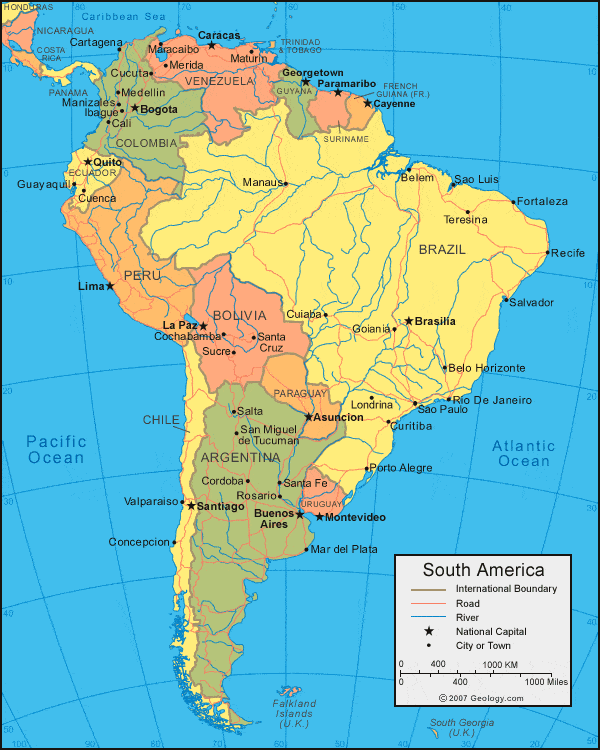
Find Bolivia

Bolivia and its neighbor Paraguay are both landlocked nations in the continent of South America. Find them on a map, and label them on this blank map from Enchanted Learning.