Showing posts with label eclipse. Show all posts

July 17 - Total Solar Eclipse in China

  Posted on July 17, 2022     


This is an update of my post published on July 17, 2011:


The earliest record of a confirmed total solar eclipse happened on this date in 790 B.C. The record was written in China. The reason we can confirm the date, although we don't have any records of the event from any other civilization, is because knowledge of the movements of the sun and the moon allow us to compute eclipses of the past as well as predict eclipses of the future!


Historians give the ancient Chinese credit for being the most accurate observers of astronomical events in the world, before the medieval Islamic or Arab astronomers eclipsed them. 

(Yeah, I used the word eclipse to mean “surpass” or “outshine” in an article about astronomical eclipses!)


One of the main reasons for all this careful observation was timekeeping. The Chinese used a lunisolar calendar which indicated both the lunar phases and the position in the solar year, with the four seasons depending on day length. Because lunar phases and the solar year are independent, the Chinese had to add leap days in order to keep the seasons in sync with the calendar—and so a lot of time was spent keeping tabs on constellations and the sun and moon.


Some ancient Chinese scholars conceived of the heavens as a dome-like hemisphere or as a celestial sphere like the one conceived by ancient Greeks. However, one school of ancient Chinese astronomers (the Xuan Ye school) viewed the heavens as an infinite space with stars and other bodies floating about “at rare intervals” (in other words, far from one another),  and that each celestial body had independent speed and movement. In other words, these Chinese cosmologists thought of the celestial bodies as being not attached to anything. 

The Xuan Ye view is very close to the theories of modern astrophysicists!


May 28 - Battle of the Eclipse

   Posted on May 28, 2022     


This is an update of my post published on May 28, 2011:


The year was 585 B.C.

The Medes and the Lydians were at war. 

The king of the Medes was fighting the king of the Lydians, and the king of the Lydians was fighting the king of the Medes - and that meant that they were both sending soldiers to fight one another.

They were fighting over land and revenge for an act that had been carried out in revenge for another act that had been carried out in revenge for... Well, you get the idea. Everybody was acting badly, and soldiers had been battling it out on behalf of their kings for MORE THAN FIVE YEARS!

Then, on May 28, 585, the gods stepped in.

The gods made day into night to show their displeasure, and the battle stopped.


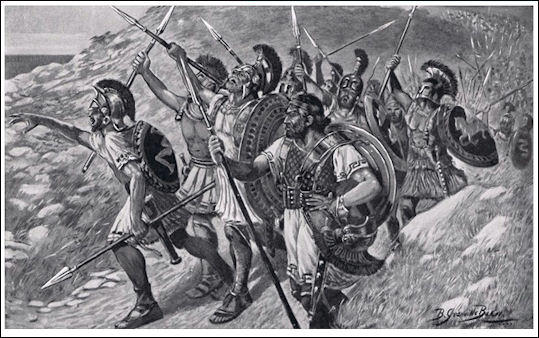
The Lydians (above) looked with astonishment at...
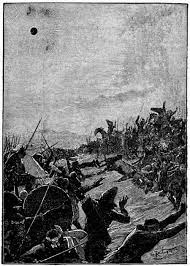
a black hole in the sky (below)
where the Sun should have been...


Somehow the two sides managed to arrange a truce. A boundary line was agreed on. One king's daughter married the other king's son to make sure the truce lasted.

Umm....

Of course, what stopped the battle on this day almost 2,500 years ago wasn't a miracle created by the many Lydian gods or the one Median god. It was a total solar eclipse. Total solar eclipses are very rare but also completely normal and (nowadays) well understood.

Basically, the battle site just happened to be in the moon's shadow.


I hope you get to see a total solar eclipse someday.
I have! And it looks really, really WRONG, somehow,
even if you completely know how normal it is, and
the cause, and that everything will be back to normal
in just a few minutes.

Because we can very accurately calculate the dates of solar eclipses, this battle is one of the earliest events that modern historians can pinpoint with a precise date.


 Julia Pierpont Day


 (Saturday before Memorial Day)


Plan ahead:


Check out my Pinterest boards for:
And here are my Pinterest boards for:


April 28 - Happy Birthday, Francis Baily

    Posted on April 28, 2022

This is an update of my post published on April 28, 2011:


I am lucky enough to have seen a total solar eclipse,
and I think you should try hard to see one if you
possibly can!


Francis Baily was lucky, because he got to see two solar eclipses!

You probably know that a solar eclipse is a rare event when the moon gets in the way of Earth's view of the sun. In other words, those people on Earth in the moon's shadow see an eclipse!

What you may not know is the anatomy of a shadow and how that relates to what kind of eclipse people get to see.


The umbra is the darkest part of the shadow in the diagram. People in the umbra see the moon completely cover the sun—and then they get to see the sun's corona, which is usually washed out by the brightness of the sun itself. This is called a total solar eclipse.


Total solar eclipse

The antumbra extends beyond the tip of the umbra. People in the antumbra see the moon fully in front of the sun, but the moon is too small to completely cover the sun, so there appears to be a ring of fire around a black disc. This is called an annular solar eclipse.


Annular solar eclipse

The penumbra is the lighter gray part of the shadow in the diagram. Obviously, you can see that many more people will be in the wide penumbra than in the narrow umbra. These people will see the sun with a “bite” taken out of it as the moon only partially covers it. This is called a partial solar eclipse.


Back to Baily


Francis Baily, born on this day in 1774, was an English astronomer. On May 18, 1836, he observed an annular solar eclipse in Scotland, and he reported that there were bright “beads” of sunlight bulging on the ring of sun visible during the eclipse. These beads are now called “Baily's beads,” and they are caused by the irregular surface of the moon, which of course has mountains and valleys and craters.


Baily traveled to Italy to see a total solar eclipse on July 8, 1842. Again, he was able to observe the beads just before and just after totality.


By the way, when just one “bead” is left uncovered, we see the “diamond ring effect.”


Plan ahead:


Check out my Pinterest boards for:

And here are my Pinterest boards for: