Showing posts with label Parker. Show all posts

April 19 – John Parker Day

Posted on April 19, 2016


On the morning of April 19, 1775, John Parker was already dying of consumption.

At age 46, he only had months to live.

Still, he had been elected as militia captain by the men of his town, Lexington, Massachusetts. He had had experience as a soldier in the French and Indian War – when he wasn't busy being a farmer and mechanic – and the had Massachusetts Militia needed farmers who were experienced in battle to lead what was basically a group of farmers with muskets.

The British troops, on the other hand, were trained soldiers called “regulars.” And on this date in 1775, a group of about 700 British regulars under Colonel Francis Smith moved to Concord, Massachusetts, to search for supplies and weapons that were rumored to be hiding there.

Lexington just happened to be on the road to Concord.


Captain Parker heard that British soldiers were approaching – but of course he didn't know why they were coming his way. The Revolutionary War hadn't started yet...British troops had been marching through the countryside without battles for months now...Parker had no good reason to order an attack on the better-equipped, better-trained Brits.

Actually, from all accounts, Parker didn't order such an attack. But it is uncertain exactly what did happen. British Colonel Smith had ordered an advance guard to see if there was going to be any confrontation; when the advance guard approached the colonists gathered on the Common in Lexington, Parker ordered his men to avoid a confrontation. One soldier – much later – remembered the order this way:

"Stand your ground. Don't fire unless fired upon, but if they mean to have a war, let it begin here."

Another soldier, a fellow you may have heard of named Paul Revere, remembered the order to be slightly different:

"Let the soldiers pass by. Do not molest them without they begin first."

It's reported that the British soldiers, too, had orders not to shoot. But....there was shooting!

Nobody is certain who shot first, but after the “Battle of Lexington” eight militia were killed, ten were wounded, and zero British regulars were killed and only one was wounded.

Not all that auspicious a beginning for the often-romanticized American Revolution!

Later that day Parker led his men to ambush the British soldiers as they returned to Boston from Concord, and later still he led his men as they resisted the British Siege of Boston...but in less than five months, Parker died from consumption.

By the way...
  • Consumption is the old name for tuberculosis.
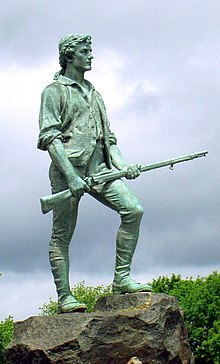
  • This statue, which stands in Lexington Battle Green, represents minutemen in general. Actually, Parker's Lexington company were not really minutemen (who were only one-quarter of the militia). The statue has come to represent John Parker, even though the statue depicts a young, healthy soldier, and Parker was a middle-aged, quite ill captain.


Also on this date:


Anniversary of the first free-fall parachute descent using a rip cord


Plan ahead:

Check out my Pinterest boards for:
And here are my Pinterest boards for:

August 22 – Happy Birthday, Ray Bradbury and Dorothy Parker

Posted on August 22, 2015

Today I want to talk a bit about two American writers.


The older of the two, Dorothy Parker, was on this date in 1893. She grew up (in New York City!) to write poems, short stories, and screenplays. She was also a critic and was well known for her satire and other witty writing.

Parker was a founding member of the Algonquin Round Table – a group of writers and guests who met almost daily for lunch at the Algonquin Hotel. She won two Academy Awards – one for writing the screenplay for A Star Is Born – and she won the prestigious O. Henry Award for one of her short stories.

So, she was successful.


But she is perhaps even more famous for getting involved with political movements, and she promoted cicil liberties and civil rights movements. She helped to start up the Hollywood Anti-Nazi League before World War II, and she worked against Fascism in Spain, too, heading the Spanish Children's Relief and Project Rescue Ship. Actually, I cannot list all of the causes she worked on and leant her name to – there were a lot!

All that political action made her suspect to some. The FBI started watching her, and Parker was considered to be a Communist by some conservative forces in the U.S. We're talking the McCarthy era, here: a time when people could just accuse you – without evidence! – of being a “Commie” and end up ruining your career. Dorothy Parker ended up being on the Hollywood blacklist for her political views.

When Parker died, at age 73, she left all her money to Dr. Martin Luther King, Jr. When he died, her money was passed on to the NAACP, an organization that works for civil rights for people of color.

I bet, when Parker wrote that, she was thinking
of ugliness as racism, misogyny, and other
forms of bigotry!

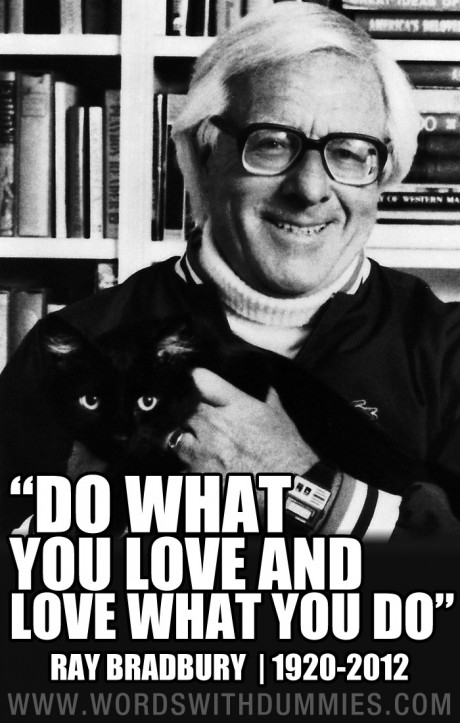
Bradbury was born several decades after Parker, on this date in 1920, in Illinois. Bradbury also lived in Tucson, Arizona, and Los Angeles, California – reaching L.A. when Bradbury was 14 years old.

Bradbury was excited to live in L.A., because he adored Hollywood. He joined drama club at high school, and he often roller-skated through Hollywood, hoping to meet celebrities.

Well, young Bradbury-on-skates DID see stars! He even got to meet a few. One was George Burns, who was a famous comedian and entertainer who did vaudeville, movies, radio, and TV, working steadily for more than 75 years! As a matter of fact, Bradbury's first job as a writer was working for Burns – and Bradbury got that job right away, at age 14!

Wow-za!

But Bradbury's fame didn't come from comedy writing, but instead from writing science fiction and horror. He's considered of the greatest of the greats (although, I have to admit, his fiction is too weird and even his sci-fi is too tinged with horror for my taste).


Some of Bradbury's most famous books are Fahrenheit 451, The Martian Chronicles, and The Illustrated Man.

I found it interesting that Bradbury wrote every single day from age 12 on. Every. Single. Day! When he made that claim, he had already written every single day for 69 years – and he died at age 91, so I'm not sure, but it is possible that he wrote almost 29 THOUSAND days in a row!!!

Wow-za again!!

Ray Bradbury actually wrote at least one book for kids, too: Switch on the Night.


Also on this date:


Russian Flag Day


Plan ahead:

Check out my Pinterest boards for:

And here are my Pinterest boards for: