Showing posts with label extinction. Show all posts

August 12 - Quagga - gone!

 Posted on August 2, 2022     


This is an update of my post published on August 2, 2011: 


Have you ever heard of quagga? This kind of zebra looked as if whoever was in charge of painting stripes ran out of paint. The horselike animal, native to South Africa, had vivid stripes on the head and neck. In the mid-section of the animal the white stripes faded and dark in-between stripes became wider. The rear section was solid brown.

The quagga used to be be classified as an individual species, but now it is considered a sub-species of the plains zebra.


Unfortunately, the quagga was hunted to extinction for meat, hides, and to prevent it from competing with farm animals. The last of the wild quagga was probably killed in the late 1870s. There were still some quagga in zoos, but on this day in 1883, the last one died in a zoo in Amsterdam.

One of the foals of the Quagga Project

The quagga is the first extinct animal to have its DNA studied. Recently a natural historian began a project to recreate the quagga by selective breeding from plains zebra stock. In 2005 the first foal of the Quagga Project was born, and by 2006 creatures that look very much like the quagga-of-old had appeared. 

This sort of “breeding back” project is controversial. Apparently the project's goal is to reintroduce the quagga back into the wild, but some scientists say that even creatures that look like the quagga will not be true quagga. There is no technology, so far, to use DNA recovered from quagga specimens in breeding—and that, some say, would be what was necessary to truly bring back an extinct species.


May 13 - Remembering Georges Cuvier

    Posted on May 13, 2022

This is an update of my post published on May 13, 2011:


Georges Cuvier named the pterodactyl and the mosasaurus. He opposed the idea of evolution. He proved that species of animals have gone extinct. He believed that the “original people” were white (Caucasian). He established the fields of comparative anatomy and paleontology.


Like so many scientists who lived and worked a long time ago, Cuvier had some really good ideas that established or revolutionized branches of science—but he also had some ideas that, since his death, have been shown to be utterly wrong. 

(And racist!)

When you look at the work of Cuvier, a French biologist and paleontologist who died on this day in 1832, you can't help thinking - or at least hoping - that he would have changed many of his incorrect views if he could've seen the evidence we humans have gathered since his time.

For example, in opposing evolution—the idea that populations of animals change over time—Cuvier was opposing the theories of his contemporaries, Lamarck and Geoffroy Saint-Hilaire. And, we now know, those theories were incorrect. Charles Darwin's theories of common descent and of evolution driven by natural selection—which have been added to, now that we know about genes and DNA, and which TONS of evidence show are essentially correct—wouldn't be published until more than 20 years after Cuvier died.


Fossils drawn by Georges Cuvier

As the saying goes, in science we stand on the shoulders of giants. Today's average 11 year old kid knows more science than the most brilliant Ancient Greek natural philosopher, and a college freshman pre-med student knows more Bio, probably, than Cuvier! Still, Cuvier is one of those giants of intellect and endeavor upon whose work biology is built.


Cuvier believed in catastrophism...

Cuvier studied fossils of animals that no longer exist today, such as the wooly rhinoceros and the mammoth, and he came to believe that they went extinct due to some sort of natural catastrophe. Geologists who put forth the theory of catastrophism explained geological formations through catastrophes, too; for example, the carving of canyons and valleys might be explained by mighty floods.

The opposite of catastrophism is uniformitarianism. This is the theory that geological features can be explained by forces we can see today, acting gradually over years, decades, centuries, millennia. Under this theory, valleys and canyons (for example) are carved slowly and gradually by the slow movement of glaciers, or by many rainstorms and erosion events.
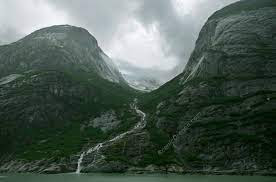

Glaciers carve U-shaped valleys.
Rivers tend to carve V-shaped valleys,
but of course over the course of time,
many of these valleys widen.


Today geology is based on uniformitarianism and catastrophism, together. Earthquakes and volcanoes seem like natural catastrophes to us, but to a geologist, these and other tectonic forces are constant enough to be an important, almost continuous, part of land formation and shaping. Erosion tends to be almost continuous, too. Catastrophes such as super-volcanoes, major storms and floods, and of course huge meteors (perhaps asteroids or comets) that impact the Earth all happen occasionally and sculpt the land as well. 

Biologists and geologists have worked out together that (almost certainly) at least some animal extinctions have been caused by huge tectonic or impact events. (And of course, extinctions of some species of plants and other organisms would share these same causes.)


September 1 - Passenger Pigeons - Extinct!

 Posted on September 1, 2021


This is an update of my post published on September 1, 2010:


Martha, a passenger pigeon, died on this day in 1914. She was thought to be the last passenger pigeon in the world, and when she died in a Cincinnati zoo, people sadly declared the species extinct. No passenger pigeon has been seen anywhere in the world since.


This species was hunted to extinction, although of course there were population reductions due to loss of habitat, as well. These birds traveled and nested in huge flocks, sometimes more than two billion birds in a flock! As flocks flew by, they sometimes stretched a mile wide and 300 miles long across the sky, taking several hours to pass. These huge numbers made the passenger pigeon one of the most common birds in the world in the nineteenth century.


When Audubon was making his famous
studies and illustrations of birds, there were
LOTS of passenger pigeons about.

And it became extinct in the early years of the twentieth century!

It's sad to read that super unfair and inhumane hunting methods were used to kill these birds, and that as late as 1896, hunters killed the final flock of 250,000 passenger pigeons—even though everyone knew that it was the last large flock! Apparently in one place in Michigan alone, 50,000 birds were killed per day throughout a hunting season that lasted almost five months. Dead birds—used for meat—were shipped by the boxcar-full to Eastern cities.


During the last two decades of this species' existence, conservationists tried to breed passenger pigeons in captivity. However, the birds were used to living and breeding in huge groups, and in small flocks, birds did not mate successfully nor live long. The only silver lining to this sad story is that people became aware of human impact on species and of the possibility of extinction because of overhunting. New laws and practices arose because of this extinction, and surely some creatures still live today because of that new interest in conservation.


Also on this date:


Self-University Week Begins