Showing posts with label Civil War. Show all posts

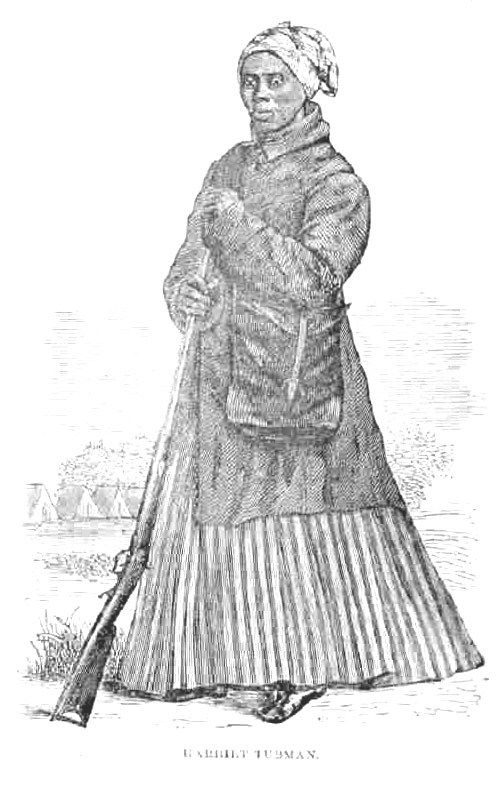
March 10 - Harriet Tubman Day – U.S.

 Posted on March 10, 2021

This is an update of my post published on March 10, 2010:


Harriet Tubman was strong, brave, and hard working on behalf of others, and this day commemorates her life; she was born into slavery some time in 1820 or 1821, and she died on March 10, 1913.

After Tubman escaped from slavery, traveling from Maryland to Pennsylvania, she made thirteen trips back to the south to rescue other enslaved people and bring them north to freedom on the Underground Railroad. Because of this, she has been called a conductor on the Underground Railroad and also the Moses of her people.

Tubman's first rescue missions were to bring her family north to freedom. Eventually she guided other enslaved folks north, and she ended up escorting around 70 people to freedom as well as telling many others how to reach the northern states. She said later that she “never lost a passenger.”


Tubman proved her exceptional bravery because any runaway caught in the south would be returned to slavery, and she proved her exceptional strength because she had to withstand a terrible head wound as well as many beatings and other mistreatment. An overseer had thrown a two-pound metal weight at another slave, and it hit Tubman in the head. Just a teenager, bleeding and unconscious, Tubman was given no medical attention. Two days later, she was sent back into the fields. Tubman had problems from this head injury, including severe headaches and seizures, all her life.

During the Civil War, Tubman worked hard to defeat the Confederacy. She acted as a nurse to Union troops, helped enslaved people who took advantage of the war to run away, led bands of scouts to map out unfamiliar land, and acted as a spy for the Union. Tubman even led an armed assault, the first woman to do so in the Civil War, and more than 700 enslaved people were rescued during that raid.

After the Civil War and slavery were ended, Tubman tended to her family (including her aging parents) and also worked for women's right to vote. She donated land to be used for a home for elderly people.

Harriet Tubman was widely known and greatly respected in her own time, but she was seldom paid for her nursing and spying services, invaluable though they were, and she was quite poor. One time that she received an honor, she had to sell a cow in order to afford the railroad ticket to go to the celebrations!

Luckily, some people who were busy heaping praise and honors on her also raised donations to partially pay her back for her service to her country. Unluckily, at one point two men swindled her in what 
sounds like an old-time version of the Nigerian e-mail scam.

All in all, Harriet Tubman had an eventful life, but never an easy one. Her strength and morality won for her fame but never fortune.


Harriet Tubman's image will soon replace Andrew Jackson on U.S. 20-dollar bills - and she will be the first African American pictured on any U.S. money, as well as the first woman on paper currency in the nation in more than a century!

Here are some resources to learn more about Harriet Tubman and the Underground Railroad.

Here is a picture of Harriet Tubman that you can print and color.


February 20 - Frederick Douglass Day

Posted on February 20, 2021

This is an update of my post published on February 20, 2010:


We often celebrate historical people on the anniversary of their birth (AKA, their birthday!), but Frederick Douglass never knew what day he was born. It wasn't even certain exactly what year he was born. His best guess for his birth year was 1818.

Why didn't he know his birthday? He was born a slave (in Maryland in the U.S.) with the last name Bailey. He never knew his father, and he was separated from his mother when he was just a baby.

Douglass ran away from slavery when he was around 20 years old. He changed his name and settled in Massachusetts, where he made it his lif
e's work to work for the abolition of slavery. He worked for human rights of all sorts, including women's right to vote, and equality for Native Americans and recent immigrants as well as for black folks. Douglass spoke and wrote about his ideas and informed white audiences of the horrible realities of slavery.


Frede
rick Douglass's words:
"I would unite with anybody to do right and with nobody to do wrong."

“At a time like this, scorching irony, not convincing argument, is needed.”

“I prayed for twenty years but received no answer until I prayed with my legs.”

(When asked to describe what it felt like when, as a runaway slave, he reached the North and freedom):
“Anguish and grief, like darkness and rain, may be depicted; but gladness and joy, like the rainbow, defy the skill of pen or pencil.”
– Thanks to Brainy Quote and Wikipedia!


What happened to Frederick Douglass after the Civil War?

The Good:
  • Douglass's speech honoring the slain Abraham Lincoln was so moving to the president's widow, apparently, that she gave Douglass Lincoln's favorite walking stick.
  • Douglass worked as president of a freedman's bank, a U.S. Marshall, and a diplomat; he also continued on the lecture circuit, speaking at universities and emphasizing voting rights and other civil rights.

The Bad:
  • Douglass's house in Rochester, New York, was burned down in 1872, possibly because of arson. The family moved to Washington, D.C.

  • Douglass's wife died in 1882, which made him quite depressed; later, when he married a woman who was working for women's rights, the new couple met up with a lot of hatred and anger because she was white.

The Odd:
  • In 1872, Douglass became the first black person to be nominated as Vice President of the U.S. This would be in the “good” list, except for the fact that nobody consulted Frederick Douglass before nominating him! He was on the ticket, along with Victoria Woodhull as the presidential candidate, for the Equal Rights Party, and not only did Douglass not campaign, he never even acknowledged the nomination.

Read the book Narrative of the Life of Frederick Douglass.
This book is short and easy to understand, but be forewarned: Douglass's account of the horrors of slavery is pretty vivid.


Watch some videos.
Try this one or this one.

There is a coloring page about Douglass on Super Coloring.


Also on this date:


 Anniversary of Frederick Douglass's death
 (original post)


World Pangolin Day


(Third Saturday of February)


 (Third Saturday in February)


February 12 - Darwin Day AND Lincoln's Birthday

Posted on February 12, 2021

This is an update of my post published on February 12, 2010:


Charles Darwin and Abraham Lincoln were famously born on the very same day--this date in 1809--Darwin in England and Lincoln in the U.S. 

Darwin was born to a well-to-do family and ended up becoming one of the most important scientists of all time, and Lincoln was born in a much poorer family and ended up becoming one of the most important U.S. Presidents.

There have been articles and even books comparing the two, and we found out that both men lost their mothers in childhood, had strained relationships with their fathers, and suffered from depression. Both had difficulties settling on a career. Lincoln piloted a river raft, split rails, and served as a store clerk, postmaster, and surveyor before becoming a lawyer and finally seeking political office. Darwin, as the son of a wealthy society doctor, was supposed to become a doctor as well but neglected his studies at medical school. His disappointed father enrolled him in another university program so that he could become a parson in the Anglican church instead. However, after graduating, Darwin, who had always been interested in nature, took a position on the H.M.S. Beagle as a gentleman naturalist, and so began his career in science.

The m
ost significant likeness between Darwin and Lincoln, of course, is that they both had major impact on the world.


Lincoln was president during the dreadful U.S. Civil War, when southern states broke away from the country and formed the Confederate States of America in response to efforts to limit the spread of slavery. Lincoln's act of keeping the nation together shaped how the U.S. thought of itself—more a country than a collection of states—and widened the commitment that the nation was based on the idea that “all men (humans!) are created equal.” Of course, Lincoln had enormous impact on the United States itself, but Lincoln also helped set up the country as an important, long-lasting nation on the world stage, and eventually a super-power.


Darwin had a big idea - evolution (slow, gradual change) of plants, animals, and other living organism through natural selection. That big idea revolutionized all of biology and changed how people thought of themselves and their history. Because findings in biology mesh with findings in geology, chemistry, and other sciences, Darwin's theory of evolution through natural selection has had an impact on other scientific fields and even the philosophy of science.


The language of evolution and selection has been applied (sometimes incorrectly) far outside of Darwin's Origin of the Species, and astronomers talk talk about the evolution of stars, linguists discuss the evolution and extinction of languages, social scientists describe the reproduction and mutation of memes (bits of human culture, such as a particular song or style of dress), and economists discuss evolutionary models of monetary systems.

One reas
on for the influence of Lincoln and Darwin is that they both wrote exceptionally well. Here are some quotes from the two men:


A man who dares to waste one hour of time has not discovered the value of life. – Darwin

A house divided against itself cannot stand. – Lincoln

A man's friendships are one of the best measures of his worth. – Darwin

Am I not destroying my enemies when I make friends of them? – 
Lincoln
It is not the strongest of the species that survives, nor the most intelligent that survives. It is the one that is the most adaptable to change. – Darwin

America will never be destroyed from the outside. If we falter and lose our freedoms, it will be because we destroyed ourselves. – Lincoln

To kill an error is as good a service as, and sometimes even better than, the establishing of a new truth or fact. – Darwin
As I would not be a slave, so I would not be a master. This expresses my idea of democracy. – Lincoln
Ignorance more frequently begets confidence than does knowledge: it is those who know little, and not those who know much, who so positively assert that this or that problem will never be solved by science. – Darwin
Be sure you put your feet in the right place, then stand firm. – Lincoln

Learn more about Lincoln.


Here is an illustrated timeline of Abraham Lincoln's life.

And here is a short video about him.


Learn more about Darwin.


Here is a short video about Darwin's life; it has cartoon-like illustrations. 

Attend a Darwin Day event.


This international celebration includes many local events, some held in museums and universities. This year is bound to have mostly virtual / distanced / zoomed events...

Check for a local event here.


Also on this date:


 Youth Day in Venezuela


(original post)


(original post)


Chinese New Year

(also here - here - here and here)


(Second Friday of February)


Plan ahead: