Showing posts with label reconciliation. Show all posts

May 31 - National Reconciliation Week in Australia

   Posted on May 31, 2022     


This is an update of my post published on May 31, 2011:


Reconciliation 
means coming together. 

And, in the case of Australia's Reconciliation Week, it means working to overcome divisions and inequality between Aboriginal people and Torres Strait Islanders, on the one hand, and non-Indigenous (largely European-ancestry) Australians, on the other.


Torres Strait Islanders


According to the official website, National Reconciliation Week (May 27 to June 3) is "a time for all Australians to learn about our shared histories, cultures, and achievements, and to explore how each of us can contribute to achieving reconciliation in Australia."
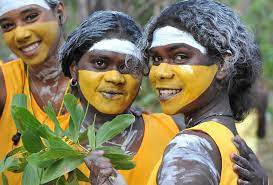

Aboriginal Australians


This year, the theme of Reconciliation Week is "Be Brave. Make Change." It's about helping to "
collectively build relationships and communities that value Aboriginal and Torres Strait Islander peoples, histories, cultures, and futures."

Cooee!

Many Aboriginal words are familiar to English speakers because they have have actually been adopted into the English language. Some of the names for animals are among my favorite words in the world: dingos, kangaroos, potoroos, wombats, wallabies, koalas, and kookaburras.
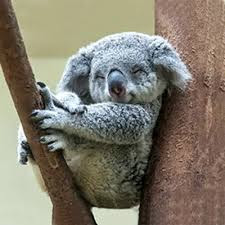


Boomerangs are weapons (and toys), billabongs are small lakes or waterholes, and yabber means (as it sounds) “to talk.”

Strangely, the word didgeridoo is not an Aboriginal word, even though it names an Aboriginal musical instrument. There are a variety of Aboriginal words for the instrument, including yadaki. The word didgeridoo is of Western origin and could be onomatopoetic—in other words, copying the sound that the didgeridoo makes.

I also thought that bandicoots and emus, Australian animals, got their names from Aboriginal languages, but in actual fact bandicoot comes from Teluga (a language of India), and emu from Arabic. Of course, there are lots of Australian slang words that are not Aboriginal in origin!


Here is a famous Kookaburra song, and here is another famous Australian bush song, "Waltzing Matilda." (Warning: the latter song tells a sad story that can be upsetting to some.)


Learn about Aboriginal art and culture!

Check out last year's post.


Also on this date:


Memorial Day in the U.S.A.


Castille-La Mancha Day in Spain


Plan ahead:


Check out my Pinterest boards for:


December 16 – Day of Reconciliation in South Africa

Posted on December 16, 2017


This public holiday was created in 1994 in an effort to start a healing process. You see, the nation had just (finally!) ended apartheid, which was a system of segregation and discrimination that had been used in South Africa to keep black people (and other people of color) separate from white people and in an inferior position as far as power and money were concerned. Apartheid had been the rule of the land for about half a century, and the wounds were going to be hard to heal...

...The South African Truth and Reconciliation Commission, working with President Nelson Mandela, carefully chose a date that was already meaningful to (white) Afrikaners and to (black) Africans.

The idea was to create more unity.

The idea of forgiveness of the past is a nice one...
But healing old wounds isn't just simple.
And forgiving is not the same as forgetting.
And facing the truth is not the same as offering
a way to make up for the past.
 

Some of the festivities include parades and ceremonies. In the past, a statue of Mandela was unveiled, inscriptions of war heroes' names were honored, and a victim of ethnic strife was honored with a tombstone.

Children are the hope for the future.
Can we raise kids to love more than fear and hate?
Can we give them equal access and equal opportunity?


Also on this date:


Check out my Pinterest pages on:
And here are my Pinterest boards for:

May 31, 2011 - National Reconciliation Week

– Australia


Reconciliation means coming together. And, in the case of Australia's Reconciliation Week, it means working to overcome divisions and inequality between Aboriginal people and Torres Strait Islanders, on the one hand, and non-Indigenous (largely European-ancestry) Australians, on the other.

According to the official website, National Reconciliation Week 2011 (May 27 to June 3) is “all about proper recognition of Aboriginal and Torres Strait Islander peoples.” 


During the week Australians can view exhibitions such as “Yiloga! Tiwi Footy,” about Tiwi football players, and “Marnti Warajanga” (We're Traveling), about the ongoing work for social and political change. Workshops for kids and film festivals are held, celebratory dinners and BBQ feasts are eaten, and cultural walks are taken.


Cooee!
Many Aboriginal words are familiar to non-Australians because they have entered English. Some of the names for animals are among my favorite words in the world: dingos, kangaroos, potoroos, wombats, wallabies, koalas, and kookaburras. Boomerangs are weapons (and toys), billabongs are small lakes or waterholes, and yabber means (as it sounds) “to talk.”


Strangely, the word didgeridoo is not an Aboriginal word, even though it names an Aboriginal musical instrument. There are a variety of Aboriginal words for the instrument, including yadaki. The word didgeridoo is of Western origin and could be onomatopoetic—in other words, copying the sound that the didgeridoo makes.


I also thought that bandicoots and emus, Australian animals, got their names from Aboriginal languages, but in actual fact bandicoot comes from Teluga (a language of India), and emu from Arabic. Of course, there are lots of Australian slang words that are not Aboriginal in origin!


Here are the lyrics to the kookaburra song, and here are the words to Waltzing Matilda. 


You can enthusiastically sing these songs even if you've never seen a kookaburra bird or coolabah tree! 


Learn about Aboriginal art and culture!
Check out last year's post.