Showing posts with label Norse. Show all posts

March 28 - Ragnar Lodbrok Day in Scandinavia

  Posted on March 28, 2022

This is an update of my post published on March 28, 2011:


On this day wayyyyy back in 845 A.D., Viking raiders under the leadership of Ragnar Lodbrok are said to have sacked Paris. This means that (according to Norse stories) they stole all the valuables they could find.

In other words, the Vikings looted. They pillaged. They plundered. They robbed and stole and took booty.

Paris was ruled at the time by Charles II “The Bald,” and Norse stories say that Charles The Bald paid Ragnar lots of money to just take the spoils and leave, rather than destroying the city—7,000 pounds of silver to go along with all the rest of the loot, just so the raiders wouldn't burn everything down!

The stories go on to say that Ragnar did leave Paris, but he continued to attack France all the way up the coast.
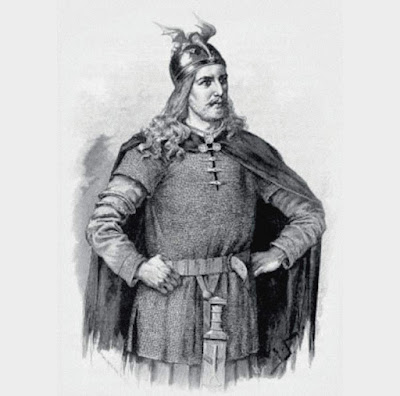
By the way, Ragnar was nicknamed “Hairy Breeks” (or “Hairy Breeches”) because he is said to have wooed his second wife by wearing thick, hairy leather pants in order to protect himself as he killed poisonous snakes that were infesting part of Sweden. Ironically, he's said to have eventually died because of snakes: when he went to Britain to pillage and loot, the Northumbrian king captured him and put him to death by throwing him into a pit of venomous snakes.

Much of what we “know” about Ragnar and the sacking of Paris and all the snakes comes from Old Norse poetry and legendary sagas. In other words, we only know what this Viking did from Viking poems and tales. Naturally, the sagas made Ragnar sound better than he really was—stronger, more daring, more clever. 

But he just sounds like a bully and a thief, to me!


Ragnar has become a character in movies and video games.
Like Robin Hood and King Arthur, Ragnar may have been
based on a historical figure - but surely not all the stories
told about him are true!

Keep in mind that some Frankish (French) stories say that the French troops defeated Ragnar when he tried to attack Paris. And there isn't an awful lot of evidence that Ragnar even existed, let alone that he sacked Paris.  


Explore the Viking Age

Were Vikings always bullying others and stealing booty? Not all of them, for sure, and not all of the time, even for those who were big meanies. Check out the Vikings for Kids video.

Here is a modern tale about Vikings - a story meant for little kids!

Did you know that Vikings never wore horned helmets?


The typical Viking horned helmet...is a myth!


Two famous helmets that were found in Denmark - helmets with metal horns of a different shape than the usual animal horns we see in Viking shows and images - date back to WAYYY before the Vikings lived.


This horned helmet dates back 2,000 years before
the Vikings!

The evidence tells us that the helmets Vikings wore didn't feature horns. Apparently costume designers and/or illustrators in the 1800s came up with the ubiquitous but incorrect horned Viking helmet!
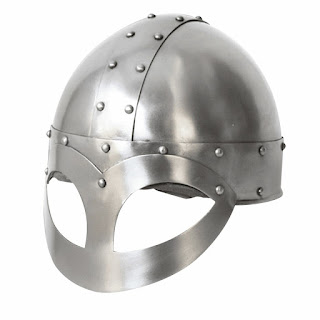
This is a modern version of a more
authentic Viking helmet design.


October 9 - Leif Erikson Day in the U.S.A.

 Posted on October 9, 2021


This is an update of my post published on October 9, 2010:


This American holiday honors the Norse explorer Leif Erikson, who is thought by historians to be the first European to land in North America, other than Greenland. This landing took place nearly 500 years before Columbus arrived in the Americas, perhaps somewhere in Canada, probably on the northern tip of Newfoundland Island.


Leif was born around the year 970 in Iceland. His father, who was called Erik the Red, was an explorer from Norway.

Leif heard from another Norse explorer that there was land visible west of Greenland, and he set off with 35 men to find it. The first landing he called (in Old Norse) “Land of the Flat Stones.” The second he called “Wood-land,” and the third, “Vinland.”


Historians have taken “Vinland” to mean wine land because grape vines grew there, or pasture land because vin used to mean “pasture.”

The Norse explorers built a small settlement at Vinland and stayed there during the winter. They returned to Greenland in the spring with a cargo of timber.


Why today?


You might ask why October 9 is Leif Erikson day. Was he born on that day? Did he die on that date? Was it the day he first landed on the shores of North America?


No, October 9 is not linked to anything in Erikson's life. Instead, it was the day of the first organized immigration to the U. S. from Norway, in 1825. (See "Also on this date," below.)


Learn more...

Here is a short video about Leif Eriksson. And here is an interesting video about Norse longboats.

NOVA has a webpage with more about Viking ships. 


Fall Astronomy Day
(Saturday closest to the first quarter Moon between September and October)


December 21 – Yule

Posted on December 21, 2014

Yule, or Yuletide, is a pagan religious festival that celebrates midwinter. It was celebrated by Germanic peoples way back in the Fourth Century and before.

Yuletide was more of a season than a day, but the festival lasts 12 days. Since today is Winter Solstice (the shortest day of the year) in the Northern Hemisphere, the biggest celebrations happen today!

We're talking burning a Yule log, Yule singing, roasting and eating a Yule boar, making Yule goat ornaments out of strawand more!


Who are the Germanic peoples?

I mentioned that Yule was a festival celebrated by Germanic peoples. This name comes from the time of the Roman Empire, when a group of people called the Celtic Gauls lived in what is now France. North and east and northeast of the Gauls lived people who were then considered less civilized and more physical (bigger, stronger, tougher): the Germanic tribes.

Nowadays, we typically think of Germanic peoples as those who speak German or languages that are related to German: Norwegians, Swedes, Danes, Icelanders, Germans, Austrians, German Swiss, English, Dutch, Afrikaners, Flemish, Frisians, and Scots.


What is this pagan religion you speak of?

First off, let's get one thing straight: there is no one pagan religion!

The Latin word that pagan came from meant, roughly, “country bumpkin.” It had nothing to do with religion—but instead it hinted that someone lived far from the city, that someone wasn't very educated, that someone was a bit backwards, at least as far as culture went.
The Spirit of Yule, aka
The Green Man, aka
The Holly King

However, when Romans used the word to refer to unlearned folks, some later readers misunderstood it to identify the religion practiced by those unlearned folks. There was so much misunderstanding and then misuse of the word, that the word pagan eventually evolved to have a religious meaning. It now refers to a broad group of indigenous (native) religious traditions and beliefs, most of them polytheistic (having multiple gods and goddess).

For many people, the word pagan has a bad connotation. These days, it doesn't make people think, “Oh, wow, what an unsophisticated yokel!” But most people think of pagan religions as not nearly as respectable as the largest religions in the world (Christianity, Judaism, Islam, Buddhism, Hinduism); some people even think of them as some sort of devil-worshipping cults (although they would be wrong!).

The particular pagan religion connected with Yule is the old Norse faith. Scholars say that the festival is associated with the Wild Hunt (a group of ghostlike hunters who presumably parade across the sky), the god Odin (who is the Norse Allfather, father of all the rest of the gods and goddesses), and the holiday Modraniht (Mother's Night, which celebrates women and fertility).


In the U.S., the Yule goat never caught on.
But in some places in the world, the goat
that used to be part of the pagan Yule is
now a part of Christmas. Witness this
decorative window (above) and ornament
(below).
Hey, wait, isn't Yuletide a Christmas thing?

When most of the people in a particular Germanic area converted to Christianity, they kept up their old Yule traditions, but tweaked them a bit here and there to fit into their new religion. To this day, many people talk about Yule, Yuletide, and Yule logs being associated with Christmas—and these things HAVE been associated with Christmas for hundreds of years! But they were originally part of the folk religions that existed in Northern Europe well before Christianity made inroads into the region.


For more Winter Solstice celebrations, including Yalda, check out this earlier post:


Winter Solstice, aka Yalda 


Also on this date:


Look on the Bright Side Day 


Plan ahead:

Check out my Pinterest pages on:
And here are my Pinterest boards for: