May 27 – National Title Track Day

Posted on May 27, 2016

The fourth Friday of May has been deemed “National Title Track Day” – a day to listen only to title tracks.

Do you know what a title track is?

 You see, back before Spotify and Pandora and whatever the latest is in streaming music services, there were these things called “albums.” An album was a gathering of 5 to 15 (or so) songs or “tracks” of music by a band (or several bands, sometimes), and you would pay one price to get all of that music. Whether you bought your albums on vinyl records, cassette tapes, or CDs (compact discs), you were still buying a group of songs...probably in order to get that one hit song you knew from the radio.

Each song, of course, would have a name. And the album would also have a name.

#1 - Sometimes the album's name would just be the band's name – that was really common for a band's first album.

#2 - Sometimes the album's name would be a song that was either a hit at the time that the album was released or was slated to become a hit, because there was an awesome music video to back it up, or it was also going to be released and publicized to the radio stations as a single.

# 3 - And sometimes the album's name would be a unique title that is different from any of the songs on that album.

A title track is the song that shares its name with the album. (That's the #2 above.) Here are a few famous title tracks:
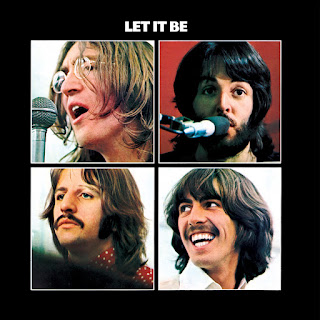
  • Let It Be,” by the Beatles – from the album “Let It Be”
  • L.A. Woman,” by the Doors – from the album “L.A. Woman”
  • Thriller,” by Michael Jackson – from the album “Thriller”
  • Purple Rain,” by Prince – from the album “Purple Rain”

When an album is named the group's name, it is often referred to as self-titled. (That's the #1 above.) The first album by the Doors was called “The Doors,” and the first album by “Weezer” was called “Weezer.” In general, people refer to the albums by those names, or as “self-titled,” or sometimes, “the band's debut album.” Sometimes a band decides to release a self-titled album well into the band's lifespan – and sometimes that album ends up getting a nickname. For example, the Beatles released their fourteenth (or so, in the U.S.) album, named “The Beatles,” in 1968 – but almost nobody calls in “The Beatles.” Instead, people call it “The White Album.”

When an album has a unique name not shared by any of the songs on that album, as in #3 above, we could say that the album has a “lost title track.” We could try to imagine what that song might be...

And that's when the band called “The Title Trackers” gets busy. They take classic albums with no title tracks, and they create their own original songs for that title.

The fun part is, they try to copy the sound of the particular band – and the look, and the feel. And their lyrics can be downright funny, in a loving, honoring-the-original sort of way....but not in a making-fun-of-the-original kind of way. 

At least, that's how The Title Trackers intend their parodies.

And that's how I enjoy them, as well...

Check out “Checking into Morrison Hotel” on the Title Trackers' website!


Also on this date:


Plan ahead:

Check out my Pinterest boards for:
And here are my Pinterest boards for:

May 26 – Independence Day in Georgia and Guyana

Posted on May 26, 2016

Today one of these two nations – Georgia or Guyana – celebrates the 1918 adoption of the Act of Independence in response to the Russian Revolution. And one the other celebrates gaining its independence from Great Britain in 1966.

Do you know which is which?

Guyana is located in South America; it was called British Guiana when it was a colony.


And Georgia had been a part of the Russian Empire for a century, but it broke away after Vladimir Lenin and his Bolshevik party took over Russia. Georgia didn't remain an independent republic for very long, though; about three years after the declaration of independence, this Eastern European nation fell to Soviet armies, and it became a part of the Union of Soviet Socialist Republics. It is now an independent republic again, of course!


Here are some facts. Figure out which of each pair pertains to Georgia, and which to Guyana:

  1. Capital city is Georgetown
  2. Capital city is Tbilisi

  1. Borders on the Black Sea, which connects to the Mediterranean Sea and thus the Atlantic Ocean
  2. Borders on the Atlantic Ocean and is located close to the Caribbean Sea

  1.  Has a red and white flag:


  2. Has a red, green, and yellow flag:

  1. English is the only official language, but most people speak a Creole
  2. The vast majority speaks a language named after the country

  1. With about 80% of the nation covered with forests, it's home to about 8,000 plant species – half of which are found nowhere else in the world!
  2. Home to about 1,000 species of vertebrates, including large carnivores like lynxes, Caucasian leopards, and wolves.

  1.  Sightseeing destinations include Svetitskhoveli Cathedral and Mount Kazbek.


  2. Sightseeing destinations include Kaieteur Falls and St. George's Cathedral.


ANSWERS: Guyana is 1, 4, 6, 7, 9, 12.... Georgia is 2, 3, 5, 8, 10, 11.
  • To learn about Georgia's other “Independence Day,” check out this earlier post


  • And to learn about another patriotic holiday in Guyana, check out this earlier post


Also on this date:


Astronaut Sally Ride's birthday


Plan ahead:

Check out my Pinterest boards for:
And here are my Pinterest boards for:

May 25 – Anniversary of Hands Across America

Posted on May 25, 2016


On this date in 1986, for fifteen minutes, people formed a 4,125-mile-long line that crossed the continental United States. The human chain was created by about 6.5 million people!!

In actual fact, there were many breaks in the chain – wide rivers and high mountains tend to do that to human chains – but the chain linked major cities and then meandered back and forth within the cities, to allow as many people as possible to participate. In some places the line of people was six, seven, even ten people deep! If we could have had hands across all the rugged, high-altitude, or deep-water spots, that many people really could have spanned the U.S., for sure.

The line meandered a bit on large scale (see above)
as well as on a smaller scales (below).

You may ask what good it does to have people hold hands “from sea to shining sea.” Aside from the reality of the cooperation it took to complete the project, there was great symbolism in a human chain of people of all ethnicities, genders, and ages working together to complete the chain.


But the event was also a fundraiser. Donations were collected in each city from many of the participants reserving their places in the line, and those donations were used to help feed, clothe, or house local people in need. In all, Hands Across America raised $34 million.

Some stars were recruited to stand in line. People as varied as actors Edward James Olmos and Brooke Shields to musicians Yoko Ono and Harry Belafonte were on hand in New York City; actor Robin Williams, Mickey Mouse, Goofy, and C-3PO helped finish the chain in Long Beach, California. In between were then-President Ronald Reagan, musician Michael Jackson, magician David Copperfield, Chewbacca the Wookiee, future president Bill Clinton, 50 Abraham Lincoln impersonators, and 54 Elvis Presley impersonators!

And more stars. And of course way, way more “ordinary” extraordinary people.


Also on this date:


Anniversary of John Scopes's indictment


Plan ahead:

Check out my Pinterest boards for:
And here are my Pinterest boards for:

May 24 – Morse Code Day

Posted on May 24, 2016

When we want to honor an inventor like Samuel Morse, or his or her invention, do we honor his birthday? The anniversary of his death? The anniversary of an “ah-ha!” moment, or of the first successful demonstration of the invention, or of the patent?

The truth is, of course, that it depends on the inventor and the invention. In some cases we have little information about exactly when an inventor thought up an idea or tested a new gadget – but we can clearly see the date of the patent. In some cases a group of people invented a device, rather than one person with a definite birthdate, and in other cases multiple people separately invented the same thing.

So when I discovered that there are two different days called “Morse Code Day” – and that neither is the anniversary of the first public demonstration of the telegraph – I got to wondering, “Why that date?” 

One of the two Morse Code Days is April 27, which is the birthday of telegraph inventor Samuel Morse.

The other is today, May 24, which is the anniversary of the first official telegram.

Samuel Morse and his partners, Leonard Gale and Alfred Vail, worked on the prototype telegraph that was demonstrated in 1938. They also had to develop a code that could be used to transmit letters and numbers. Morse studied the use of semaphore flags and optical codes – which assigned 3- or 4-digit numbers to various words – but Vail knew that such a system would be limited in what could be expressed and would be fairly difficult to translate from code to message. It was Vail who put in the effort to study the frequency of use of the 26 letters in the English language. He assigned the shortest dot-dash codes for the letters used most often, and longer codes for the infrequently-used letters.

It was perhaps even harder to convince Congress to fund the construction of the first telegraph line than it was to invent the device and the code! Finally, in 1843, Morse convinced them, thanks to the lobbying of his former classmate and supporter Henry Ellsworth, and a telegraph line was built linking Washington, D.C., to Baltimore, Maryland, a distance of about 40 miles.

In order to reward Ellsworth for his help with the skeptical Congress, Morse decided to allow Ellsworth's daughter to choose what the first official telegram would say. That's how 17-year-old Annie Ellsworth entered the story. She chose a short line from the Bible: “What hath God wrought?”


And it was on this date in 1844 that Morse, seated in the U.S. Capitol, tapped out Annie's message. Vail, sitting in a Baltimore railroad depot, received the message just seconds later. By 1800s standards, that was INSTANT communication!

The telegraph was a success almost instantly, as well. Over the next few years, private companies set up telegraph lines, and within a decade more than 20 thousand miles of telegraph wire had been strung in the U.S. alone. And although Morse had to spend years in court fighting for recognition for his work and royalties for his inventions, he died at age 80 a rich and famous man.

Of course, almost instant coded communication via wire was eventually replaced by non-coded vocal communication via wire (the telephone), and then wireless communication (cell phones). Not to mention faxes and email and text messaging and social media!

Western Union, one of the first and biggest telegraph companies, delivered its last telegram in January of 2006.


Also on this date:


Plan ahead:

Check out my Pinterest boards for:
And here are my Pinterest boards for: