Showing posts with label fruit. Show all posts

April 10 - First Bananas on Sale in England!

  Posted on April 10, 2022

This is an update of my post published on April 10, 2011:


"What's that hanging in Thomas Johnson's shop windows?"

I imagine that's what the people of London were saying on this day in 1633. Somehow historians know the date when bananas first went on sale in England. For most Londoners, it would have been their first chance to even glimpse bananas – and most of them didn't get to taste the exotic fruit. As a matter of fact, it wasn't until the 1800s that bananas were regularly imported by Britain.

Apparently, at least one banana was in England long before the date of their first sale. Archeologists excavating a pit in London have discovered a banana skin dating back to about 1500. It most likely came from West Africa, scholars believe, whereas apparently Thomas Johnson's bananas came from Bermuda. (There doesn't seem to be any details on how Johnson managed to transport them so quickly that they were still fit to display, sell, and eat!)

Bananas originated in Southeast Asia. The original wild banana ancestor didn't look much like modern bananas--humans have used artificial selection for thousands of years to create the delicious fruits we enjoy today.


Above and below, inside two species of wild bananas.
Note that the seeds are WAY more prominent.


Check out...

There are fun banana snacks here, and kid friendly recipes here.

Have you ever had a frozen banana? Yummm....

Someone drew these monkeys on this banana.
One mom swears that her kids love to eat bananas 
that she decorates with Sharpie pens - but she
just draws really simple faces and characters,
compared to this work of art!


Also on this date:


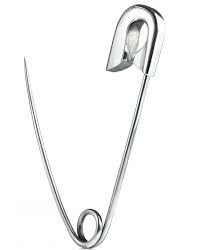
Anniversary of the invention of the safety pin


May 10 - Supreme Court Rules: Tomato is Not a Fruit!

 Posted on May 10, 2021


This is an update of my post published on May 10, 2010:


On this day in 1893, the Supreme Court of the United States ruled in Nix v. Hedden that a tomato is a vegetable, not a fruit.

What? The
 Supreme Court made a ruling about tomatoes???

The Tariff Act of 1883 required that a tariff (tax) had to be paid on imported vegetables, but there was no tariff on imported fruits. Some people claimed that they shouldn't have been charged taxes on their imported tomatoes, pointing out that tomatoes are fruits and therefore should have been tax-free.

However, the Supreme Court unanimously ruled that the Tariff Act used the ordinary meaning of the words fruit and vegetable, and under this ordinary meaning, a tomato is classified as a vegetable.

During the case, both sides brought out dictionaries and read aloud definitions. Apparently everyone agreed then (and still agrees now) that, scientifically speaking, a tomato is definitely a fruit. Fruits develop from the ovaries of flowers and contain the seeds of the plant—and tomatoes fit this description perfectly.


A vegetable is often some other part of a plant, not the fruit or seed. Examples include lettuce (which are leaves), carrots (roots), potatoes (tubers), cauliflower (flowers) and celery (stems or stalks).


But some foods that are botanically classified as fruits—like tomatoes—are still thought of as vegetables. This seems to be primarily based on their use: vegetables are thought of in connection to meals and savory foods rather than desserts and sweet foods.


Spot the V
egetables that are really Fruits:
Here are a b
unch of foods commonly called vegetables. Which ones are botanically classified as fruits?
ONIONS, YAMS, CUCUMBERS, RHUBARB, BEETS, TURNIPS, PEAS, SWEET POTATOES, BEANS, ASPARAGUS, RADISHES, PARSNIPS, CABBAGE, KALE, GARLIC, SQUASH, GREEN PEPPERS, PUMPKINS, ROMAINE, SPINACH, EGGPLANTS, COLLARD GREENS, BROCCOLI.


Answers: cucumbers, peas, beans, squash, green peppers, pumpkins, and eggplants are all fruits. By the way, rhubarb is the stalk of the plant, and is commonly (correctly) called a vegetable but sometimes called a fruit because it is used in sweet, fruity foods.

Grow some tomatoes.


Eat some
 tomatoes.


Cherry tomatoes, grape tomatoes, roma tomatoes, beefsteak tomatoes—yummy tomatoes of all sizes, colors, and kinds.


You can eat them plain or sliced in sandwiches or on top of pizza, wedged in salads, or chopped in salsa or omelets! Try tomatoes in mac'n'cheese!

Learn some b
otany.

Here is a simple activity about the parts of a plant. When you're done, go on to “NEXT” at the bottom for more plant fun. Or start at the beginning of “The Great Plant Escape.”


Dissect some fruits and flowers.

Get some flowers and/or fruits from the garden or grocery store. Carefully cut them apart
 to see the structures and seeds (always make sure an adult supervises or approves).


You might want to try cutting familiar fruits in unfamiliar ways. For example, can you cut an apple in such a way that you see a star? Be sure to eat the fruit!


To help your flower dissections, here is a demo 
on YouTube, and here are detailed instructions on Home Training Tools.


June 26 - National Coconut Day

Posted on June 26, 2020


The palm tree is for some a symbol of the good life, tropical style: Hawaii, Bali, Tahiti, and so much more.


For others it calls to mind Southern California, L.A., Hollywood. 

Actually, palm trees are one of the most useful trees in the world. In tropical areas, it is sometimes called the "tree of life," because it provides fuel, building materials, food, cosmetics, folk medicine, and so much more. 

The tree of life, lit up for December holidays!

 
The fruit of the palm tree is a coconut. It's not actually a nut, botanically speaking; it's a drupe. The two parts used for food are the inner flesh of the mature seed and the liquid coconut milk. Coconut can of course be eaten in raw chunks. But it is commonly processed: flaked and toasted, processed for coconut oil or coconut milk, and so forth.

The hard coconut shell can also be processed to make charcoal, and the fibrous brown part of the coconut, called coir, is used to make mats and brushes and mattresses and more.

Coir from unripe coconuts is useful for other things. It's called white coir, and it is used to make fine brushes (as opposed to bristly ones), string, rope, and fishing nets. Ropes made with white coir don't sink!

But on Coconut Day, I'm thinking food. Mmm...Magic Cookie Bars, Almond Joy candy bars, coconut blondies...


626 Day


(First Friday after Father's Day U.S.A.)


Plan ahead:


Check out my Pinterest boards for:


And here are my Pinterest boards for: