Showing posts with label plants. Show all posts

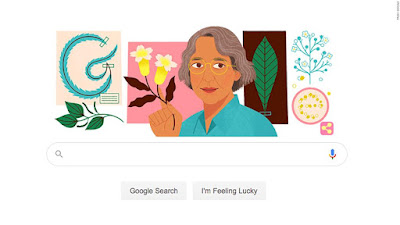
May 24 - Happy Birthday, Ynés Mexía

 Posted on May 24, 2022     


This is an update of my post published on May 24, 2011:


She was a social worker until age 51, when she decided to change her life.

And, boy, did she change it! 

Ynés Mexía became a botanist (a scientist who studies plants) and an explorer who discovered more than 500 species of plants!

It's estimated that she collected more than 137,000 plants in six expeditions over a period of just 13 years!

Ynés Mexía was born in Washington, D.C., on this day in 1870; her parents were Mexican, and her father probably worked for the Mexican embassy in the U.S. capital. She apparently didn't have a lot of formal education until she was 51 and started attending botany classes at the University of California at Berkeley. And the reason for the career change? Mexía discovered her love for plants while hiking with the Sierra Club.

Soon Mexía began to take botanical collecting trips in Mexico, Alaska, Brazil, Ecuador, Colombia, and the American Southwest.


Sadly, Mexía experienced chest pains on a collecting trip in Mexico, and at age 67 she died of lung cancer. Still, she managed to find a passion, make a contribution, and see new sights at a time when some would have said she was “over the hill.”

What will YOU do from age 51 to 67 that will result in you getting a Wikipedia article and Google Doodle?


Plan ahead:


Check out my Pinterest boards for:
And here are my Pinterest boards for:

March 27 - Plant-Cells Day!

 Posted on March 27, 2022

This is an update of my post published on March 27, 2011:


On this day in 1776, Charles-François Brisseau de Mirbel was born in France, and on this same day in 1817, Carl von Nägeli was born in Switzerland.

Above, Mirbel. Below, Nägeli


They both grew up to be scientists who study plants (who are called botanists), and they both added to our knowledge of cell biology (which is called cytology).


Mirbel is actually considered a founder of the study of plant cells. He observed that each plant cell has a continuous membrane. Von Nägeli studied cell division and pollen formation, and he may have been the first to describe chromosomes (which he referred to as “transitory cytoblasts”).

Cell division


By the way, von Nägeli was a bit of a mystic who, some science historians say, did a lot of harm by dismissing Gregor Mendel's work on genetics—even going so far as to discourage Mendel from experimenting further in the area. Not cool, von Nägeli! Not. Cool!


Learn about plant cells!

Plant cells, just like all other cells, have many parts. Check out the cell parts at the Cells Alive website: move the mouse over the interactive diagram to see the various names for cell parts, and click one of the organelles (or its label) to find out more about that part.

Do some puzzles with a cell theme. 

You can make an incredible edible cell with instructions found here. Or an edible cell-in-a-baggie; again, instructions found here.


Find more cell-model websites here.


Plan ahead:


Check out my Pinterest boards for:
And here are my Pinterest boards for:


November 29 - Classified Day

 Posted on November 29, 2021


This is an update of my post published on November 29, 2010:


For centuries people have been naming animals (and plants) and animal groups (and plant groups), making assumptions about which critters are like which other critters, sorting them according to what they look like and how they behave. Scientists call the study of classification of plants, animals, and other organisms taxonomy.


On this day in 1627, English naturalist John Ray was born. He ended up making contributions in classifying flowering plants, and he was the first person to define the word species in a scientific way. (Basically, he said that organisms are of the same species, even if they vary from one another, if they are related through reproduction.)

One of the things Ray believed and practiced was classifying creatures according to actual observations instead of according to pre-conceived groups created by either-or thinking. Instead of diagramming a rigid “tree of life” like this:


Ray allowed for a taxonomy like this:


On this day in 1762, French biologist Pierre Andre Latreille was born. He ended up making the first detailed classification of insects and crustaceans (which are shrimp, lobsters, crabs, and other shellfish).


Latreille may be the only person who saved his own life by discovering a new species. He was imprisoned during the French Revolution, and he was sentenced to death for refusing to pledge his allegiance to the new constitution. However, there in the prison he discovered a beetle that had not been known to science before. Because of this, two fellow naturalists were able to convince Latreille's captors to free him!


Classifying Fun

  • Kid Zone has a nice webpage covering some of the same content. 
  • Scientists classify plants, too. Here is a YouTube video that discusses plant classification.


(Monday after Thanksgiving)


Plan ahead:


Check out my Pinterest boards for:

And here are my Pinterest boards for: