Showing posts with label Torres Strait Islanders. Show all posts

May 31 - National Reconciliation Week in Australia

   Posted on May 31, 2022     


This is an update of my post published on May 31, 2011:


Reconciliation 
means coming together. 

And, in the case of Australia's Reconciliation Week, it means working to overcome divisions and inequality between Aboriginal people and Torres Strait Islanders, on the one hand, and non-Indigenous (largely European-ancestry) Australians, on the other.


Torres Strait Islanders


According to the official websiteNational Reconciliation Week (May 27 to June 3) is "a time for all Australians to learn about our shared histories, cultures, and achievements, and to explore how each of us can contribute to achieving reconciliation in Australia."
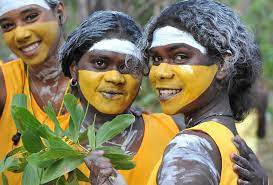

Aboriginal Australians


This year, the theme of Reconciliation Week is "Be Brave. Make Change." It's about helping to "
collectively build relationships and communities that value Aboriginal and Torres Strait Islander peoples, histories, cultures, and futures."

Cooee!

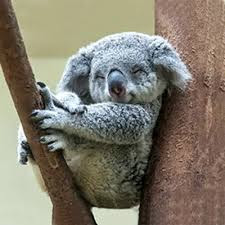
Many Aboriginal words are familiar to English speakers because they have have actually been adopted into the English language. Some of the names for animals are among my favorite words in the world: dingos, kangaroos, potoroos, wombats, wallabies, koalas, and kookaburras.


Boomerangs are weapons (and toys), billabongs are small lakes or waterholes, and yabber means (as it sounds) “to talk.”

Strangely, the word didgeridoo is not an Aboriginal word, even though it names an Aboriginal musical instrument. There are a variety of Aboriginal words for the instrument, including yadaki. The word didgeridoo is of Western origin and could be onomatopoetic—in other words, copying the sound that the didgeridoo makes.

I also thought that bandicoots and emus, Australian animals, got their names from Aboriginal languages, but in actual fact bandicoot comes from Teluga (a language of India), and emu from Arabic. Of course, there are lots of Australian slang words that are not Aboriginal in origin!


Here is a famous Kookaburra song, and here is another famous Australian bush song, "Waltzing Matilda." (Warning: the latter song tells a sad story that can be upsetting to some.)


Learn about Aboriginal art and culture!

Check out last year's post.


Also on this date:


Memorial Day in the U.S.A.


Castille-La Mancha Day in Spain


Plan ahead:


Check out my Pinterest boards for:


May 26 - National Sorry Day in Australia

 Posted on May 26, 2021

This is an update of my post published on May 26, 2010:


This Australian event is held each year to express regret for the historical mistreatment of Australia's indigenous peoples.

On this day in 1997, a report was formally given to the Australian government about the horrible practice of taking children away from indigenous families. (The children who were taken from their families and made wards of the state are now called the Stolen Generations.)


In Australia, there are concerts, barbecues, lunches, teas, and other gatherings, media statements and speeches, flag-raising and candle-lighting ceremonies, reconciliation walks, and so forth. People sign “sorry books” as a way of showing their commitment towards reconciliation, and local indigenous Australian elders are invited to speak to students. There are even essay competitions for school children.

Find out more here.

It's a good day for non-Australians to learn about the indigenous peoples of Australia.

The two main groups of indigenous Australians are Aboriginal peoples and Torres Strait Islanders. (Nowadays the word aboriginals is less common, because each group prefers to be called by its own specific name.)

Above, flag of Torres Strait Islanders.
Below, flag of Aboriginal peoples.


People came to Australia at least 40,000 years ago—perhaps as far back as 125,000 years ago!—and they spread over the mainland, nearby islands, and Tanzania.

There is a mix of languages, cultures, and customs among the indigenous groups, and there was even more diversity before European settlers started coming. (For example, there were between 250 and 300 languages when Europeans first “discovered” Australia. Today there are about 200 of these languages still in use—but all but 20 are classified as “endangered,” because most Aboriginal people use English.)

There are lots of Aboriginal Dreamtime Stories on YouTube. Here is one. And here is a simple explanation of Dreamtime.


The Australian Museum website has a rich and interesting website.

Some groups of indigenous Australians use sticks or echidna quills to paint “dreamtime stories” with traditional symbols such as fish, turtles, crocodiles, snakes, kangaroos, and other creatures. Because of the materials they use to paint, they create pictures with dots.

"Minyma Kutjara," by Janice Woods
Pitjantjatjara, Western Desert


"Tingari," by Thomas Tjapaltjarri
Pintupi, Western Australia


"Minyma Kutjara," by Julie Woods
Pitjantjatjara, Western Desert


"Sandhills and River Bed Country," by Delvine Petyarre

Country at Atneltyeye, Utopia Homelands, Central Australia


According to Wikimedia, an unnamed Aboriginal artist
turned over rights to this piece to the public.

Are you inspired to create some dot pictures? You can 
use the brush part of a paintbrush for large areas, and the wooden tip of the “wrong” side of the brush for the dots. Or use Q-tips dipped in paint.

I have always found it difficult to paint smooth river rocks with long brush strokes, but it's fairly easy to decorate rocks with dots of paint! I love painting black river rocks with white or light-colored paints!


Note: It is disrespectful to copy the specific symbols, patterns, and forms used by Aboriginal artists, because they have importance and even spiritual meaning within their various cultures. Anyone not in that culture who copies specific elements of their art would not understand those meanings, so it is a kind of sacrilege. Also, of course, copying art is a kind of theft.

Instead of copying, be inspired by Aboriginal artists to tell your own stories using dots to create forms and symbols that are important to you!

Of course, we can also appreciate the beautiful pieces made by Aboriginal artists! Appreciate - don't appropriate. Be inspired - don't copy. 

One last website--another wonderful source for dot painting!

"Bush Fire Dreaming," by Petra Nampitinpa
Walpiri Tribe, Northern Territory


Also on this date:


Astronaut Sally Ride's birthday


Vesak in India and Indonesia
(Dates vary)


World Orienteering Day

(Fourth Wednesday of May)


Plan ahead:


Check out my Pinterest boards for:
And here are my Pinterest boards for: