Showing posts with label Bolivia. Show all posts

August 6 - Independence Day in both Bolivia AND Jamaica

 Posted on August 6, 2022       

This is an update of my post published on August 6, 2011:


Bolivia is a landlocked nation in South America—in other words, it has no coast on any ocean or sea.
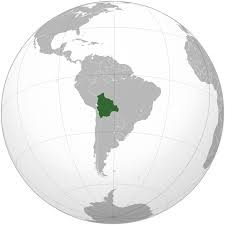
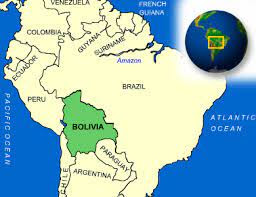


Jamaica, in contrast, is an island nation in the Caribbean Sea. It borders on nothing but ocean!


These two very different nations both celebrate independence today. Bolivia won its independence from Spain on this day in 1825, after 16 years of struggle and war, and was named after one of the military heroes of that fight, Simón Bolívar. 

Jamaica celebrates its independence from the United Kingdom in 1962, although the nation maintains part of the Commonwealth and thus has U.K. Queen Elizabeth II as its ceremonial head of state.

Bolivia has 37 official languages! — Spanish, Quechua, Aymara, and 34 other native languages. More than half of Bolivians are Amerindians (native South Americans) of various background (including Quechua and Aymara), quite different from the ethnic heritage of all other South American nations, which are heavily European/white or mestizo (mixed Amerindian and European).


Jamaica, on the other hand, has only one official language—English—and has a population that is largely of African descent.

Jamaica's Bob Marley and
reggae music are famous worldwide. 


One of the most interesting things about Bolivia, other than its rich mix of Amerindian cultures, is the range of amazing landscapes. There are high Andes mountain-scapes and weird salt-plane- scapes, for example.


Jamaica is beautiful, too, of course!


One interesting thing about Jamaica is that it hosted a bobsled team, even though Jamaica is a tropical island without snowy mountains on which to practice such a sport. The bobsled team competed in the 1988 Winter Olympic Games in Calgary, Canada, and they quickly became crowd favorites as underdogs. Bobsledders from other countries loaned them spare sleds and offered them guidance and support. The Jamaican bobsled team didn't officially finish (let alone win), because they lost control and crashed during one of their four runs. However, they did improve, and they were very fast starters. After crashing, the four bobsledders got out of their sled and walked with it to the finish line. The crowd went wild.

At the 1994 Olympics, the Jamaican bobsled team finished ahead of many other countries, including the U.S., and in 2000 they won the gold medal at the World Push Championships in Monaco.

The Disney movie Cool Runnings is loosely based on the Jamaican bobsled team!


(First Saturday in August)


(First full weekend in August)


February 10 - Carnival de Oruro in Bolivia

Posted on February 10, 2021

This is an update of my post published on February 10, 2010:
(Date varies)

A mixture of ancient Andean customs and Catholic rituals, the Carnival de Oruro is the biggest cultural event in Bolivia's year. The festival begins with a ceremony dedicated to the Virgin of the Mineshaft; next, there is a marching band competition. The highlight is a huge parade: over 28,000 dancers and 10,000 musicians take part in a procession that lasts more than 20 hours. Last, there are two plays, one about the Spanish conquest and the other about the classic battle of good versus evil.

Find out more here.

Did you know...?

  • Bolivia is a landlocked nation in South America. That means that no part of the country touches a sea coast.

  • Ecuador has two flags. One is a rectangle with three stripes and was adopted in 1851. Some sources indicate that the red stripe stands for Bolivia's soldiers, the green stripe represents fertility, and the yellow stripes symbolizes mineral deposits. The second flag is the Wiphala, a square banner with rainbow-colored squares.


There is evidence that, before the Incan Empire was conquered by Spanish invaders, its four regions were represented by colorful square banners called Wiphala. Each region had a slightly different color pattern, and the banner of Cuzco had a pattern of stripes arranged in rainbow colors rather than diagonally-arranged squares.
The Wiphala have come to represent pride in indigenous (native people's) culture and history.
One of Bolivia's lakes, Titicaca, is the
largest lake in South America.


Explore Bolivia and its people


This Bolivia Bella website is great. Scroll down to see the large “BOLIVIA for Kids” banners on such things as flags, history, maps, holidays, food, and so forth.

National Geographic Kids has a page about Bolivia, including a slide show!


Bolivia also has a really large salt flat. 

Salar de Uyuni isn't just the largest salt

 flat in South America - it's the largest in the world!


Find Bolivia


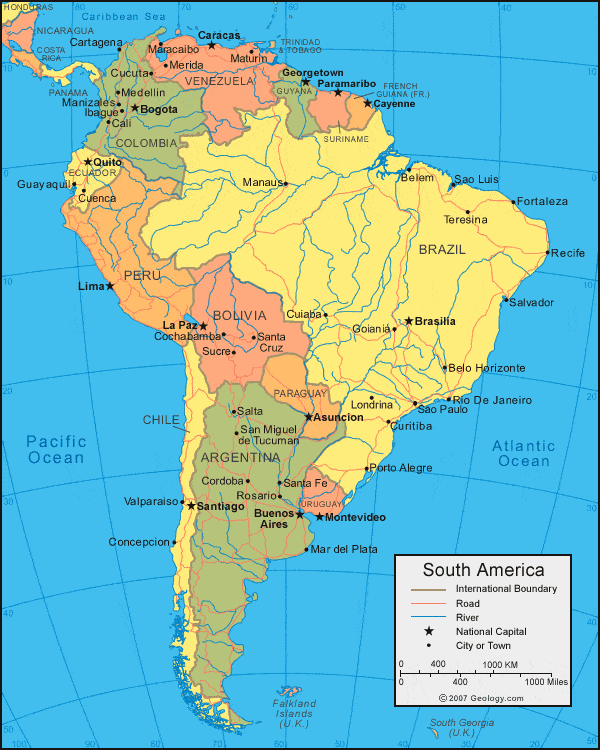
Bolivia and its neighbor Paraguay are both landlocked nations in the continent of South America. Find them on a map, and label them on this blank map from Enchanted Learning.


September 24 – Festival Time!


Posted on September 24, 2020

The nation of Bolivia is divided into nine "departments," which are political units that roughly equal the word "states" in the United States. (Actually, the word "state" means "nation" or "country" as well as - in some places - a smaller political unit inside a country. So confusing!)

Two of these departments are Pando and Santa Cruz. Both of these departments hold their local festivals on September 24.


Let's compare these two departments:

Santa Cruz is much larger; it's around 370 thousand square kilometers (143 thousand square miles), which is close to the size of Montana in the U.S. Pando is less than a fifth of the size, with only around 64 thousand square kilometers (25 thousand square miles); it's closer in size to West Virginia.

There is even more difference between Pando and Santa Cruz when it comes to population. Santa Cruz has more than 3 million inhabitants and is about 23 people per square mile, and Pando has just 110 thousand inhabitants! That's only 4 or 5 people per square mile! 

Words used to describe Pando explain why it is so under-populated: Wikipedia 
describes Pando as "backwards and remote" and "densely forested." As a landlocked nation, Bolivia counts on rivers that run to the sea and that can be navigated by boat, and Pando has navigable rivers that join up with the mighty Amazon and eventually reach the Atlantic Ocean. Back in the Pando's heyday, rubber trees were harvested and carried off to markets on those rivers.


Santa Cruz is about a third of Bolivia, and it is the richest part of the nation as well. There are huge natural gas reserves and the world's second largest iron ore reserve, and agriculture is very important. But much of the territory is covered with rainforests, so hopefully getting the gas, iron, and farm products isn't TOO disruptive of them! I can imagine that discovery of new pharmaceuticals (medicines) could be a growth industry one day?

Apparently, there are some very nice hotels and tourist destinations in the department of Santa Cruz: