Showing posts with label meteorites. Show all posts

April 26 - Thousands of Meteorites Fell - But No One Was Hurt!

   Posted on April 26, 2022

This is an update of my post published on April 26, 2011:


Some people worry that, since rocks sometimes fall from the skies, somebody might get conked in the head and die. That is not at all likely—as this story from 1803 makes non-painfully obvious:

On this day a couple of centuries ago, thousands of meteorites peppered the French town of L'Aigle. The meteorites ranged from one quarter ounce to 20 pounds—ouch!—but not one of them hurt anybody!

One fragment might have hit someone—but didn't hurt him. A wirepuller named M. Piche reported that he was hit on the arm by a small stone. He picked it up, curious, but immediately dropped it again because it was very hot.
There was also, reportedly, a close call: a stone fell on the pavement of the churchyard of St. Michel. It ricocheted off the pavement, bouncing upwards about a foot before coming to rest—right at the feet of the chaplain!

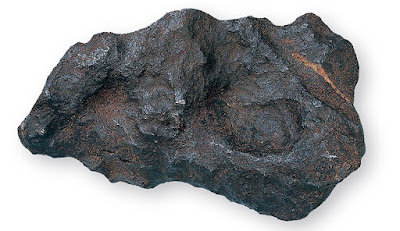
This 1803 event is an example of a meteoroid breaking apart as it sped through the Earth's atmosphere, so the 2,700 to 3,000 bits that landed could be said to be “meteorite fragments” rather than separate meteorites.

A new science is born!

This event marked a turning point in understanding meteorites. In the 1700s it seemed fantastic, perhaps impossible, that a rock should fall from outer space. When people reported seeing a bright flash and then a stone falling out of the sky, and then the stone recovered, these events were investigated; each time scientists determined that a more reasonable explanation for the light and stone existed. A lightning strike on a larger rock was blamed, in one instance, and a volcanic eruption was blamed in another.


The reports about thousands of stones falling on L'Aigle prompted the French Academy of Sciences to send Jean-Baptise Biot to check out the event. Biot studied the rocks and their location, and interviewed people in the town and nearby villages about the fireball they saw in the afternoon sky—and he came to the conclusion that the stones were of extraterrestrial origin—in other words, from space.

Other scientists, too, were able to study the rocks and Biot's data—he made the world's first “strewn field map”...


...and comparisons were made between these stones and others that had been seen falling from the sky. Soon consensus was reached in the scientific community: rocks could and did fall to the Earth from space. The science of meteorites began...

By the way...

Some people might read this story and think, wow, here's a great example of science getting things wrong for years! Those stuffy scientists with all their doubt about what people saw—they were Wrong! They said rocks couldn't fall from outer space—and they were WRONG!

Some people might even nod their heads and think, “See, anything's possible!”

But really this is a story of why science is so good at getting things right... A skeptical attitude that looks for multiple reasonable causes or known mechanisms for an unexplained phenomenon is a very good thing. Notice that, once evidence accumulated that shifted the probability to stones actually falling from space, scientists accepted that as the explanation. Scientists were then able to go back to old findings and reinterpret data, and of course modified their theories as new meteorite events occurred. 

Skepticism + openness to new ideas + ACTUAL EVIDENCE = reason + science.

And another “by the way”...


Apparently there are some stories about stones falling from the sky and hitting or even killing people, but there are very few confirmed claims. In 1954 a meteorite crashed through the roof of a home in Alabama, crashed into a radio, and bounced onto a woman named Ann Hodges. She was bruised but not badly injured. Also, a boy in Uganda claimed that a small stony meteorite fell onto his head. He was standing under banana trees, and the meteorite reportedly fell through numerous banana leaves before striking him on the head. As the stone was tiny and had hit so many leaves on its way, the boy felt no pain from the strike.


Plan ahead:


Check out my Pinterest boards for:

And here are my Pinterest boards for:


August 6 - Life on Mars?????!?!!!

Posted on August 6, 2020

Meteorites are found all the time - especially in Antarctica, where the dark space stones show up well on the ice!


Scientists think that some meteorites found on the Earth originated on Mars. These meteorites are made up of elements in the same mix as rocks and air on Mars. 


You may wonder, okay, but how do rocks on Mars travel to Earth?

Most meteorites are created when something in space impacts another something - for example, when two asteroids collide, or when an asteroid hits a moon or planet - and those impacts spray rocks in all directions - some towards Earth's orbit. So it makes sense that some meteorites found on Earth are from Mars!

Okay, so we find meteorites often, and meteorites that originated on Mars sometimes...

But what about a meteorite - found on Earth - that has evidence of ancient life on Mars?

On this date in 1996, a group of scientists announced that they had found evidence for ancient microscopic life inside a Mars-originating meteorite!

Wow! That would be an absolute first - first evidence of actual life on another planet or another anything-other-than Earth.

BUT, alas, the electron microscopic photos that seemed to show fossilized bacteria could be explained in less dramatic ways. For example, the wormlike structures could just be uneven patches in the coating used to study samples with electron microscopes!


It's not certain that the meteorite (ALH 84001) does NOT have microfossils, but it's also not certain that it does. Science inches forward by testing and retesting hypotheses - which are educated guesses of how things work - and by replicating earlier work. Some scientists who work with meteorites, with Martian rocks still on Mars, and with astrobiology are trying to look for evidence of ancient Martian life, trust me! 

So even though science-in-general finds the claim about ALH 84001 premature, it's not ridiculous and might - unlikely, but might - prove to be true.


October 27 – Meteor!

Posted October 27, 2018

A lot of debris from space falls onto the Earth.

And when I say "debris," I MOSTLY do not mean human trash / junk. Space junk like lost equipment, dead satellites, and upper stage boosters is definitely a concern, but most of it is circling the Earth; stuff that gets bumped out of orbit and falls on us often burns up in the atmosphere. Of course, some larger pieces do survive the friction of plunging through our protective layer of air, and NASA claims that an average of one catalogued piece of debris falls somewhere on Earth each day - and has for 50 years now!


But....so far there has been zero big-time problems for people down on Earth from the human-made debris. No significant property damage, no deaths or injuries.

But in space, there is a lot of debris that humans didn't make. I'm talking about all the dust, bits of rock, pebbles, larger chunks of rock and ice, and even boulders or small planetoids. All of this debris is either stuff left over from when the solar system formed or stuff created when comets break up or when rocky or icy bodies collide in space. 


And any of that dust-to-boulder-or-larger stuff that happens to hit the Earth becomes a meteor (a "shooting star") in our skies - lovely streaks of light that are exciting to see.

Rarely does a meteor make it all the way to the Earth's surface, but the larger bits that do are called meteorites. There are meteorites that are mostly made of iron, some that are mostly made of stone, and some that are a mix of stone and iron.


Now - how many meteors and meteorites fall on the Earth? An astounding 37,000 to 78,000 TONS of space debris rains down on Earth EVERY YEAR!

Most of that would come from dust-sized particles that of course burn up in the atmosphere. Phew!

Still, thousands of teeny bits of space rock make it all the way to the Earth's surface every year. Of course, most of them fall into the ocean (which makes up about 70% of the Earth's surface), and a lot of them fall onto empty sweeps of land like Antarctica, Siberia, the Sahara Desert, the forests of Canada and Africa and South America, and so on... 

Most of the Earth is ocean.
Above, the Pacific Ocean as viewed from space.
Below, even the land portions of the Earth are
only partially inhabited.


On this date in 1973, a 3-pound (1.4 kg) meteorite struck the ground in a city - in Cañon City, Colorado, to be specific - a very rare event. It landed on a garage, tearing a 6-inch hole in the garage roof, and leaving a 2-inch gash in the cement floor.


Notice that it didn't hit a car, or a pet, or a person.

In all of history, apparently, only 35 meteorites have ever hit a human-made structure in the United States. And only one person has ever been hit by a meteorite (at least that we know about): a 34-year-old woman napping in her home in Alabama was struck by a nine-pound meteorite. It gave her a big bruise but that was it! Wow!

This "only one person" I'm talking about is the only person known to have been hit by a meteorite anywhere in the world, throughout all of recorded history. (A man in India who was reported to have died in 2016 from an impact of what many presumed was a meteorite was apparently the victim of some sort of land-based explosion.)

However, being hit by a meteorite isn't the only thing to worry about. A really large meteorite can explode in the atmosphere and create a shock wave. In 2013 a 12-ton meteor entered the Earth's atmosphere and broke apart some 20 miles (30 km) above the Russian city of Chelyabinsk. About 1,000 to 1,200 people were injured in that extremely rare incident - but most of the injuries were cuts from glass broken by the shock wave.

I couldn't find any evidence that bits of the meteorite itself struck anyone. I read that 75% of the meteorite evaporated, but 9,000 to 13,000 pounds of meteorite (in varying sizes of chunks) fell onto Earth. The largest fragment was 1,400 pounds, and it broke through ice that was more than two feet thick to fall into a lake, leaving a 23-foot-wide hole in the ice!


But apparently no pets or people were struck by meteorite pieces - and nobody died from their shock-wave injuries. Phew!