Showing posts with label Morse Code. Show all posts

July 12 – Night of Nights

Posted on July 12, 2017

On this date in 1999, at 5:00 p.m., the last commercial radio transmission in Morse Code was made.


Or...actually, it was supposed to have been the last. But the men and women who worked in maritime radio felt sad when silence fell on the bands on which there used to be so many radiograms, and the occasional call for help.

And they made a plan to commemorate that last transmission - in a way that would make it, not the last, but lasting!

The first Night of Nights was celebrated on July 12, 2000, and that night and every July 12th after radio station KPH begins to transmit in Morse Code at 5:01 p.m. and continues to do so until midnight.


Some people sit at the receiving station, hearing the short and long beeps and watching as it is translated by skilled radiotelegraphers into weather forecasts, traffic lists, press releases, and special commemorative messages. 

Other people participate by making calls from ships on the sea, just like old times. 

It may not sound really impressive or exciting - Morse Code is like a super low-res pong game in the age of sophisticated multi-user video games! But for lots of people, keeping the knowledge of maritime radio and honoring the memory of those who served in that arena are both important reasons to keep up Night of Nights year after year.


Also on this date:


Independence Day in Sao Tome and Principe


Plan ahead:


Check out my Pinterest boards for:
And here are my Pinterest boards for:

May 24 – Morse Code Day

Posted on May 24, 2016

When we want to honor an inventor like Samuel Morse, or his or her invention, do we honor his birthday? The anniversary of his death? The anniversary of an “ah-ha!” moment, or of the first successful demonstration of the invention, or of the patent?

The truth is, of course, that it depends on the inventor and the invention. In some cases we have little information about exactly when an inventor thought up an idea or tested a new gadget – but we can clearly see the date of the patent. In some cases a group of people invented a device, rather than one person with a definite birthdate, and in other cases multiple people separately invented the same thing.

So when I discovered that there are two different days called “Morse Code Day” – and that neither is the anniversary of the first public demonstration of the telegraph – I got to wondering, “Why that date?” 

One of the two Morse Code Days is April 27, which is the birthday of telegraph inventor Samuel Morse.

The other is today, May 24, which is the anniversary of the first official telegram.

Samuel Morse and his partners, Leonard Gale and Alfred Vail, worked on the prototype telegraph that was demonstrated in 1938. They also had to develop a code that could be used to transmit letters and numbers. Morse studied the use of semaphore flags and optical codes – which assigned 3- or 4-digit numbers to various words – but Vail knew that such a system would be limited in what could be expressed and would be fairly difficult to translate from code to message. It was Vail who put in the effort to study the frequency of use of the 26 letters in the English language. He assigned the shortest dot-dash codes for the letters used most often, and longer codes for the infrequently-used letters.

It was perhaps even harder to convince Congress to fund the construction of the first telegraph line than it was to invent the device and the code! Finally, in 1843, Morse convinced them, thanks to the lobbying of his former classmate and supporter Henry Ellsworth, and a telegraph line was built linking Washington, D.C., to Baltimore, Maryland, a distance of about 40 miles.

In order to reward Ellsworth for his help with the skeptical Congress, Morse decided to allow Ellsworth's daughter to choose what the first official telegram would say. That's how 17-year-old Annie Ellsworth entered the story. She chose a short line from the Bible: “What hath God wrought?”


And it was on this date in 1844 that Morse, seated in the U.S. Capitol, tapped out Annie's message. Vail, sitting in a Baltimore railroad depot, received the message just seconds later. By 1800s standards, that was INSTANT communication!

The telegraph was a success almost instantly, as well. Over the next few years, private companies set up telegraph lines, and within a decade more than 20 thousand miles of telegraph wire had been strung in the U.S. alone. And although Morse had to spend years in court fighting for recognition for his work and royalties for his inventions, he died at age 80 a rich and famous man.

Of course, almost instant coded communication via wire was eventually replaced by non-coded vocal communication via wire (the telephone), and then wireless communication (cell phones). Not to mention faxes and email and text messaging and social media!

Western Union, one of the first and biggest telegraph companies, delivered its last telegram in January of 2006.


Also on this date:


Plan ahead:

Check out my Pinterest boards for:
And here are my Pinterest boards for:

January 11 – Learn Your Name in Morse Code Day

Posted on January 11, 2015

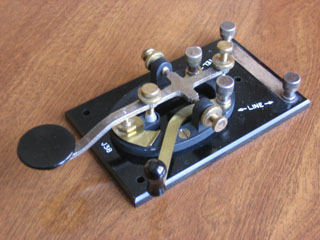
Back in the day, before there was the internet, before there was the telephone even, there was the telegraph. People were able to communicate over long distances, quickly, using electrical signals. But that meant that every number and letter had to be encoded as long-and-short electrical signals. The code developed by Samuel Morse and Alfred Vail is now called the Morse Code:

The Morse Code Alphabet
A  .-
B  -...
C  -.-.
D  -..
E  .
F  ..-.
G  --.
H  ....
I  ..
J  .---
K  -.-
L  .-..
M  --
N  -.
O  ---
P  .--.
Q  --.-
R  .-.
S  ...
T  -
U  ..-
V  ...-
W  .--
X  -..-
Y  -.--
Z  --..
0  -----
1  .----
2  ..---
3  ...--
4  ....-
5  .....
6  -....
7  --...
8  ---..
9  ----.
Fullstop  .-.-.-
Comma  --..--
Query  ..--..


We commonly call the long-and-short signals “dashes” and “dots” or “dahs” and “dits.”

The electrical telegraph signals were carried from place to place along a wire, and some people became professionals skilled at sending and interpreting telegraph signals.

These days, Morse Code is used mostly by amateur radio operators, but pilots and air traffic controllers often learn it as well.

Today has been set aside to encourage people to learn their name (at least) in Morse Code. If you want to hear what your name sounds like in dits and dahs, check out his translator.


Also on this date:


Plan ahead:

Check out my Pinterest pages on:
And here are my Pinterest boards for:

January 6, 2012 - Communications Inventions Day


First patent for a typewriter (on this date in 1714)

An Englishman named Henry Mill submitted a vague description of "an artificial machine or method for the impressing or transcribing of letters singly or progressively one after another." But there is no evidence that he had a working model of a typewriter, nor that he further developed his idea.

First public demonstration of the telegraph (on this date in 1838)

American painter Samuel Morse was heartbroken when his wife got ill and died while he was far away painting someone's portrait. He realized that he could at least have seen her and said goodbye if only there were a rapid form of long-distance communication – and he stopped painting in order to invent a device to do just that.

First telephone call from a submerged submarine (on this date in 1898)

When I think “submarine,” I think “ocean,” but this first phone call from a sub came from a guy named “Lake” (Simon Lake, to be exact) from the bottom of a river!

Learn....
  • Ramp up your typing skills with a free online typing course such as this one or this other one. 
  • Have you ever wanted to learn Morse Code? There's a website for that! 
  • Do you know how submarines submerge or rise? Find out in this very short video. 


Also on this date: