Showing posts with label philosophy. Show all posts

May 18 - Happy Birthday, Bertrand Russell

      Posted on May 18, 2022

This is an update of my post published on May 18, 2011:


This guy was really, really smart!

Bertrand Russell, who was born in Wales (Great Britain) on this date in 1872, became a philosopher, mathematician, logician, and historian, and he used logic and reason to discuss social problems, war, religion, and nuclear disarmament. 

He was a clear thinker and a clear writer, two of my favorite qualities in an intellectual.

He was awarded a Nobel Prize in Literature in 1950.


Being open...

One thing I like about Bertrand Russell is that he was capable of changing his mind. Although many times his first opinion on a topic remained intact all his life (for example, his support of women's rights and suffrage), in other cases he supported ideas or causes that he later modified or even reversed. For example, his first response to the Russian Revolution was hope that Communism would be a wonderful system for equality and liberty. However, he took the time to check out the results, rather than just speculate from afar; he went to the Soviet Union and met with Vladimir Lenin in 1920. He was unimpressed with what he saw, and he wrote critically of Lenin's Communism. Later, he was even more strongly critical of Stalin's regime.


In other words, he sought evidence about something he had supported, and when the evidence warranted a change in opinion, he quickly and publicly changed.

Russell didn't change his mind whimsically; he didn't just follow fads. He warned people who made extraordinary claims, especially those who made claims that couldn't be disproved, that the onus was on them to offer positive evidence for their idea.

After all, Russell pointed out, nobody could prove that a teapot wasn't in outer space, somewhere, flying in a faraway orbit around the sun—but despite the fact that people can't disprove the idea, it's certainly reasonable for them to NOT believe such a claim!
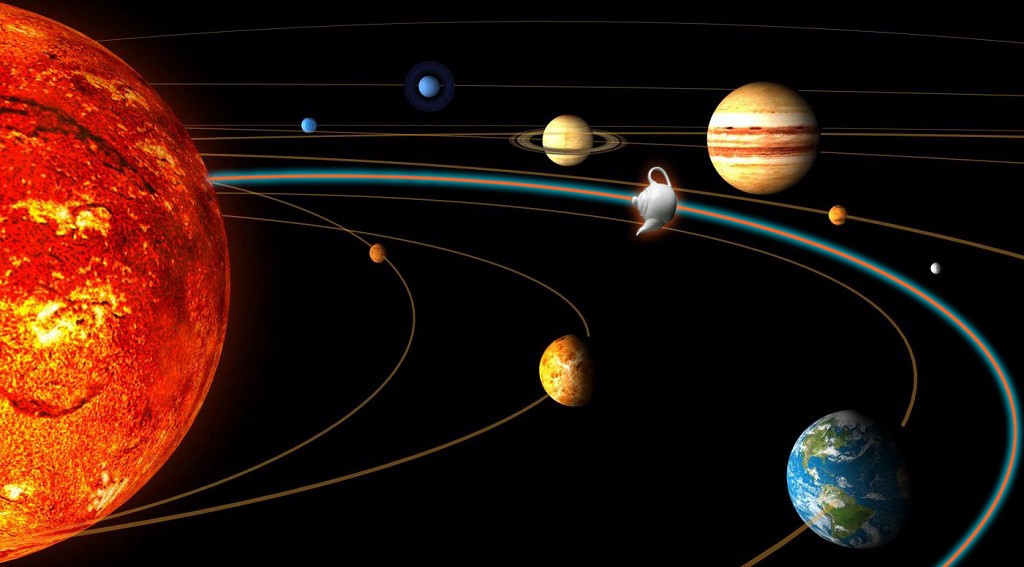

It's almost impossible to DISprove some ideas -
like the idea that there is an ordinary teapot
circling the Sun. But we should be very careful
about ideas that aren't falsifiable - and we should
require positive evidence to support them! 

In other words, Russell kept an open mind, but he didn't leave his mind so far open that his brains fell out!


Open-mindedness is a virtue.
Skepticism is ALSO a virtue.
The thing to do is to use your 
skepticism to prompt you to seek
evidence from good sources,
and to confirm the evidence 
from multiple sources -
and then be open-minded enough
to adopt a new idea that has a ton
of supporting evidence!


September 28 - Confucius's Birthday

 Posted on September 28, 2021


This post is an updated version of my post published on September 28, 2010:


The traditional date given for Confucius's birthday is September 28, 551 BC (BCE). This great Chinese philosopher's birthday is celebrated in Taiwan as Teachers' Day, because Confucius was a master educator; on this day many Taiwanese students bring their teachers flowers, cards, or small gifts.


Confucius was brought up in poverty by his hard-working mother after his warrior father died, but he ended up being one of the most influential thinkers and philosophers in the world.


Confucius encouraged his disciples (students or followers) to think deeply for themselves rather than just follow rules. He believed in the perfectibility of individuals and society.


Confucius taught one of the earliest known versions of what is known as the Golden Rule (long before Jesus lived and taught). Confucius's version is sometimes called the Silver Rule:


Never impose on others what you would not choose for yourself.


In other words, “Don't do to others what you do not want done to yourself.”


Confucius taught a lot of philosophy—not just on matters of ethics, but also on politics and social organization.


Some people treat Confucianism as a religion, but others argue it is more of a life philosophy that can be combined with any or no religious tradition.


Learn more about Confucius!


Check out Kids Philosophy Slam.  It includes some great quotes, discussion questions, and further links.


May 25 - Happy Birthday, Ralph Waldo Emerson

 Posted on May 25, 2021

This is an update of my post published on May 25, 2010:


Born on this day in 1803, in Boston, Massachusetts, Emerson grew up to be one of America's most important writers and philosophers. His friends included writer / philosopher Henry David Thoreau, Bronson Alcott (father of Little Women author Louisa May Alcott), and Nathaniel Hawthorne (author of The Scarlet Letter).

Emerson is associated with the Transcendentalist movement within philosophy, and he promoted the idea of individualism—that is, the importance of independence and self-reliance rather than group-think.


Here are some quotes from Emerson:

      “Children are all foreigners.”
“A friend is one before whom I may think aloud.”

“A hero is no braver than an ordinary man, but he is braver five minutes longer.”

“Do not go where the path may lead, go instead where there is no path and leave a trail.”


Dive into Philosophy

I found an interesting website about teaching kids philosophy: A philosophy professor of Mount Holyoke College in South Hadley, Massachusetts, Thomas Wartenberg, created the website with 
discussion questions on philosophical topics raised by children's books, including short picture books. Called “book modules,” these could be a great resource for talking about important ideas.


Another website devoted to kids and philosophy is Red T Media. There are books and discussions about wondering, and Big Ideas, and wondering about Big Ideas.


Appreciate Nature

Emerson seemed to think that there was a lot of wisdom to be found in nature. Here are some quotes:

“Adopt the pace of nature: her secret is patience.”

“The sky is the daily bread of the eyes.”

“Earth laughs in flowers....”
Go outside today and soak up a little bit of wisdom, laughter, and nature.


Emerson: Master of the Chiasmus

I'm sure you're asking, what in the world is chiasmus?

It's a figure of speech in which there are two phrases, and the words in the first phrase are just turned the other way around in the second phrase. Here are some examples that were NOT written by Emerson:
Eat to live, don't live to eat. (Ben Franklin)

Why do we drive on a parkway and park on a driveway? (from George Carlin)
You don t have to be great to start, but you have to start to be great. (Zig Ziglar)

Here are some examples of chiasmus written by Emerson:

"The true philosopher and the true poet are one,
and a beauty, which is truth,
and a truth, which is beauty,
is the aim of both."

"If a man owns land,
the land owns him."

"Words are also actions,
and actions are a kind of words."

Can you write or find some other examples of chiasmus?


(Varying dates)


Plan ahead:


Check out my Pinterest boards for:
And here are my Pinterest boards for: