Showing posts with label Scotland. Show all posts

April 6 - National Tartan Day in the U.S.A.

 Posted on April 6, 2022

This is an update of my post published on April 6, 2011:


Today is a day to honor your Scottish ancestors—if you've got 'em!

Why April 6? The date goes back a loooong time, to April 6, 1320, when the “Scottish Declaration of Independence” was signed by Scottish nobility in Arbroath Abbey.


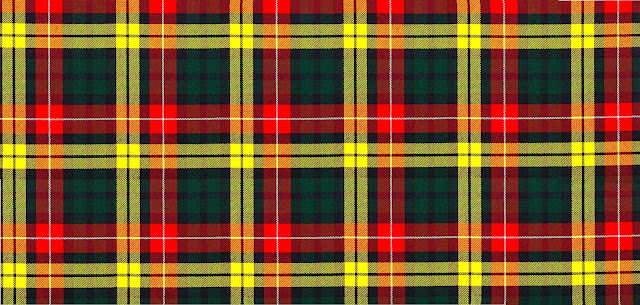
Why “tartan”? Tartan is a plaid pattern of criss-crossing horizontal and vertical stripes in various colors. Scottish kilts almost always have a tartan pattern. The pattern is not called “plaid” in Scotland; a plaid is a tartan cloth worn slung over the shoulder, or a tartan blanket. 

Different tartan patterns, with distinctive colors, used to be associated with the region of Scotland in which it was made, but since the mid-1800s, the different tartans came to be associated with different clans (families).


Wallace


Buchanan


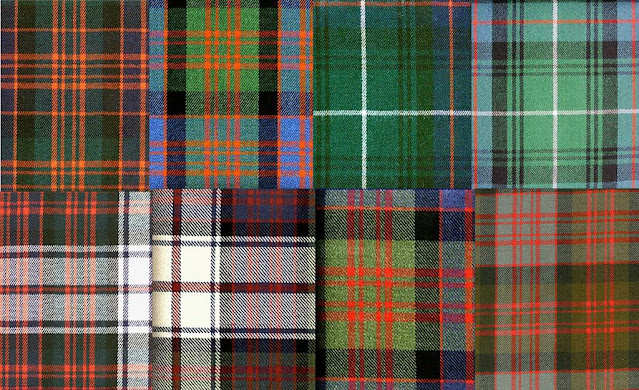
There are a variety of tartans associated with some families.
Here are 8 different tartans for the MacDonalds!

Find out more about Tartan Day here.

Try making your own tartan.

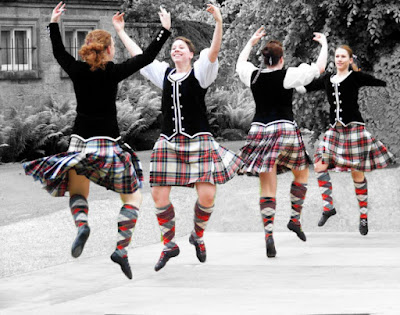
Some celebrations of Tartan Day might include playing bagpipes, doing Scottish dances, holding parades, or putting on Scottish games. Have fun!


February 20 - Norwegian Islands...Pawned???

  Posted on February 20, 2022


This is an update of my post published on February 20, 2011:


Have you ever heard of a pawn shop? That's a place where a person can borrow money, leaving something valuable as collateral. When the person repays the loan, he or she gets that valuable item back--but, after an established period of time, if the person does not pay back the loan, the pawnbroker owns the item and can sell it for a profit.


A pawn shop local to me. The things for sale are items that
the owners couldn't buy back in time!

Now, how does someone drag something as large as an inhabited island into a pawn shop?

Of course, that's ridiculous! However, King Christian I of Denmark and Norway was a bit broke when his daughter married King James III of Scotland. The practice in those days was for parents of a bride to pay a dowry to the groom, and Margaret's dowry was set at 60,000 florins of the Rhine--which was a lot of money. Christian I didn't have that much cash laying about—so he paid 2,000 florins and then pledged ownership of Orkney and Shetland Islands to Scotland until he could pay off the remainder.


Christian I of Denmark and Norway, above


Above, you can see that the Orkney Islands are really close to Scotland
(which is the northern part of the main British Island, marked by the city
of Roxburgh). They are pretty far from Denmark (the unmarked peninsula
at the far right of the map) and Norway (the nation marked with the cities
Bergen and Oslo). The Shetland Islands are closer to the midpoint
between Britain and Norway.

Below, you can see the shape and number of the Orkney and
Shetland Islands. The gray part is Scotland alone, without
England and Wales.


It seems that the king didn't check with the inhabitants of the island; nor did he get the advice of the Council of the Realm—he just pawned the islands. He was smart enough to include a clause in the contract that he or future kings of Norway could redeem the islands for a fixed sum of 210 kg of gold or 2,310 kg of silver. (However, during the 1800s and 1900s, Norwegian leaders made several attempts to redeem the debt and reclaim the islands—and Scotland refused.)

And so it was that, in 1469, James III of Scotland married Margaret of Denmark.


And, on this date in 1472, Scotland peacefully annexed the Orkney and Shetland Islands. And they remain Scottish / British / part of the United Kingdom to this day!

Check out the Orkney Islands in this video.


The five photos above show the Orkney Islands.

Here is a video of the Shetland Islands.


The five photos above show the Shetland Islands.


May 2 - Happy Birthday to the (Modern) Legend of the Loch Ness Monster

 Posted on May 2, 2021


This is an update of my post published on May 2, 2010:


This isn't the Loch Ness Monster's birthday, because the monster almost certainly doesn't exist! And it's not the anniversary of the first story about the mysterious creature, because those stories have been around a loooooooong time—there is a story about a water beast in the River Ness about 1,500 years ago! 

(This story involved a miracle: a saint commanded the beast to halt as it began to attack a man...and the beast obeyed. Notice that this story was about a river creature, not a lake creature, and that it is an awful lot like other miracle stories common at the time.)

It is the modern-day “Nessie” story that started on this date in 1933, when a Scottish journalist reported that a local couple claimed to have seen a huge animal rolling and plunging on the surface of the Scottish lake. (Loch means lake, by the way.)


The local newspaper ran the story, not of the sighting of a huge animal, but of the sighting of a huge monster
A few months later, a London couple reported a similar sighting. They described the creature as being like a dragon or a pre-historic animal. Once again, the local newspaper printed their report, and soon more and more sightings flooded in. People were seeing “sea serpents” and “monster fish” and long-lost dinosaur relatives (plesiosaurs).


Eventually, the story got picked up by newspapers in London and elsewhere, and a full-on media “feeding frenzy” began. London newspapers sent reporters to Scotland, a circus offered 20 thousand pounds for the capture of the beast, and ordinary folk drove to the lake to see the monster for themselves.

Nessie is Good for Business!


Nowadays, there is an entire tourist industry based on the legend of the Loch Ness Monster.


When I went to Loch Ness, I realized right away that there was a lot of cool atmosphere around the lake—especially where the ruins of a castle crouched on a jut of land. The glooming clouds and steady breeze made the lake ripple in such a way that it was really very easy to see a dark gray serpent-like shape traveling over the water.


(But when I stared at any one spot, I saw what looked like the hump of the creature's back over and over and over again, as if the creature was swimming in a little loop in that one place forever, at the same rhythm as the wind.)

I wish I'd seen something like this.
But...I didn't!

The small town nearby (Drumnadrochit) had a different atmosphere. It was, in a word, kitsch.

Giant statues of Nessie provided photo ops with the kids, souvenirs of all sorts were imprinted with a friendly, cartoon version of the monster or with a more realistic plesiosaur, and there were “exhibits” of breathless wonder about all the so-called sightings.


Kitsch can be lots of fun, and we looked at all the color-changing Loch Ness Monster mugs and plastic Nessie rulers and “I survived the Loch Ness Monster” key bobs and so on and so forth, on and on...


I wish this cute Nessie ladle had been on offer
way back when I was at Loch Ness. It's sooo cute!

I finally selected a Nessie T-shirt that I have since worn out (I am now the proud owner of a Loch Ness Monster dusting rag).

A Question of Classification...


The Loch Ness Monster is not classified as a reptile (as you might think because of the plesiosaur connection) or as a fish, or as a mammal. Instead, it is a cryptid. This is the name for the group on animals that are rumored to exist but whose existence is very much doubted by scientists because of a complete lack of reputable evidence. Some other 
examples of cryptids are Yeti, aka the Abominable Snowman, aka Bigfoot.


No Evidence? Wait a minute—what about all those eye-witness reports? And there are supposed to be photos and film, too!


Many sincere people claim to have spotted the monster, but they are apparently reporting non-monster things such as my water ripples, large eels (which do live in the lake), bird wakes, or even seals. (Loch Ness is quite close to the ocean.) Also, we can assume that some of the reports are hoaxes. (Whenever an opening for a hoax arises, somebody always gladly rushes forward to take advantage of the situation!)

This is the famous photo of "Nessie" taken by
a doctor name Robert Kenneth Wilson.
The problem is, it was faked.

As to the blurry photo and film that have been offered as proof of Nessie's existence, again some have been shown to be depictions of ordinary inanimate objects floating on the lake, while at least one is a confessed hoax.


Loch Ness has been searched for any signs of a “monster”—by fishermen and hunters, sonar and underwater cameras, and even by submersibles. Of course it's impossible to PROVE that the creature does not exist, but in the almost 80 years since the first (modern) reports, there has never been an actual creature captured, nor a skeleton or body found. Because of this lack of reliable / verifiable evidence, the vast majority of scientists consider it very unlikely that plesiosaurs still live on in Loch Ness.


Nessie doesn't exist anywhere, but exists as a story
everywhere. The statue above is in Grand Rapids, Michigan,
and the one below is in Disney World, Florida.


Toyota Signed Nessie for Commercials!

Actually, since Nessie doesn't exist, Toyota apparently hired someone who knows how to do cool special effects or CGI. Take a look.


Make Your Very Own Nessie!


Use clay or origami to create a sea serpent!

Or...you could use bananas?


Listen to a Story!

This is for little kids, and it's pretty fun. I like the fact that the story is told with a Scottish accent. The only problem is, the story seems to indicate that there is a real Nessie—and there almost surely isn't. Still, little kids love make-believe!


Another Bit of Fun...


...Read - and listen to - this poem, called “The Loch Ness Monster Song.”


World Laughter Day 
(First Sunday in May)


(First Sunday in May)


Plan ahead:


Check out my Pinterest boards for:
And here are my Pinterest boards for: