Showing posts with label songs. Show all posts

May 27 – National Title Track Day

Posted on May 27, 2016

The fourth Friday of May has been deemed “National Title Track Day” – a day to listen only to title tracks.

Do you know what a title track is?

 You see, back before Spotify and Pandora and whatever the latest is in streaming music services, there were these things called “albums.” An album was a gathering of 5 to 15 (or so) songs or “tracks” of music by a band (or several bands, sometimes), and you would pay one price to get all of that music. Whether you bought your albums on vinyl records, cassette tapes, or CDs (compact discs), you were still buying a group of songs...probably in order to get that one hit song you knew from the radio.

Each song, of course, would have a name. And the album would also have a name.

#1 - Sometimes the album's name would just be the band's name – that was really common for a band's first album.

#2 - Sometimes the album's name would be a song that was either a hit at the time that the album was released or was slated to become a hit, because there was an awesome music video to back it up, or it was also going to be released and publicized to the radio stations as a single.

# 3 - And sometimes the album's name would be a unique title that is different from any of the songs on that album.

A title track is the song that shares its name with the album. (That's the #2 above.) Here are a few famous title tracks:
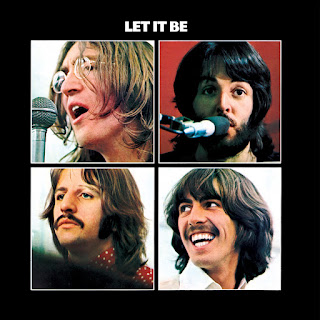
  • Let It Be,” by the Beatles – from the album “Let It Be”
  • L.A. Woman,” by the Doors – from the album “L.A. Woman”
  • Thriller,” by Michael Jackson – from the album “Thriller”
  • Purple Rain,” by Prince – from the album “Purple Rain”

When an album is named the group's name, it is often referred to as self-titled. (That's the #1 above.) The first album by the Doors was called “The Doors,” and the first album by “Weezer” was called “Weezer.” In general, people refer to the albums by those names, or as “self-titled,” or sometimes, “the band's debut album.” Sometimes a band decides to release a self-titled album well into the band's lifespan – and sometimes that album ends up getting a nickname. For example, the Beatles released their fourteenth (or so, in the U.S.) album, named “The Beatles,” in 1968 – but almost nobody calls in “The Beatles.” Instead, people call it “The White Album.”

When an album has a unique name not shared by any of the songs on that album, as in #3 above, we could say that the album has a “lost title track.” We could try to imagine what that song might be...

And that's when the band called “The Title Trackers” gets busy. They take classic albums with no title tracks, and they create their own original songs for that title.

The fun part is, they try to copy the sound of the particular band – and the look, and the feel. And their lyrics can be downright funny, in a loving, honoring-the-original sort of way....but not in a making-fun-of-the-original kind of way. 

At least, that's how The Title Trackers intend their parodies.

And that's how I enjoy them, as well...

Check out “Checking into Morrison Hotel” on the Title Trackers' website!


Also on this date:


Plan ahead:

Check out my Pinterest boards for:
And here are my Pinterest boards for:

April 11, 2013 - Sing It! Day

Today is special because of two (count 'em, two!) different holidays that have to do with songs and singing!


First, today is Barbershop Quartet Day.

Back in the “good old days,” the barbershop was a place where people hung out, gossiped, and clowned around with one another. Sometimes African American men would sing while they waited their turn in the barber's chair...messing around with harmonies as they belted out familiar spirituals, folk songs, and popular tunes. Of course, they always sang a cappella, which means without the accompaniment of any musical instrument.

Without a guitar or piano providing a rich sound, these singing sessions at the barbershop started to follow a pattern of four-part harmony. One man would sing “lead”—that is, he would sing the actual tune—and three other men would sing harmonies above (tenor) and below (baritone and bass).

The practice of singing at the barbershop caught on, and the a cappella four-part-harmony style caught on even more, spreading to minstrel singers, women singers, and even church choirs. Nowadays, barbershop quartets don't generally sing at a barbershop, but they sing without accompaniment from any musical instruments, and they sing with tight four-part harmonies.

By the way, women quartets also call the four parts lead, tenor, baritone, and bass. In most contexts, these terms mean a particular vocal range—the actor Dan Stevens, for example, has a baritone voice, and Christina Aguilera is considered a soprano—but in barbershop singing, the terms just refer to a particular part to be learned and sung: the tune, high, low, and lowest.

Richard Berry
Second, today is also International “Louie, Louie” Day.

Louie, Louie” is a song written in 1955 by a Los Angeles man named Richard Berry. It's about a Jamaican sailor who misses his lady love and is returning to the island to see her. The lyrics are inspired by Jamaican English, which has different rules than other dialects of English.

The song has been recorded many different times by many different groups, but the most famous version is the 1963 recording by the Kingsmen.

According to Snopes, the Kingsmen thought they were just rehearsing when they taped the song. The boom microphone wasn't set up properly for the lead singer, plus he had strained his voice the day before AND had braces on his teeth. At any rate, it turned out that this “rehearsal” ended up being THE recording—and the one and only big hit for the Kingsmen!

An actual letter sent to Kennedy.
So...why am telling you about the microphone and the braces and all that? It is actually quite hard to tell what words that lead singer is singing, and somehow a rumor got started the lyrics were obscene. Some outraged parents even wrote to complain to governmental officials such as Attorney General Robert Kennedy. They probably didn't complain about specific words or phrases being used in the song—since the lyrics were (a) innocent and (b) almost impossible to decipher—but they probably just complained, “This song is dirty! Do something about it!”

The FBI got involved. According to Snopes, investigators took TWO AND A HALF YEARS listening to the song at various speeds, trying to hear the obscene lyrics. They interrogated the songwriter and the various people who had recorded the song over the years—but not the lead singer who had actually sung the specific recording being investigated! Crazy, huh?

The FBI ended up ruling that the lyrics were unintelligible at any speed. In other words, they couldn't understand the lyrics. And probably the moms and dads who had complained couldn't, either. And no doubt most of the kids listening to the song couldn't. The vocal track just isn't all that clear.

In case you are interested, here are the lyrics:

Louie, Louie, me gotta go.
Apparently more than one
album has been pressed
made up entirely of
different versions of this
 iconic song!

A fine little girl, she wait for me;
Me catch a ship across the sea.
I sailed the ship all alone;
I never think I'll make it home.

Three nights and days we sailed the sea;
Me think of girl constantly.
On the ship, I dream she there;
I smell the rose in her hair.

Me see Jamaica moon above;
It won't be long me see me love.
Me take her in my arms and then
I tell her I never leave again.


Also on this date:


Scientist and inventor Percy Julian's birthday


March 27, 2013 - Quirky Country Music Song Titles Day


If I Had a Nose Full of Nickels, I'd Sneeze Them All Atchoo!”

She Thinks My Tractor's Sexy”

You're the Reason Our Kids Are Ugly”

How Come Your Dog Don't Bite Nobody But Me?”


These are actual song titles (by Lou Carter, Kenny Chesney, Loretta Lynn & Conway Twitty, and Mel Tillis & Webb Pierce). Country music songs often have long, or funny, or downright quirky titles. 

Of course, there are plenty of short-and-normal song titles, too—such as Lady Antebellum's “Downtown” and Darius Rucker's “Wagon Wheel.” 

But today's the day to relish the long-winded and strange and especially the humorous titles country music so frequently dishes up.

Country music evolved from the folk music played and sung in the Appalachian mountains, in the eastern United States. Country music became a recognized and commercial genre (type of music) in the 1920s, and in the 1940s, it became popular all over the U.S. The popularity spread to Canada and eventually Australia, and is now finally making inroads worldwide.

Grab yer cowboy hat and yer gee-tar...

...And sing your favorite country music songs!

  • Some people just can't hang with country music! Weird Al Yankovic did a parody of a song that was popular back in the early 90s. It is not complimentary! 

And now...
      [drum roll, please]
               for my favorite country music song title:

If the Phone Don’t Ring, It’s Me Not Calling You Up


Also on this date: