Showing posts with label botany. Show all posts

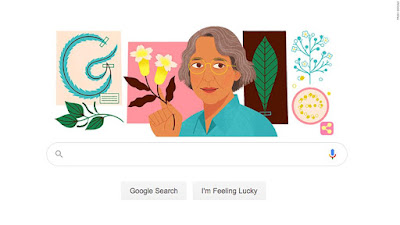
May 24 - Happy Birthday, Ynés Mexía

 Posted on May 24, 2022     


This is an update of my post published on May 24, 2011:


She was a social worker until age 51, when she decided to change her life.

And, boy, did she change it! 

Ynés Mexía became a botanist (a scientist who studies plants) and an explorer who discovered more than 500 species of plants!

It's estimated that she collected more than 137,000 plants in six expeditions over a period of just 13 years!

Ynés Mexía was born in Washington, D.C., on this day in 1870; her parents were Mexican, and her father probably worked for the Mexican embassy in the U.S. capital. She apparently didn't have a lot of formal education until she was 51 and started attending botany classes at the University of California at Berkeley. And the reason for the career change? Mexía discovered her love for plants while hiking with the Sierra Club.

Soon Mexía began to take botanical collecting trips in Mexico, Alaska, Brazil, Ecuador, Colombia, and the American Southwest.


Sadly, Mexía experienced chest pains on a collecting trip in Mexico, and at age 67 she died of lung cancer. Still, she managed to find a passion, make a contribution, and see new sights at a time when some would have said she was “over the hill.”

What will YOU do from age 51 to 67 that will result in you getting a Wikipedia article and Google Doodle?


Plan ahead:


Check out my Pinterest boards for:
And here are my Pinterest boards for:

December 8 - Happy Birthday, Jan Ingenhousz

  Posted on December 8, 2021


This is an update of my post published on December 8, 2010:


The Dutch scientist Jan Ingenhousz (1730-1799) discovered photosynthesis and also discovered that plants, like animals, have cellular respiration. Those are major, major discoveries—but not what he was best known for in his own lifetime. His claims to fame back then were:

(1) his successful inoculation of the royal Habsburg family of Austria - a kind of vaccination against the dreadful and deadly smallpox disease, and 

(2) his appointment as the doctor of the Empress Maria Theresa.

Ingenhousz did a lot of work in biology and chemistry in at least six different European countries and corresponded many times with an important American, Benjamin Franklin. 


Photosynthesis is the process by which plants use the energy in sunlight to convert carbon dioxide and water into sugars and oxygen. In other words, it is the process by which plants makes their own food!


Actually, plants don't just make their own food—the photosynthesis by plants, some bacteria, and algae creates the basis of almost all food chains and therefore form the foundation of almost all life on earthproviding both food and oxygen for animals.


Check out to Peter Weatherall's song about photosynthesis.

Photosynthesis starts in a plant cell's chloroplasts. The green pigment chlorophyll is crucial to most photosynthesis.


Cellular respiration is pretty much the opposite of photosynthesis. It is the process by which plant and animal cells break down food (such as sugars) in order to obtain energy. The process requires oxygen.


Find out more at Biology 4 Kids
Here is a straightforward video about respiration and photosynthesis. 

Respiration occurs inside cells' mitochondria.


To review:

Photosynthesis — carbon dioxide + water + energy (sunlight) = sugar + oxygen

Respiration — sugar + oxygen = carbon dioxide + water + energy (to grow or move or repair cells or reproduce)

Ready for another song - this one about both photosynthesis and cellular respiration? Here it is. 


May 14 - Happy Birthday, Mikhail Tsvett

 Posted on May 14, 2021

This is an update of my post published on May 14, 2010:


This Russian botanist (plant scientist), born on this day in 1872, discovered chromatography. He was trying to separate a mixture of plant pigments that were very sim
ilar to each other. One method he tried was trickling the mixture through a glass tube packed with calcium carbonate powder. As the liquid trickled down through the powder, each kind of pigment stuck to the powder with its own unique amount of strength. This created a series of bands (or stripes), and each band was a different pigment.
Using his new technique, Tsvett discovered several new plant pigments. He named the technique chromatography, he called the resulting bands a chromatograph, and he called the new pigments carotenoids.


Although Western scientists did not discover Tsvett's work for 30 years, his technique is now used all over the world.


Felt Pen Chromatography
This will work with any water-based felt-tipped pen, but it's most fun to u
se a bunch of different brands of black markers. (Again, remember, they have to be water-based markers! Don't use Sharpies or other permanent markers!)

I did a similar experiment several times using coffee filters rather than blotting paper.


Chalk 
Chromatography


Test red, yellow, green and blue food coloring to see if they are made of various substances. Instead of using coffee filters or blotter paper, use white chalk. At the end of the experim
ent, you will have cool-looking chalk with a colorful outer decoration.

Get instructions here.

Leaf C
hromatography


Squeeze some “leaf juice” onto the coffee filter to test for pigments in plant leaves. This experiment is more like Tsvett's original research. Get instructions here.

T-Shirt Chromatography


Get an old (or cheap-and-new) white T-shirt for this activity. This time, use alcohol rather than water, and permanent markers rather than water-based ones. Follow the instructions carefully to make a unique Tee to wear.

Chromatography as Art


Did You Know...?

Forensic science (crime-scene investigation) can involve chromatography to see what type of pen was used in a crucial piece of evidence. Unfortunately, the test would tend to destroy the evidence—so I'm sure that CSI scientists test only part of a small part of the message, letter, or other ink sample.


Also on this date:


Mathematician John C. Fields's birthday


(Second Friday of May)


Plan ahead:


Check out my Pinterest boards for:

And here are my Pinterest boards for: