Showing posts with label particle physics. Show all posts

August 8 - Happy Birthday, Ernest Lawrence

   Posted on August 8, 2022     


This is an update of my post published on August 8, 2011:


Ernest Lawrence was born in South Dakota on this day in 1901. But his long career as a physicist occurred at the University of California, Berkeley.

Lawrence invented the cyclotron, a type of particle accelerator and atom smasher, in 1929. 


His first model only cost around $25 in materials, could be held in one hand—and it worked! That small model accelerated protons to a remarkable 1% of the speed of light! (Remember that today's particle accelerators and atom smashers, such as the Large Hadron Collider, cost billions of dollars and are many miles wide! Of course, such huge machines achieve far great speeds and smashing-power than that first model!)


The Large Hadron Collider can accelerate particles
quite close to the speed of light - so fast a particle
could whizz around the Earths equator seven and a
 half times in just one second!


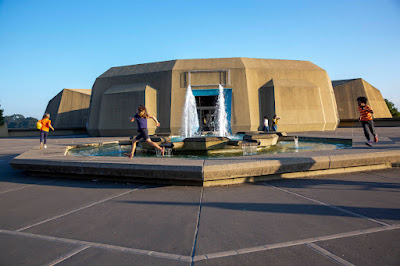
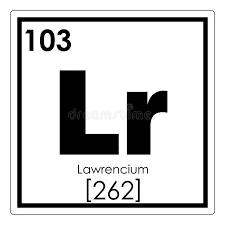
Berkeley's Lawrence Hall of Science is named for Lawrence, as is the chemical element lawrencium. Lawrence won the Nobel Prize in 1939.


Above and below - the Lawrence Hall of Science
has wonderful things to see and do to explore
various fields of science. 


June 18 - Missing Neutrinos Found!

   Posted on June 18, 2022     


This is an update of my post published on June 18, 2011:


When you're as teensy as an electron, it's hard to see you!

But electrons have a negative charge, so we can at least detect that charge. They interact with matter because they are charged—for example, the electrons streaming away from the Sun excite atoms in our atmosphere and cause colorful curtains of light called aurorae.


There are other particles streaming away from the Sun that are just as tiny as electrons but that have no charge. These neutral particles are called neutrinos. And boy, are they hard to detect!!!

Way back in 1930 theoretical physicist Wolfgang Pauli predicted that there should be such a thing as a neutrino. When physicists make such predictions, they are working with data and equations, and they sometimes find that something is missing in their data—the math doesn't come out right unless some other thing, still unknown, exists. Pauli was in that situation—he thought that there must be a particle as large as an electron, but with no charge. He named this not-yet-discovered particle a neutron.

A few years later, another physicist discovered a much larger neutral particle that he named neutron. So the as-yet-undiscovered particle got renamed neutrino.

In 1956, physicists were able to detect neutrinos (well, it turned out that they were closely-related particles called anti-neutrinos) created in nuclear reactors. And in the 1960s, scientists were able to detect and even count neutrinos coming from the Sun, using huge tanks of dry-cleaning liquid deep, deep underground. (Those few incoming neutrinos that hit a chlorine atom in the liquid changed the chlorine to argon. The amount of argon in the liquid was then measured.)


The Sun emits particles (including neutrinos)
in all directions. This is called the solar wind.

Once they were able to detect and measure neutrinos, scientists noticed that Earth was receiving only one third to one half of the expected solar neutrinos. Again, our equations were scrutinized—this time, the equations that modeled how nuclear fusion operates deep in the Sun's core. Could there be something wrong with our model? Could something be missing?


The Sudbury Neutrino Observatory reported on this day in 2001 that the missing neutrinos were there, all along, but had changed “flavors” in their long journey through the outer layers of the Sun, through space, and through our own atmosphere. The earlier neutrino detectors had only detected electron neutrinos, but the SNO used heavy-water detectors that also detected muon and tau neutrinos. With data on all three flavors of neutrinos, the expected number was found, and our model of how the Sun operates was confirmed.


Above and below, the Sudbury Neutrino Observatory


None of the neutrinos have a charge,
and they are pretty close to having zero mass,
as well.


Have you always wanted...
...a muon neutrino of your very own? Get it here.


Older students might enjoy the Particle Adventure


Also on this date:


Birthday of musician Paul McCartney


Mermaids on Parade


(Saturday closest to Summer Solstice)


Plan ahead:


Check out my Pinterest boards for:

And here are my Pinterest boards for:


November 18 - William Tell Shoots an Apple Off His Son's Head – Or Does He?

  Posted on November 18, 2021


This is an update of my post published on November 18, 2010:


William Tell is a folk hero of Switzerland. He is said to have broken an unreasonable rule of the Austrian man, Albrecht Gessler, who ruled his region with brutality. Gessler's punishment for Tell, we are told, was that Tell had to shoot an apple off the head of his son, Walter. If Tell didn't try the task, Gessler assured him, both he and his son would be executed. On the other hand, if William Tell succeeded, they would both freed.

So, on November 18, 1307, William Tell raised his crossbow and took two crossbow bolts from his quiver. He shot one of the bolts toward his son—and neatly split the apple in half. At this point, Tell and his son should have been freed.


However, Gessler was curious about why Tell had taken two bolts from his quiver. He asked, and Tell told him that, if he had failed at the marksman task and killed his son, he would have used the second bolt to kill Gessler.

Angry, Gessler broke his promise and had William Tell tied up and carried to a boat on Lake Lucerne. He intended to have Tell taken across the lake and locked up in his castle. However, a storm broke out, and, in the confusion, Tell managed to escape. He went by land to the castle and laid in wait for Gessler. When the latter arrived, Tell shot and killed him.


William Tell's accuracy as a marksman and bravery in escaping and assassinating a ruthless tyrant led, according to legend, to a rebellion and the eventual formation of the Swiss Confederation.

Legend or History?

Many people tell this story as a true historic event. Specific names are mentioned, and there is a very specific date tied to the main event as well. The story is widely repeated and has inspired at least one play as well as paintings and murals. It sounds legit, right?

However, there is apparently no good evidence that William Tell, his son Walter, or Albrecht Gessler ever lived. Perhaps most convincing that the story is a myth rather than a history is the fact that there is a very similar—but earlier—Danish legend. Only the names have been changed: a Danish man named Palnatoki was forced by King Harald Bluetooth to shoot an apple off his son's head. Palnatoki took several arrows from his quiver and, when asked why, he explained that if he had struck his son with the first arrow, he would have turned his bow on the king.

So...the story of William Tell is probably a fiction.


The “William Tell Overture”

A composer named Gioachino Rossini wrote an opera inspired by the legend of William Tell, and the instrumental beginning of this opera is pretty famous. It has been used, over used, and sometimes even abused in popular media—including becoming the theme song of the 50s TV show The Lone Ranger.

Have you ever heard this stirring composition?


Modern Heroes in Switzerland

One of the hugest science experiments of all times is happening right now in Switzerland, and the scientists (of many different nationalities) who work there are truly modern heroes. One American scientist, Katherine McAlpine, created a rap video about the Large Hadron Collider at CERN—and even though it is scientifically accurate, the video went viral!


(A viral video is one that is widely shared and spread “by word of mouth” on the internet. The “Large Hadron Rap” has been viewed more than eight MILLION times.)

By the way, in the video, McAlpine refers to CERN looking for the Higgs boson - and scientists did discover it, just as they had hoped to.


(Thursday of American Education Week)


(Thursday before Thanksgiving)