Showing posts with label environmentalist. Show all posts

May 27 - Happy Birthday, Rachel Carson

   Posted on May 27, 2022     


This is an update of my post published on May 27, 2011:


Some Rachel Carson she started an entire movement—

...A movement that is worldwide in import, with life-and-death stakes.

Rachel Carson, born in Pennsylvania on this day 1907, is credited with starting the modern environmental movement. She was a marine biologist who was a gifted writer; she wrote three books about ocean life that earned her financial security and a certain amount of fame—two of them were even best sellers.


She turned her attention to the problems caused by synthetic (“man”-made) pesticides. She was able to use her writing skills, her fame, and her connections with both the scientific community and with publications such as The New Yorker to shine a spotlight on the effects of pesticides such as DDT on creatures such as birds, and her book Silent Spring eventually caused the nationwide ban on DDT.


Spraying poison willy-nilly should give us all the willies!

Thanks to Rachel Carson, more people began to think globally rather than locally, long-term rather than short-term, and holistically—taking into consideration the entire ecosystem rather than just one insect farmers want to get rid of.


Carson chatting with some kids in a forest...

Carson had to deal with breast cancer, a respiratory virus she may have caught because she was weakened by radiation treatments, severe anemia caused by radiation treatments, and cancer spreading to her liver—but after all that her cause of death almost two years after the publication of Silent Spring was a heart attack. She was just 57 years old.

Still, Carson made a huge impact for the better by showing that human activities sometimes have a huge impact for the worse on the environment.

Schools, research vessels, several buildings, many 
conservation areas, and this bridge have all been
named after Rachel Carson.


April 3 - Happy Birthday, John Burroughs

 Posted on April 3, 2022

This is an update of my post published on April 3, 2011:


John Burroughs wrote 23 books, was very popular and well-connected during his own time, and was important in the American conservation movement—and I don't remember ever hearing about him!

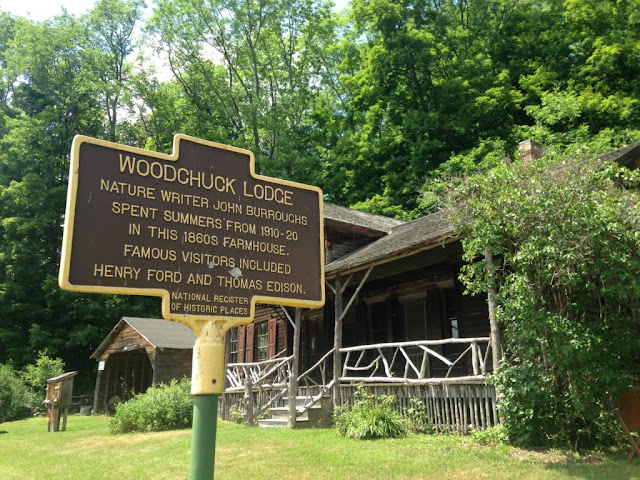
Born on this day in 1837, in New York, Burroughs grew up to become the Grand Old Man of Nature. He wrote about the Catskill Mountains, fly fishing, birds and bees, flowers and trees, and all things natural. He hung out with Teddy Roosevelt, Thomas Edison, Henry Ford (who gave him a car, as a gift!), John Muir, Walt Whitman, and Harvey Firestone. He traveled to Alaska with scientists, artists and photographers, and he wrote about the expedition and his other travels. 

Burroughs wrote about science in general, including controversial topics: he disagreed with the (relatively) new-fangled idea of evolution through natural selection (but now that truck-loads and mountains of evidence have accumulated, we know he was wrong). 

John Burroughs lived to be 84 years old.


Burroughs wrote in 1912:

"We can use our scientific knowledge to improve and beautify the earth, or we can use it to...poison the air, corrupt the waters, blacken the face of the country, and harass our souls with loud and discordant noises, [or]...we can use it to mitigate or abolish all these things."

Links I Like

Here is a short story written by Burroughs. It's really interesting!

A natural history society is named after him and runs field trips, lectures, and a newsletter. If you live in New York, check it out!


April 21 - John Muir Day

 Posted on April 21, 2021

This is an update of my post published on April 21, 2010:


The naturalist and conservationist John Muir was born in Scotland on this date in 1838. He came to America with his family when he was 11 years old, and they settled on a farm in Wisconsin. He went to the University of Wisconsin - Madison for a few years, paying his own way and studying botany for the first time.

Muir left school to wander around Canada, collecting plants and, when he needed money, working in a sawmill in the Ontario area. In 1866 he returned to the U.S. and worked as an industrial engineer in Indianapolis, Indiana, but that ended when a work injury almost blinded him. After six weeks in a darkened room, Muir emerged determined to be true to his dreams of exploration and the study of plants.

So he walked about 1,000 miles from Indiana to Florida, going the “wildest, leafiest, and least trodden way” he could find. He wanted to go to South America and continue his wilderness
 walk, but he fell ill with malaria, so instead he sailed to New York and then traveled by steamship to California.


As soon as Muir's ship landed in San Francisco, California, he made his way to Yosemite. He immediately fell in love with the place in a big way.


Muir lived in Yosemite Valley for years, studying the botany and geology of the area. He suggested that the valley was carved out by glaciers, rather than by a gigantic earthquake as theorized by Josiah Whitney. (Whitney's idea was widely believed at the time.)

Muir was often lonely and comforted himself, not only with the beauties of nature, but also with reading the writings of Ralph Waldo Emerson. After Muir had lived in Yosemite for three years, Emerson himself came to the valley. The two men were delighted to meet each other. Emerson offered Muir a professorship at Harvard, but Muir turned him down without even considering the idea.

Emerson and Ezra Carr, a former professor from the University of Wisconsin, urged Muir to write about his theory of Yosemite's creation through glaciation. Muir discovered an active glacier in the area, and a large earthquake shook the valley but didn't make it deeper, so more and more people turned to Muir's theory as the likelier. (Of course, a huge amount of evidence has since been found to pretty much clinch Muir's theory.)


Eventually John Muir moved to a more civilized area, Oakland, where he married, helped raise two daughters, and lived on a ranch. He continued to study and write about botany and geology and conservation. He took breaks by traveling to his beloved Sierras, and he also climbed Mt. Rainier in Washington and went on expeditions to Wrangel Island in the Arctic Sea and along the Alaskan coast. Later in life, Muir traveled the world talking about preservation of wild spaces; he visited Britain, France, Germany, Russia, China, India, Egypt, Australia, New Zealand, Japan, Hawaii, and, briefly, Indonesia and the Philippines. He stayed in Arizona for a while, and he finally got to South America and even Africa!

As important as Muir's writings and scientific contributions were, he is best known for helping to start the Sierra Club, a conservation group, and for gaining protected status for Yosemite as a national park. Both the club and the national park were successes, but Muir also opposed building a dam at Hetch Hetchy, and that fight he lost.

In 1903, President Theodore Roosevelt went to Yosemite and asked Muir to show him “the real Yosemite.” The two men camped in the back country, slept out under the stars and were even dusted by a bit of snow in the early morning. Muir was able to convince the president of the importance of Yosemite and of federal control of the park.


Later in his life Muir shrugged off the title “conservationist,” as he often disagreed with th
e land-use ideas of people who called themselves by this term. Muir began to call himself a “preservationist,” because he wanted to keep certain lands almost entirely untouched. He considered them of great spiritual value, more beautiful than the greatest temple or cathedral ever built by humans.

Muir lived to age 76 and died in Los Angeles, California, of pneumonia. Many places and institutions have been named after John Muir, particularly in California. My own sister went to John Muir High School in Pasadena. There are a bunch of other schools plus a college named after him, plus several mountains, a glacier, a wilderness area, several long hiking trails, a beach, a stand of redwoods, many parks, a camp, and even an asteroid!


These are two of the many beautiful parts of 
the John Muir Trail that I have hiked through.
Above, Garnet Lake. Below, the Devil's Postpile.


Muir has been featured on several postage stamps and appears on the California state 
quarter. Muir's birthday was declared John Muir Day by Governor Arnold Schwarzenegger in 2004.

An earlier postage stamp calls Muir a "conservationist."
But you read above that he didn't love that title. He preferred
"preservationist" - and that's exactly what the more recent
stamp calls Muir!


Celebrate!

Watch a video clip about Muir and Roosevelt in Yosemite.

Read some quotes by John Muir, and think about the relevance of each to his life and also to yours. (Quotes selected by Harold Wood for the Sierra Club.)

Muir Woods National Monument

If you want more Muir writings, the Sierra Club provides a great resource with selected passages, letters, eulogies, and bibliographies...plus the complete text of his books!

(Look for the blue drop-down menu called "Writings.")

Do a jigsaw puzzle of Muir.

Here is a coloring sheet of the California state quarter depicting Muir.

If you can, visit a wilderness area near you.
Even better, make a plan to preserve a bit of wilderness!


Also on this date: