Showing posts with label mathematician. Show all posts

April 1 - Happy Birthday, Sophie Germain

  Posted on April 1, 2022

This is an update of my post published on April 1, 2011:

The French mathematician Sophie Germain was born on April Fool's Day in 1776 (no kidding!). She made contributions in number theory, acoustics, and elasticity.

Because she was a woman, her parents didn't want her to get a higher education—so she read books from her father's library and wrote letters to important mathematicians. To try to discourage her from studying at night, her parents wouldn't allow her to have warm clothes or a fire in her bedroom; so, after they went to sleep, she would wrap herself in her bedding and light a candle and read, compute, and study.


Check out this book by Cheryl Bardoe.

Germain's parents finally relented after finding her one morning, asleep at her desk, the ink frozen in its horn, and papers covered in calculations.

Still, even after her parents gave in, Germain couldn't have a career as a mathematician, because she was a woman. So she worked independently all her life.

Sophie Germain's work on Fermat's Last Theorem provided a foundation for mathematicians for the following centuries, and her work on elasticity won a grand prize from the Paris Academy of Sciences.


Germain also studied philosophy and psychology. Long after her death (caused by breast cancer), a street and a girls' school were named after her.

Nowadays, people who have studied Germain's work are convinced that she had a brilliant mind, but also that her contributions were limited by her lack of educational opportunity.

And that is no joke...


December 17 - Happy Birthday, Emilie du Chatelet

  Posted on December 17, 2021


This is an update of my post published on December 17, 2010:


Born in 1706, this French mathematician and physicist was (unfortunately for her career) a woman. In order to gain entry to Gradot's coffeehouse to participate in scientific discussions, she dressed up like a man. She translated Sir Isaac Newton's Principia, and for many years hers was the only translation into French of this important work.


Isn't it sad that a woman at that time would have to pretend to be a man so that she could travel where she needed or wanted to go, learn what she needed or wanted to know, or do what she needed or wanted to accomplish?

By the way, trans men are not women pretending to be men in order to do the things they want to do; they are men. Please don't get the two mixed up.


May 16 - Happy Birthday, Maria Gaetana Agnesi

 Posted on May 16, 2021


This is an update of my post published May 16, 2010:


Born on this day in 1718, in Milan, Italy, Maria Gaetana Agnesi is the first woman in the Western world considered to be an important mathematician since Ancient Greece's Hypatia, back in the 5th Century.

Agnesi was also a philosopher and a linguist.

Agnesi was a child prodigy. At 
age 9, she wrote a one-hour speech (in Latin) on the right of women to be educated, and she delivered it to an academic group.  By 13 she was considered a “Walking Polyglot” because she knew French, Greek, Hebrew, Spanish, German, Latin, and of course her native Italian. From age 15 to 20, her father organized meetings at their house: the most learned men in Bologna would come, and the teenage Agnesi would read and argue philosophical questions. However, she didn't really want to participate in these events, and at 20 she put a stop to them.
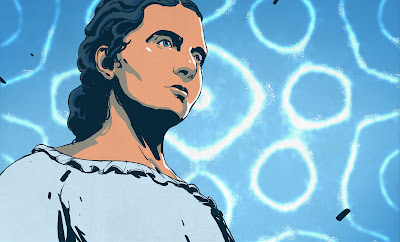
Google's celebration of Agnesi might look weird -
like, what's with the lines? - but the image harkens
back to one of Agnesi's diagrams:


Agnesi was considered dazzingly beautiful. She wanted to enter a convent and just study, but her father asked her to continue to teach her younger siblings. (Maria's mother had died, and her father married two more times.) All told, Maria was the oldest of her father's 21 children, so teaching all of them took a lot of her time.

Agnesi's biggest contribution to mathematics was a two-volume book on differential and integral calculus that brought together in a systematic way the work of several different mathematicians, with her own analysis and interpretations. When it was published in 1748, Analytical Institutions made an academic sensation.
Agnesi also became a university professor (Wikipedia claims she is the first woman university professor). She eventually joined a convent and helped the poor, homeless, and sick.

Agnesi wrote about calculus.
You may be thinking, “What is calculus, anyway?”


Watch this very short video to find out!


Play Around with Math!
This English version of a Dutch website has tons of really interesting math puzzles and games. I loved looking at the Impossible Object (rotate it around to see the illusion), and I played Colouring Sides 1 (fun!) and Falling Sums (also good).

Click Math Arcade on the FunBrain website for some math “video games.”