Showing posts with label mathematics. Show all posts

May 14 - Happy Birthday, John C. Fields

    Posted on May 14, 2022


This is an update of my post published on May 14, 2011:


As a college professor and math researcher in the late 1800s, John C. Fields was disappointed in the state of math research in North America (he was Canadian and was teaching in the U.S.). So he went to Europe to hang out with some math greats and to make some math discoveries.


When he returned to Canada in 1902, Fields worked hard to raise the reputation of mathematicians in North America. One way that society honors people is to award prizes and especially to award prize money. So Fields started an award for younger mathematicians to give recognition of their contributions to mathematics, and also to help support their work with a monetary prize of $15,000.


The Fields Medal is very prestigious and is considered the Nobel Prize of Mathematics. (But Nobel Prize winners get a million dollars!!) One thing that makes this award different from most is that it has to be awarded to a person who is less than forty years old.


Wonder about math...

When I read about mathematicians, I often see words like research and discovery – and for a while there, that surprised me. In my world of helping little kids with arithmetic, math has been something to be learned and used—something very, very practical as we deal with counting things, money, time, measuring lengths and weights and volumes... Math seemed like something to be used in professional research or scientific inquiry--rather than to be the subject of it. And using a word like discovery made me feel like there must be some magical math land that mathematicians visit—and that they come back and tell the rest of us about their latest findings...

But as I read and heard more about all the fascinating areas of math research and exploration - even in popular TV shows, like the 2000's series NUMB3RS - I realized more and more that "higher math" could seem esoteric, but mathematical discoveries can be used in practical fields such as detective work and robotics and architecture and and and....


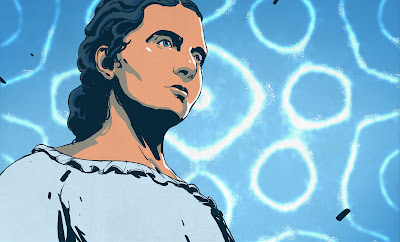
What would Mathematics Land look like?


Enjoy math!

If you like the idea of Mathematics Land, be sure to check out The Phantom Tollbooth, by Norton Juster, and A Gebra Named Al, by Wendy Isdell.


If you like the idea of math being all around us and very useful, check out the book Math Curse, by Jon Scieszka.


And of course, there's always that wonderful old Disney film Donald in Mathmagic Land! Love it!


Also on this date:


Birthday of botanist and chromatography pioneer Mikhail Tsvett 


(Second Saturday in May)


(Second Saturday in May)


(Second Saturday in May)


(Second Saturday in May)


Plan ahead:


Check out my Pinterest boards for:
And here are my Pinterest boards for:


April 1 - Happy Birthday, Sophie Germain

  Posted on April 1, 2022

This is an update of my post published on April 1, 2011:


The French mathematician Sophie Germain was born on April Fool's Day in 1776 (no kidding!). She made contributions in number theory, acoustics, and elasticity.

Because she was a woman, her parents didn't want her to get a higher education—so she read books from her father's library and wrote letters to important mathematicians. To try to discourage her from studying at night, her parents wouldn't allow her to have warm clothes or a fire in her bedroom; so, after they went to sleep, she would wrap herself in her bedding and light a candle and read, compute, and study.


Check out this book by Cheryl Bardoe.

Germain's parents finally relented after finding her one morning, asleep at her desk, the ink frozen in its horn, and papers covered in calculations.

Still, even after her parents gave in, Germain couldn't have a career as a mathematician, because she was a woman. So she worked independently all her life.

Sophie Germain's work on Fermat's Last Theorem provided a foundation for mathematicians for the following centuries, and her work on elasticity won a grand prize from the Paris Academy of Sciences.


Germain also studied philosophy and psychology. Long after her death (caused by breast cancer), a street and a girls' school were named after her.

Nowadays, people who have studied Germain's work are convinced that she had a brilliant mind, but also that her contributions were limited by her lack of educational opportunity.

And that is no joke...


February 28 - French Scientist Day

    Posted on February 28, 2022


This is an update of my post published on February 28, 2011:


Today is the birthday of these French scientists:


René-Antoine de Réaumur (born in1683) – entomology

Louis Godin (1704) – astronomy


René-Just Haüy (1743) – mineralogy


Edmond Frémy (1814) – chemistry


Henri Breuil (1877) – archeology


Pierre Fatou (1878) – mathematics


Which of these fine gentlemen from the 1600s to the 1800s, do you think, did each achievement? Hint: you can figure out who did what by noting their field...

  1. Who is most known for discovering a salt that acts to promote oxidation?

  2. Who went to Peru to help take measurements to determine the size and shape of the earth?


  3. Who studied the relationship between the growth of insects and temperature?


  4. Who is noted for his studies of cave art?


  5. Who accidentally discovered the geometrical law of crystallization when he dropped some calcite?


  6. Who studied iterative and recursive processes?


ANSWERS:
1. Edmond Frémy
2. Louis Godin
3. René-Antoine de Réaumur
4. Henri Breuil
5. Rene-Just Hauy
6. Pierre Fatou


(varies every year - Shrove Monday)


Plan ahead:


Check out my Pinterest boards for: