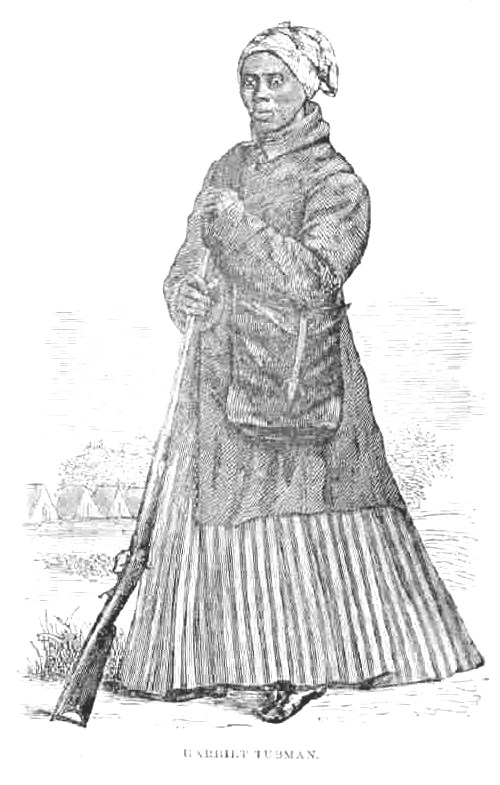
Showing posts with label Tubman. Show all posts

March 10 - Harriet Tubman Day – U.S.

 Posted on March 10, 2021

This is an update of my post published on March 10, 2010:


Harriet Tubman was strong, brave, and hard working on behalf of others, and this day commemorates her life; she was born into slavery some time in 1820 or 1821, and she died on March 10, 1913.

After Tubman escaped from slavery, traveling from Maryland to Pennsylvania, she made thirteen trips back to the south to rescue other enslaved people and bring them north to freedom on the Underground Railroad. Because of this, she has been called a conductor on the Underground Railroad and also the Moses of her people.

Tubman's first rescue missions were to bring her family north to freedom. Eventually she guided other enslaved folks north, and she ended up escorting around 70 people to freedom as well as telling many others how to reach the northern states. She said later that she “never lost a passenger.”


Tubman proved her exceptional bravery because any runaway caught in the south would be returned to slavery, and she proved her exceptional strength because she had to withstand a terrible head wound as well as many beatings and other mistreatment. An overseer had thrown a two-pound metal weight at another slave, and it hit Tubman in the head. Just a teenager, bleeding and unconscious, Tubman was given no medical attention. Two days later, she was sent back into the fields. Tubman had problems from this head injury, including severe headaches and seizures, all her life.

During the Civil War, Tubman worked hard to defeat the Confederacy. She acted as a nurse to Union troops, helped enslaved people who took advantage of the war to run away, led bands of scouts to map out unfamiliar land, and acted as a spy for the Union. Tubman even led an armed assault, the first woman to do so in the Civil War, and more than 700 enslaved people were rescued during that raid.

After the Civil War and slavery were ended, Tubman tended to her family (including her aging parents) and also worked for women's right to vote. She donated land to be used for a home for elderly people.

Harriet Tubman was widely known and greatly respected in her own time, but she was seldom paid for her nursing and spying services, invaluable though they were, and she was quite poor. One time that she received an honor, she had to sell a cow in order to afford the railroad ticket to go to the celebrations!

Luckily, some people who were busy heaping praise and honors on her also raised donations to partially pay her back for her service to her country. Unluckily, at one point two men swindled her in what 
sounds like an old-time version of the Nigerian e-mail scam.

All in all, Harriet Tubman had an eventful life, but never an easy one. Her strength and morality won for her fame but never fortune.


Harriet Tubman's image will soon replace Andrew Jackson on U.S. 20-dollar bills - and she will be the first African American pictured on any U.S. money, as well as the first woman on paper currency in the nation in more than a century!

Here are some resources to learn more about Harriet Tubman and the Underground Railroad.

Here is a picture of Harriet Tubman that you can print and color.


November 29 – Birthday of W.V.S. Tubman

Posted on November 29, 2016
In Harriet Tubman, the U.S. has a true hero. 

Well, the African country of Liberia has a Tubman as a hero, too! William Vacanarat ShadrachTubman, born on this date in 1895, has been called the “father of modern Liberia.”

(Actually, the last name Tubman is more common in Liberia than one might guess, because, in the mid-1800s, a slave owner in Georgia named Emily Tubman tried to free her slaves and to pay for them to travel to Liberia where they could live in freedom. It was actually quite hard to do – Emily Tubman had to appeal to the Georgian legislature for permission to free each slave, and when permission was denied, she had to work to get a special ruling to free them! When the group of 69 freedmen finally traveled to Africa to seek new lives, they took the last name “Tubman” to honor their former mistress.)

William Tubman grew up to be a lay pastor, a lawyer, a court recorder, a tax collector, a teacher, and a colonel in the militia – and all that before he was 28! In 1923 he was elected as the youngest senator in the history of Liberia. He also served as a spokesperson on behalf of his nation to the League of Nations and as a justice in the Liberian Supreme Court. In 1943, at the age of 48, Tubman was elected president.

Right away he had a difficult decision to make. You see, Germany was at the time being run by Hitler and the Nazi Party, and it had plunged the world into a horrific war. But Germany and Germans were deeply involved in Liberia's economy. Liberia relied on German merchants, on trade with Germany, and on German doctors – most of the doctors in the entire country were from Germany!

Even though it was the harder thing to do, Tubman ruled that Liberia sided with the United States and the other Allies fighting against Germany, and he expelled all Germans living in his nation. Eventually Liberia declared war on Germany and Japan.

After the war, Tubman worked to create friendly relations among all the new nations emerging in Africa; in 1961, these efforts resulted in the founding of the African Union.

Tubman is a hero for Liberians partly because he worked hard to reduce the problems between Americo-Liberians (former slaves transported to Africa from the U.S.) and indigenous Liberians (native peoples). He is a hero partly because he instituted policies that brought in investments from other nations, leading to vastly increased prosperity for Liberians. And he is a hero because he he invested government monies into developing roads, railway systems, sanitation systems, hospitals, and literacy programs. Instead of relying on just one product, rubber, Tubman made sure that multiple kinds of industries developed the nation's resources, including making Liberia #1 in Africa for iron production.

National heroes often appear on stamps and money!
Here's the not-so-heroic part:

Liberia had no term limits for the presidency. Here in the U.S., George Washington set a precedent of stepping down after two 4-year terms; in 1947, after having Franklin Delano Roosevelt elected president a record-breaking four times, an amendment was added to the Constitution mandating a maximum of two terms. But not so in Liberia.

As I said, Tubman became president in 1943, and he stayed in office until his death in 1971. That's 28 years with just one president – a period of time in which the U.S. would have from four to seven different presidents. Tubman controlled the majority party and did not volunteer to let go of his power, and probably acting in fear after an assassination attempt, he repressed those who opposed him.

So even though Tubman did a lot of good things for his country, he became more and more authoritarian. Definitely not a good thing!

After Tubman died, his Vice President took over, but there was political dissent, an overthrow, two civil wars. Most of Tubman's good works were undone by all of that – a lot of people died, a lot of people displaced, a devastated economy! Even though there was a peace agreement in 2003 and democratic elections in 2005, still, more than a decade later, 85% of Liberians lived below the poverty line.

Here, a Liberian boy walks down a street
littered with shell casings from bullets! Yikes!

Also on this date:


Plan ahead:

Check out my Pinterest boards for:

And here are my Pinterest boards for:

September 17 – Harriet Tubman Escapes!

Posted on September 17, 2013


Today we can celebrate a woman breaking laws, stealing, and running away from her crimes.

Well—running away WAS her crime!

In the early United States, it was perfectly legal to own other people. You could buy and sell other people, and you could pretty much do what you wanted to do with “your own” people.

What was against the law was for those people to run away. Not only was it illegal for a slave to run away, it was illegal for anyone to help a slave run away. And, in a sense, the runaway was depriving his or her “master” of property that had been paid for.

Of course slavery was horribly wrong, and so in this case, breaking the laws was a good thing, and following the laws was an immoral thing. I wonder if you think that any laws we have today are bad laws that should be broken?

At any rate, on this date in 1849, a woman named Harriet Tubman successfully escaped slavery. She made it to Philadelphia, Pennsylvania, where slavery was illegal and she was free.

Why do you think that Tubman's
nickname was "Moses"?
But Tubman didn't sit around up north just enjoying her freedom. Instead, she continued her “crime spree” by returning to her home state of Maryland to break out her family. One group at a time, returning over and over again into dangerous territory, Tubman helped dozens of enslaved people find their way to freedom.

Soon, another bad law was created: the Fugitive Slave Law of 1850 required law officials in free states to help recapture escaped slaves. So Pennsylvania and other free states were no longer safe. Tubman didn't buckle—she just started traveling further with the groups she led—all the way north to Canada.

When the Civil War began, Tubman worked for the Union Army. She served as a cook, a nurse, an armed scout, and even a spy! She was the first woman to lead an armed expedition during the war—and this raid was very successful, freeing more than 700 slaves!

To learn more about the Underground Railroad, which was a system of safe houses for escaping slaves, check out the Scholastic website.


To learn more about Tubman, check out this earlier post. 


Also on this date:


Plan Ahead!


And here are my Pinterest pages on October holidays, October birthdays, and historical anniversaries in October.


March 10, 2010

Harriet Tubman Day – U.S.

Harriet Tubman was strong, brave, and hard working on behalf of others, and this day commemorates her life; she was born a slave some time in 1820 or 1821, and she died on March 10, 1913.

After Tubman escaped from slavery, traveling from Maryland to Pennsylvania, she made thirteen trips back to the south to rescue other slaves and bring them north to freedom on the Underground Railroad. Because of this, she has been called a conductor on the Underground Railroad and also the Moses of her people.

Tubman's first rescue missions were to bring her family north to freedom. Eventually she guided other slaves north, and she ended up rescuing more than 70 slaves. She said later that she “never lost a passenger.”

Tubman proved her exceptional bravery because any runaway caught in the south would be returned to slavery, and she proved her exceptional strength because she had to withstand a terrible head wound as well as many beatings and other mistreatment. An overseer had thrown a two-pound metal weight at another slave, and it hit Tubman in the head. Just a teenager, bleeding and unconscious, Tubman was given no medical attention. Two days later, she was sent back into the fields. Tubman had problems from this head injury, including severe headaches and seizures, all her life.


During the Civil War, Tubman worked hard to defeat the Confederacy. She acted as a nurse to Union troops, helped slaves who took advantage of the war to run away, led bands of scouts to map out unfamiliar land, and acted as a spy for the Union. Tubman even led an armed assault, the first woman to do so in the Civil War, and more than 700 slaves were rescued during that raid.

After the Civil War and slavery were ended, Tubman tended to her family (including her aging parents) and also worked for women's right to vote. She donated land to be used for a home for elderly people.

Harriet Tubman was widely known and greatly respected in her own time, but she was seldom paid for her nursing and spying services, invaluable though they were, and she was quite poor. One time that she received an honor, she had to sell a cow in order to afford the railroad ticket to go to the celebrations!

Luckily, some people who were busy heaping praise and honors on her also raised donations to partially pay her back for her service to her country. Unluckily, at one point two men swindled her in what
sounds like her time's version of the Nigerian e-mail scam.

All in all, Harriet Tubman had an eventful life, but never an easy one. Her strength and morality won for her fame but never fortune.

Read more about the raid
that Harriet Tubman led on the National Geographic Kids site.


On the regular National Geographic website, there is a feature about the Underground Railroad.


Do a word-search puzzle about Harriet Tubman at Surfing the Net with Kids.

Check out this slide show to see just a small part of the legacy of Harriet Tubman.

Here is a picture of Harriet Tubman that you can print and color.


Also on this date...
Happy Birthday, Marcello Malpighi


Born on this date in 1628, Malpighi was an Italian doctor and biologist who was one of the first scientists to use a microscope to study living things.

He confirmed the existence of capillaries, which are tiny, thin-skinned blood vessels that allow blood to move out of the circulatory system and into tissues, as well of course as the other direction, from the tissues back into the circulatory system. (Biologist William Harvey had inferred that there must be such things as capillaries but hadn't been able to see them.)

He made many discoveries, including taste buds and the small holes that insects breathe through, and he contributed to the science of embryology (the science of how creatures develop inside eggs or wombs).

Plus a lot more!

Use a v
irtual microscope.

The Power of Ten takes you from outside the Milky Way Galaxy all the way to teeny-tiny quarks—but along the way, you will see some pretty good microscopic views of an oak leaf.


Here is a neat quiz in which you match the microscopic view of something with the correct label. Try it—it's interesting!