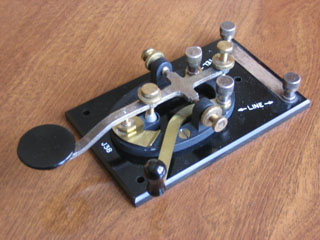
Showing posts with label telegraph. Show all posts

July 27 – Cross Atlantic Communications Day

Posted on July 27, 2016

Have you heard someone say something like, “My aunt is going across the pond on Thursday”? “Across the pond” is a jokey sort of understatement for “over the Atlantic,” either from the U.S. to Europe, or vice versa. It's understatement because it makes it seem as if the mighty Atlantic Ocean (3 to 4 thousand miles wide) were a mere pond.

Of course, nowadays, anywhere on Earth is just seconds away from anywhere else, when we're talking about communications. Back in the 1700s, the fastest way to communicate “across the pond” was to send written communications by ship – so news from the American colonies, for example, would get to England in six or seven weeks.

Eventually faster ships—and having small, speedy ships dedicated to just delivering mail and news—cut the communication time between America and Europe to just ten days.

Still – multiple days!

And stormy weather could delay ships for weeks.

In the 1850s, people began laying a “transatlantic” (across-the-Atlantic) telegraph cable across the sea floor from Ireland to Newfoundland. It was finished in August of 1858, but it only functioned for three weeks...and during those three weeks, the signal quality became very poor very quickly. The transmission time thus got quite slow (not ten-days slow, of course, but mamy more minutes than it should have taken!).

On the second attempt, starting in 1865, better materials were used, and the connection was completed on this date in 1866.


Finally, people in the Americas could communicate with people in Europe the same day. As a matter of fact, they could get a response back on the same day! What a revolution!

Soon new cables were laid with duplex and quadruplex systems that could relay more than message at a time, and eventually telegraph cables were replaced with telecommunications cables. Of course, now we use satellite signals more often than cable communication! And things are pretty instant!

Hooray for progress!

Hooray for technology!


Also on this date:


Plan ahead:

Check out my Pinterest boards for:
And here are my Pinterest boards for:

May 24 – Morse Code Day

Posted on May 24, 2016

When we want to honor an inventor like Samuel Morse, or his or her invention, do we honor his birthday? The anniversary of his death? The anniversary of an “ah-ha!” moment, or of the first successful demonstration of the invention, or of the patent?

The truth is, of course, that it depends on the inventor and the invention. In some cases we have little information about exactly when an inventor thought up an idea or tested a new gadget – but we can clearly see the date of the patent. In some cases a group of people invented a device, rather than one person with a definite birthdate, and in other cases multiple people separately invented the same thing.

So when I discovered that there are two different days called “Morse Code Day” – and that neither is the anniversary of the first public demonstration of the telegraph – I got to wondering, “Why that date?” 

One of the two Morse Code Days is April 27, which is the birthday of telegraph inventor Samuel Morse.

The other is today, May 24, which is the anniversary of the first official telegram.

Samuel Morse and his partners, Leonard Gale and Alfred Vail, worked on the prototype telegraph that was demonstrated in 1938. They also had to develop a code that could be used to transmit letters and numbers. Morse studied the use of semaphore flags and optical codes – which assigned 3- or 4-digit numbers to various words – but Vail knew that such a system would be limited in what could be expressed and would be fairly difficult to translate from code to message. It was Vail who put in the effort to study the frequency of use of the 26 letters in the English language. He assigned the shortest dot-dash codes for the letters used most often, and longer codes for the infrequently-used letters.

It was perhaps even harder to convince Congress to fund the construction of the first telegraph line than it was to invent the device and the code! Finally, in 1843, Morse convinced them, thanks to the lobbying of his former classmate and supporter Henry Ellsworth, and a telegraph line was built linking Washington, D.C., to Baltimore, Maryland, a distance of about 40 miles.

In order to reward Ellsworth for his help with the skeptical Congress, Morse decided to allow Ellsworth's daughter to choose what the first official telegram would say. That's how 17-year-old Annie Ellsworth entered the story. She chose a short line from the Bible: “What hath God wrought?”


And it was on this date in 1844 that Morse, seated in the U.S. Capitol, tapped out Annie's message. Vail, sitting in a Baltimore railroad depot, received the message just seconds later. By 1800s standards, that was INSTANT communication!

The telegraph was a success almost instantly, as well. Over the next few years, private companies set up telegraph lines, and within a decade more than 20 thousand miles of telegraph wire had been strung in the U.S. alone. And although Morse had to spend years in court fighting for recognition for his work and royalties for his inventions, he died at age 80 a rich and famous man.

Of course, almost instant coded communication via wire was eventually replaced by non-coded vocal communication via wire (the telephone), and then wireless communication (cell phones). Not to mention faxes and email and text messaging and social media!

Western Union, one of the first and biggest telegraph companies, delivered its last telegram in January of 2006.


Also on this date:


Plan ahead:

Check out my Pinterest boards for:
And here are my Pinterest boards for:

January 11 – Learn Your Name in Morse Code Day

Posted on January 11, 2015

Back in the day, before there was the internet, before there was the telephone even, there was the telegraph. People were able to communicate over long distances, quickly, using electrical signals. But that meant that every number and letter had to be encoded as long-and-short electrical signals. The code developed by Samuel Morse and Alfred Vail is now called the Morse Code:

The Morse Code Alphabet
A  .-
B  -...
C  -.-.
D  -..
E  .
F  ..-.
G  --.
H  ....
I  ..
J  .---
K  -.-
L  .-..
M  --
N  -.
O  ---
P  .--.
Q  --.-
R  .-.
S  ...
T  -
U  ..-
V  ...-
W  .--
X  -..-
Y  -.--
Z  --..
0  -----
1  .----
2  ..---
3  ...--
4  ....-
5  .....
6  -....
7  --...
8  ---..
9  ----.
Fullstop  .-.-.-
Comma  --..--
Query  ..--..


We commonly call the long-and-short signals “dashes” and “dots” or “dahs” and “dits.”

The electrical telegraph signals were carried from place to place along a wire, and some people became professionals skilled at sending and interpreting telegraph signals.

These days, Morse Code is used mostly by amateur radio operators, but pilots and air traffic controllers often learn it as well.

Today has been set aside to encourage people to learn their name (at least) in Morse Code. If you want to hear what your name sounds like in dits and dahs, check out his translator.


Also on this date:


Plan ahead:

Check out my Pinterest pages on:
And here are my Pinterest boards for:

May 30, 2013 - Loomis Day

Loomis was a dentist.
Today we are encouraged to celebrate Mahlon Loomis for “thinking outside of the box.” He came up with the idea of wireless communication—a telegraph that would harness the electrical currents in the Earth's upper atmosphere to transfer telegraph messages without the need for wires.

Loomis did not come up with a working idea of how to do this! His patent application not only had no schematic diagram about how to build a wireless telegraph, nor any theoretical backing for his concept, it was also very close to the idea and even wording of a patent application already awarded to William Henry Ward. Both patents applications were vague and impractical.

Loomis did do an experiment that seemed to demonstrate the first wireless communication in the world. He flew two kites at equal heights 14 miles away from one another; each kite was tied to a copper string, and each string was attached to a galvanometer. Loomis was able to use one kite to move the other kite's meter!
This is NOT what was happening during
the experiment!

Loomis thought that, because the two kites were flown at the same height, he was creating a closed circuit as electricity moved from a transmitter, up a wire, through a particular layer of atmosphere, and down the other wire to the meter. However, scientists now know that the atmosphere creating one leg of a closed circuit is impossible. Instead, scientists speculate, Loomis was unknowingly creating a radio signal with one apparatus, and the equal-length wire of the other kite was resonant with that signal and therefore acted as a radio receiver. Interesting, huh?

What would we do without
wireless technology today?
Loomis received his patent on this date in 1872. I personally find value in people thinking up all sorts of outlandish possibilities—artists and science fiction writers are two groups of people who often make these sorts of contributions to society—but I admire even more the scientists who work hard to discover principles of the universe and engineers who work hard to create devices that work. Loomis didn't succeed at either of these – but he did indeed think outside of the box!

Also on this date:


Anniversary of the discovery of krypton


Plan Ahead...

Check out my Pinterest boards of June holidays


January 6, 2012 - Communications Inventions Day


First patent for a typewriter (on this date in 1714)

An Englishman named Henry Mill submitted a vague description of "an artificial machine or method for the impressing or transcribing of letters singly or progressively one after another." But there is no evidence that he had a working model of a typewriter, nor that he further developed his idea.

First public demonstration of the telegraph (on this date in 1838)

American painter Samuel Morse was heartbroken when his wife got ill and died while he was far away painting someone's portrait. He realized that he could at least have seen her and said goodbye if only there were a rapid form of long-distance communication – and he stopped painting in order to invent a device to do just that.

First telephone call from a submerged submarine (on this date in 1898)

When I think “submarine,” I think “ocean,” but this first phone call from a sub came from a guy named “Lake” (Simon Lake, to be exact) from the bottom of a river!

Learn....
  • Ramp up your typing skills with a free online typing course such as this one or this other one
  • Have you ever wanted to learn Morse Code? There's a website for that! 
  • Do you know how submarines submerge or rise? Find out in this very short video


Also on this date: