Coldest temperature record – 1971
The record for coldest temperature in the U.S. occurred on this day in 1971, at Prospect Creek, Alaska. It was 80 degrees below zero, Fahrenheit (AKA 62 degrees below zero Celsius)! Brrr...

Cold-temperature records were set in other years, and other places, two weeks before and after this record-breaking low:
Jan. 25, 1902 - Japan -42 F / -41 C
Feb. 6, 1933 - Russia -90 F / -68 C
Jan. 27, 1944 - Netherlands -17 F / -27 C
Feb. 3, 1947 - Canada -81 F / -63 CFeb. 2, 1956 - Spain -26 F / -32 CJan. 28, 1990 -- Finland -61 F / -52 CTo put all of that into perspective, the lowest temperature ever measured anywhere on earth was at Vostok Station in Antarctica, and it was -128.6 F (-89.2 C).
What Is Temperature, Anyway?
You probably know that temperature is a measurement of how hot or cold something is. However, what is it that makes something hotter or colder?
Let's talk about a chunk of ice. Even though a chunk of ice looks to us like it is just sitting there, motionless, all the molecules are vibrating a little bit. As the ice warms up, the molecules vibrate a little faster. When a part of the ice exceeds 32 degrees Fahrenheit, or 0 degrees Celsius, the molecules are moving quickly enough that that part of the ice melts and becomes liquid water.
If we continue to heat the ice until it all melts, the water molecules move enough to bump into each other a bit. Then, when we keep heating the water, the molecules continue to move faster and faster and bump into each other more and more often. Eventually the molecules move fast enough to change states again, this time evaporating, in other words becoming a gas (water vapor or steam).
Room Temperature
 If you have a good quality thermometer, try to take readings of the temperature of a particular room. Take the temperature at eye-level, floor level, and just below the ceiling. Take it near an air vent, near a window or exterior door, and in the middle of the room. Does the temperature vary? Why or why not?
The saying is, heat rises. Do your temperature readings bear this out? Can you go somewhere even higher (a second floor, say) to check it out further? What other factors could affect the temperature on different floors of the same building?Get Wise About WeatherThis site has weather games and experiments.
There are games about reporting and predicting weather here.
Also on this date...
Anniversary of good stuff AND bad stuff for women in the sciences.
On this date in 1849, Elizabeth Blackwell graduated from Geneva College in New  York first in her class, thus becoming the first woman to earn a medical degree in the U.S. It's said that Blackwell was only admitted to the college in the first place because people thought her application was a hoax, and neither professors and students were polite to her.
On th is date in 1911, Marie Curie was turned down for France's Academy of Science—even though she was the first woman to win a Nobel prize and the first person to win two Nobel prizes! She remains one of only two people to ever win prizes in two different areas!
On this date in 1918, Gertrude Elion was born. She became an or ganic chemist and molecular biologist with a master's degree in chemistry. Elion researched the human immune system and developed medicines that would attack viruses and bacteria; she also created drugs to fight leukemia and to make kidney transplants safer. In 1988 Elion won a Nobel prize.
Go, girls!
Any girls out there might want to learn about some of the websites, camps, or organizations that support girls learning math and science. Start the hunt here or here or here.
 Space-Stuff Day
On this date in 1992, Dr. Roberta Bondar, Canada's first female astronaut, became the first neurologist to enter space. She flew on the Discovery space shuttle and did microgravity experiments with a variety of organisms. Dr. Bondar also served as NASA's head of space medicine.
 On this date in 1997, American Lottie Williams became the first—and, so far, only— human ever reported to be hit by human-made space debris (also known as “space junk”). Williams was jogging in a park near her Oklahoma home very early in the morning, and she saw a brilliant fireball-type meteor. She felt a “gentle tap” on her shoulder and looked down; on the ground was a piece of blackened metal. Later it was confirmed that the metal was a piece (shown here, right) of a fuel tank for a rocket that had launched a U.S. Air Force satellite the year before. The rest of
 the fuel tank crashed into a field in Texas (shown here, left).
On this date in 2003, we said bye to Pioneer 10, the first thing made by humans to leave the solar system. The next day (January 23, 2003) scientists were able to detect the last feeble signal from the spacecraft as it continued to speed away from Earth.
Launched in 1 972, Pioneer 10 was the first spacecraft to fly through the asteroid belt and to fly by Jupiter. Even though it accomplished these two main goals before two years had passed, Pioneer kept up the studies and transmissions as it streaked through the outer regions of our solar system. All told the spacecraft studied interplanetary and planetary magnetic fields; solar wind parameter
 s; cosmic rays; the heliosphere; neutral hydrogen abundance; distribution, size, mass, flux, and velocity of dust particles, Jovian aurorae and radio waves, atmosphere of Jupiter and some of its satellites. Of course, it also photographed Jupiter and its satellites.
The mission was formally ended in 1997. After that time the probe was used in training flight controllers on how to acquire radio signals from space. Scientists believe that no longer have contact with Pioneer 10 because it is too far away and because the power supply is dwindling—not because of equipment failure.
A Message to Aliens?
Before Pioneer 10 and its sister spacecraft Pioneer 11 were launched, a journalist named Eric Burgess had a great idea—putting a message of some sort to any alien intelligences that may discover the probe, somewhere, someday. He made his suggestion to Carl Sagan, a famous astronomer and science writer.
Sagan loved the idea and, with the help fellow scientist Frank Drake and wife Linda Salzman Sagan, created a clever message to unknown creatures and minds, trying to communicate with images a little about who we humans are and where we live.
The plaque is 9 inches by 6 inches and made of gold-adonised aluminum. Here is a simple explanation of what the various symbols mean.
the idea and, with the help fellow scientist Frank Drake and wife Linda Salzman Sagan, created a clever message to unknown creatures and minds, trying to communicate with images a little about who we humans are and where we live.
The plaque is 9 inches by 6 inches and made of gold-adonised aluminum. Here is a simple explanation of what the various symbols mean.
Read about Space Junk.
Build a Pioneer 10 paper model.
Help design microgravity experiments!
Run gravity simulations.
 Smallpox vaccine introduced – 1799
Edward Jenner should be a household name! He is sometimes called the “Father of Immunology” and is credited with saving more lives than anyone else in the history of the world.
This British scientist noticed that milkmaids rarely got the dreaded disease smallpox, although 60% of the population caught the disease and 20% died from it.
 (Yes, you got that right: 1 out of every 5 people died from smallpox back then. And 1 out of every 3 people who caught the disease died from it. Crazy, huh?)
He further noticed that milkmaids caught cowpox, a much less virulent disease, at a much higher rate than the general population (since it is a disease caught from contact with an infected cow). Jenner speculated that cowpox gives immunity to smallpox.
Jenner was not the first to have thought of this connection between cowpox and smallpox. Early forms of vaccination were practiced in ancient China as early as 200 B.C., and people in India and Turkey developed early vaccination practices as well. At least six people in Britain and Germany had privately arranged to be infected with cowpox, and to infect their families, hoping for (and achieving) immunity to smallpox. Ronald Hopkins states: "Jenner's unique contribution was not that he inoculated a few persons with cowpox, but that he then proved they were immune to smallpox. Moreover, he demonstrated that the protective cowpox could be effectively inoculated from person to person, not just directly from cattle. In addition he tested his theory on a series of 23 subjects. This aspect of his research method increased the validity of his evidence.”
Jenner went on to present his work to the Royal Society (a group of scientists that reviews new findings) and to further study and promote vaccination.
Jenner's legacy is not just the eradication of smallpox (which is wonderful enough!), but also the diminishing of many other diseases such as whooping cough, polio, tetanus, measles, and chicken pox.
Sobering Statistics
To see what a horrifying thing smallpox used to be, compute the number of people in your life who would have had it and would have died from it if scientists hadn't created the vaccination. Use the percentages given: 60% of the population got smallpox, and 20% of the population died from it.In order to do this task, use a calculator (or paper-and-pencil, or just mental math!) to find 60%, and then 20%, of... - your family
- your class
- your school
- your church
- your town
- your state
- your country

Also on this day...It's Errol Barrow Day in Barbados
Today the pe ople of Barbados honor their first prime minister, who helped win independence from Britain.Barbados is a small Caribbean island that is close to South America and part of the “border” between the Atlantic Ocean and the Caribbean Sea. That is, if chunks of water had borders, which they almost never do!What's your IQ?(Your Island Quotient, that is...)
Can you figure out which ocean or sea each group of islands below is in?
1. Hawaii, Tahiti, Galapagos
2. Jamaica, Cayman, Puerto Rico
3. Azores, Iceland, Bermuda
4. Cyprus, Sicily, Crete
5. Sri Lanka, Phi Phi, Penang
Your choices are:
- Atlantic Ocean
- Indian Ocean
- Pacific Ocean
- Caribbean Sea
- Mediterranean Sea
ANSWERS: 1. Pacific Ocean 2. Caribbean Sea 3. Atlantic Ocean 4. Mediterranean Sea 5. Indian Ocean
 First game of basketball—1892
Dr. James Naismith invented the sport of basketball while working at a YMCA in Massachusetts. Wanting a vigorous game that could help young men stay fit during the long New England winters, he nailed a peach basket onto a 10-foot elevated track, and each team of nine tried to make baskets using a soccer ball. (Five players soon became the norm.)
Dr . Naismith named his new game basketball and created 13 rules, apparently incorporating some from a children's game “Duck on a Rock.” According to his hand-written diaries, he was nervous about his new game.
That first game was a real barn-burner. The final score was 1-0. The winning basket was shot from 25 feet away.Actually, it's lucky that the score stayed so low, because the peach basket had a bottom (baskets do have bottoms, you know!), and the ball had to be fetched manually from the basket after a goal. (Soon people realized the wisdom of drilling holes into the bottoms of the baskets so that the ball could be pushed out from below with a long pole. Metal hoops and nets replaced peach baskets in 1906, and soon people realized that the net could have an opening at the bottom, allowing the ball to pass through.)
 Although Dr. Naismith was nervous about his game, it caught on quickly. The same year as that first men's game, Senda Berenson modified the rules for women and began basketball as a women's sport at Smith College. People in the YMCA began to go to other YMCAs in America, and soon the sport had spread all throughout the country and Canada. As early as 1895 (a mere three years after the sport's beginning) basketball was already well established at several womens' high schools.
YMCA personnel decided that the rough game and the rowdy crowds it attracted were not compatible with the Y's mission, and began to discourage the game, but the boom of popularity continued as amateur and professional sports clubs and colleges began to host the game. The first pro league, the National Basketball League, began in 1898.
And, at that point, the sport was not yet a decade old!Now basketball is played worldwide; it's an Olympic sport and a big business. A mericans used to dominate the sport, but of all the players on the two most recent FIBA World Championships teams, only one was an American. Even NBA basketball has become globalized, with players coming from Sudan, China, Germany, Spain, Serbia, France, Croatia, Russia, the Virgin Islands, South Africa, Australia, Argentina, Lithuania, Spain, and many other countries.
Celebrate basketball's birthday!
- Watch a game.
- Play a game.
- Go old-school: perch a basket (with a bottom!) somewhere high and try to make a goal. Use a Nerf ball or other soft indoor ball.
- Play balloon b-ball.
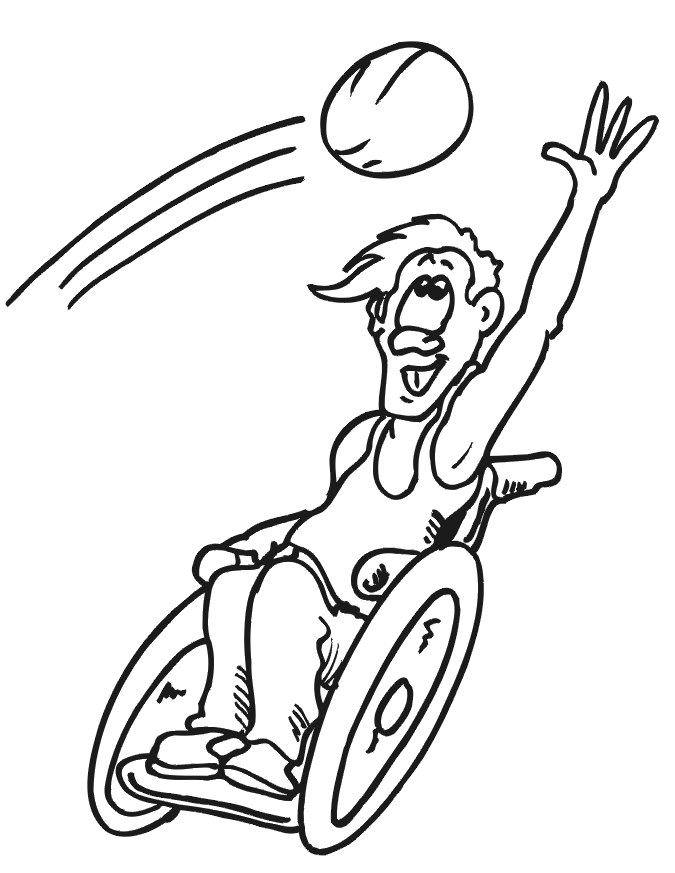
Here is a word search puzzle. Wheelchair basketball is great exercise for the participants and fun to watch, too. Here is a picture to color. Go all-out and throw a BD party for basketball. There are lots of ideas here.
 Happy Birthday, Paul Cezanne day in 1839, this French artist is considered by many, including Matisse and Picasso, to be the father of modern painting.
 Born on this date in 1839, Cezanne came out of Impressionism, in which painters used visible brush strokes to explore ordinary subject matter, with an emphasis on changing light conditions. Cezanne's works are usually classified as Post-Impressionist; they are famous for small, repetitive brush strokes and planes of brilliant color. He focused on the basic forms (such as cones, cylinders, and spheres) found in nature and also on optical effects. Cezanne created hundreds of paintings—landscapes, still life compositions, portraits (including the self-portrait seen here), and other assorted paintings.
 Here is a great website to help you explore Cezanne's life and works. There is an illustrated story, a tutorial about forms, a quiz, a computer art activity, a suggested “on paper” art activity, and much more.
At Olga's Gallery, you can scroll through small images of Cezanne's painting. Click the ones you want to see in a larger format.
Here is a great website to help you explore Cezanne's life and works. There is an illustrated story, a tutorial about forms, a quiz, a computer art activity, a suggested “on paper” art activity, and much more.
At Olga's Gallery, you can scroll through small images of Cezanne's painting. Click the ones you want to see in a larger format. 
 Complete this jigsaw puzzle to see one of Cezanne's still life masterpieces.
At the Garden of Praise, you can read about Cezanne and do a variety of puzzles about him and his works. You can also explore the rest of the Garden of Praise art lessons and puzzles.
For the very young, the Metropolitan Museum of Art (in NYC) has a charming sing-along called “Cezanne's Apples.”
Martin Luther King, Jr., Day – U.S.(King's birthday is actually January 15)
Martin Lut her King, Junior, well known as a champion of human rights, was awarded at least 50 honorary degrees from colleges and universities, was chosen Time Magazine Person of the Year in 1963, and was honored by a variety of other awards—including the Nobel Peace Prize in 1964!
After he was as sassinated in 1968, Dr. King received many posthumous honors, including a Grammy (Best Spoken Word Album), the Presidential Medal of Freedom, and the Congressional Gold Medal. More than 730 cities in the U.S. have streets named after him—not to mention buildings, schools, memorials and other places!
King was asked about how he would want to be remembered, and he said that, if people were around for his funeral, he said they shouldn't talk about his awards, but instead:“I'd like somebody to mention that day that Martin Luther King Jr. tried to give his life serving others. I'd like for somebody to say that day that Martin Luther King Jr. tried to love somebody.
I want you to say that day that I tried to be right on the war question. I want you to be able to say that day that I did try to feed the hungry. I want you to be able to say that day that I did try in my life to clothe those who were naked. I want you to say on that day that I did try in my life to visit those who were in prison. And I want you to say that I tried to love and serve humanity.
Yes, if you want to say that I was a drum major, say that I was a drum major for justice. Say that I was a drum major for peace. I was a drum major for righteousness. And all of the other shallow things will not matter.”
By the way, there were people around for King's funeral. About 100,000 of them.
His Life in Photos
Time magazine has a touching (heartrending, at times) photo essay here.
His Most Iconic Speech
Listen to it here.
His Biographies
There are tons, but here are three that are good for kids:
A Picture Book of Martin Luther King, Jr. by by David A. Adler: King’s life illustrated for kids
My Brother Martin: A Sister Remembers Growing Up With the Rev. Dr. Martin Luther King, Jr. by Christine King Farris: King’s sister offers her perspective on what influenced him
Dear Dr. King: Letters from Today's Children to Dr. Martin Luther King, Jr. edited by Jan Colbert and Ann McMillan Harms: A look a race relations in America today through the eyes of children
His Memorials
There are many memorials dedicated to Dr. King. Take a look at the beautiful Yerba Buena Gardens memorial and Maya Lin's Civil Rights Memorial Fountain.
Serve Others
Some people honor Dr. King by using his day to give service to others. It's easier for kids to volunteer in their own communities, but perhaps this year many families will also think of Haiti and give to the Red Cross or other organizations working at disaster relief. (To donate to the Red Cross, simply text “HAITI” to 90999.)
Here is a website with some great ideas of how kids can get involved with community service.
 Happy Birthday, Ben Franklin!
Born 15th of 17 kids (!!!), Benjamin Franklin was born on this day in 1706. He only had two years of formal schooling but became one of the best-educated people of his time. He was what's known as a polymath (someone who is good at a lot of things): a printer, scientist, inventor, newspaper publisher, writer, statesman, the first US Postmaster General and (at age 70) U.S. Minister to France...and lots more! Some of the things he invented are bifocals, the lightning rod, the Franklin stove, the glass “armonica,” and an odometer.
Wow!Franklin set up the first public library in the Americas and the first fire department in Pennsylvania, too.
There are loads of fun Ben Franklin activities to be found on the internet. Here is one site with interesting stuff to read and do, and links to other sites, including this internet scavenger hunt.
Franklin's Legacy
 Of course, Americans honor Franklin's memory by having his image on the $100 bill and his name on countless cities, streets, and institutions, but did you know this:
Benjamin Franklin got the idea of leaving a small amount of money in a trust fund to gather interest for a long period of time from the French mathematician Charles-Joseph Mathon de la Cour (who used the idea as a plot point in a friendly parody about Franklin). Inspired, Franklin left 1,000 pounds (about $4,400 at the time) each to the cities of Boston (where he was born) and Philadelphia (where he lived most of his life), with the instructions that they gather interest for 200 years before being used to fund public projects of some sort. Franklin's Philadelphia trust had loaned the money to local residents, by and large for mortgage loans, for decades, and when the trust came due, the fund had grown to more than 2 million dollars; city leaders decided to use the money for scholarships for city youth. Boston had used some of the money at the 100-year mark to fund a trade school; later the entire fund, which had grown to almost 5 million dollars, was used to support the institute.
When Ben Franklin died, people in many countries mourned him, and about 20,000 people attended his funeral. According to the website Garden of Praise, people visiting his grave throw pennies on his headstone, and every year $6,000 worth of pennies are collected and given in Franklin's honor to charity.
Science and controversy
 Franklin did a lot of thinking about, and some experimentation with, electricity and lightning. He got the idea of trying to draw the lightning out of the clouds to a sharp-ended metal rod that draws the electrical charge harmlessly down into the ground. He proposed his lightning rod, with sharp ends, in 1749. (Between 1750 and 1754, a Czech man named Prokop Divis made an independent invention of a lightning protection device similar to Franklin's.)Apparently there was a controversy about whether lightning rods should have sharp ends, as suggested by Franklin, or blunt ends. It became a bit of a political issue as King George and other Brits favored blunt-ended lightning rods. Of course, the colonies favored Franklin's design, a move that was reportedly seen by the British as just another way of being disobedient to the crown.
According to Wikipedia, the controversy over sharp or blunt ends is still not completely resolved! Doing controlled experiments with lightning is difficult, but in 2000 Moore, et al, published findings that blunt-tipped lightning rods are marginally better.
Another controversy over the lightning rods was the question of whether or not it was really right to use lightning rods; some people thought that lightning was an instrument of God's judgment. However, since churches tended to be the tallest buildings in any given town, and lightning thus struck churches far more often than, say, saloons, most religious people soon came to favor using the protective device.
It's interesting to note that, although some Christian clergy railed against the new invention, Prokop Divis, European inventor of the lightning rod, was a Catholic priest as well as a scientist.
Create music a la Franklin
Benjamin Franklin invented a musical instrument based on the wet-finger-on-the-drinking-glass. In Franklin's time, musicians sometimes performed on sets of carefully tuned glasses; Franklin created what he called a “more convenient” arrangement. He first called it a glassychord, but then decided on armonica, based on the word harmony.
Mozart, Beethoven, and hundreds of others composed musical pieces for the instrument, but the invention was largely abandoned when music performances moved to larger and larger venues—and music critics of the time bemoaned the fact that there was no way to make the armonica's sound louder.
Now we have microphones, but there are still only a dozen or so armonica players in the world. The 2007 movie Across the Universe featured the song "Girl," written by the Beatles, played on a glass harmonica (yet another name for this instrument!).
Create your own version of this instrument!
More fun
There are more experiments and some word puzzles about Franklin here.
 This statue of Bejamin Franklin, called "Keys to Community" by James Peniston, is largely covered by keys--->

 Coldest temperature record – 1971

 York first in her class, thus becoming the first woman to earn a medical degree in the U.S. It's said that Blackwell was only admitted to the college in the first place because people thought her application was a hoax, and neither professors and students were polite to her.
  is date in 1911, Marie Curie was turned down for France's Academy of Science—even though she was the first woman to win a Nobel prize and the first person to win two Nobel prizes! She remains one of only two people to ever win prizes in two different areas!
 ganic chemist and molecular biologist with a master's degree in chemistry. Elion researched the human immune system and developed medicines that would attack viruses and bacteria; she also created drugs to fight leukemia and to make kidney transplants safer. In 1988 Elion won a Nobel prize.